

On this page
Blow up a balloon as hard as you can. The balloon tells you how much air went into it, not how much is still inside you. A spirometer has the same limit: it measures air that moves through its mouthpiece, so air that never moves cannot show up on the trace. That one idea answers a common type of NEET-UG statement question.
What is residual volume, and why can't you breathe it out?
The OpenStax Anatomy and Physiology textbook defines residual volume as "the air left in the lungs if you exhale as much air as possible." The same chapter says this leftover air keeps the alveoli from collapsing, which makes breathing easier. It lists tidal volume as about 500 mL. It gives total lung capacity as about 6000 mL for males and 4200 mL for females.
Why can't a spirometer measure residual volume?
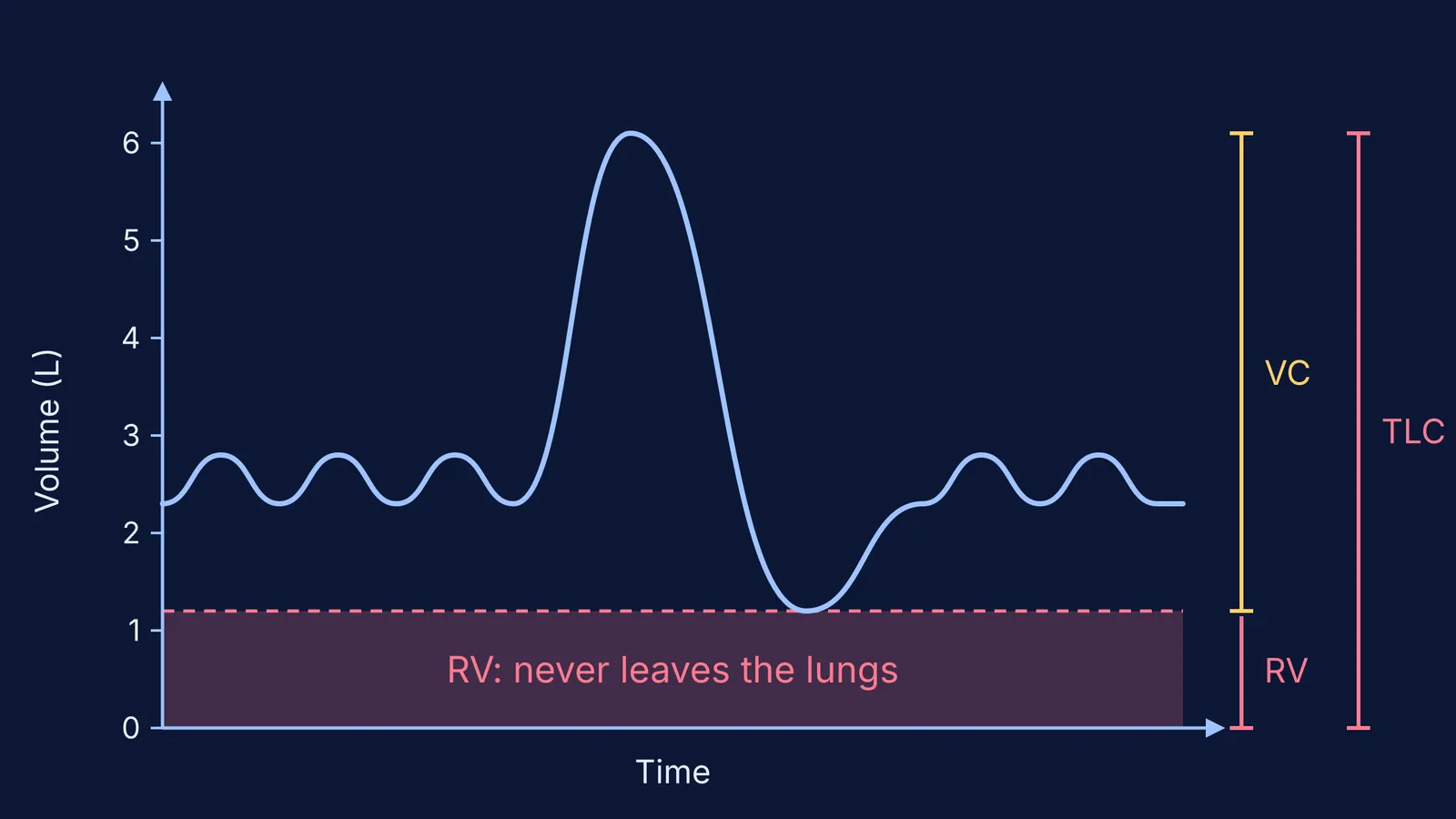
Picture the trace. In quiet breathing the line rises and falls by one tidal volume. A deepest breath in takes it to its highest point; a hardest breath out takes it to its lowest. That lowest point is not zero. It is the top of the residual volume.
The distance between highest and lowest points is the vital capacity. The air below the lowest point never passed through the device, so the trace has no true zero.
The Merck Manual Professional Edition explains how clinics solve this. They first find the functional residual capacity (FRC), which is "the amount of air remaining in the lungs after normal exhalation." They measure FRC by gas dilution or with a plethysmograph. Knowing the FRC then "allows the lungs to be divided into subvolumes that are either measured with spirometry or calculated."
A 2016 study in Scientific Reports by Tang and colleagues compared helium dilution and whole-body plethysmography, two common methods, in 170 patients with COPD. As the paper explains, the plethysmograph works on Boyle's law: at constant temperature, pressure times volume stays constant. Once FRC is known, residual volume is FRC minus expiratory reserve volume, and total lung capacity is residual volume plus vital capacity.
Which lung capacities include residual volume?
Sort every volume into two groups. The Merck Manual gives FRC = RV + ERV, IC = TV + IRV and VC = TV + IRV + ERV, and notes that FRC is normally about 40% of TLC.
A spirometer can show these, because none of them contains RV:
Tidal volume (TV)
Inspiratory reserve volume (IRV)
Expiratory reserve volume (ERV)
Inspiratory capacity (IC = TV + IRV)
Expiratory capacity (EC = TV + ERV)
Vital capacity (VC = IRV + TV + ERV)
A spirometer cannot show these, because each one contains RV:
Residual volume (RV)
Functional residual capacity (FRC = ERV + RV)
Total lung capacity (TLC = IRV + TV + ERV + RV)
A quick way to remember it: if the name has "residual" or "total" in it, the spirometer cannot see it. For the full set of textbook figures, see our guide to lung volumes and capacities with their values.
Worked example
The Wikipedia summary of lung volumes gives these averages for adult men, from Tortora's Principles of Anatomy and Physiology: IRV 3.3 L, TV 0.5 L, ERV 1.1 L and RV 1.2 L.
From the trace alone you can get IC = 0.5 + 3.3 = 3.8 L.
You can also get VC = 3.3 + 0.5 + 1.1 = 4.9 L.
You cannot get FRC = 1.1 + 1.2 = 2.3 L without a separate RV measurement.
You cannot get TLC = 4.9 + 1.2 = 6.1 L either.
Check: 2.3 out of 6.1 is about 38%, close to Merck's figure that FRC is normally about 40% of TLC.
How do NEET-UG statement questions test this?
Statement questions often take a true fact and change one word. Here are five practice statements we wrote in that style:
"Vital capacity includes residual volume." False. VC leaves RV out.
"Functional residual capacity can be measured directly with a spirometer." False. FRC contains RV.
"Total lung capacity equals vital capacity plus residual volume." True.
"Residual volume can be expelled by forceful expiration." False. That is ERV.
"Inspiratory capacity can be read from a spirogram." True. IC is TV + IRV.
Use this three-step check on any statement:
Circle the volume or capacity it names.
Ask whether that volume includes RV.
If it does and the statement says a spirometer measures it, mark it false.
More traps from this chapter are collected in common mistakes in Breathing and Exchange of Gases. For timed practice, try these statement and match-the-list questions on breathing and gases.
If the volumes still blur together, the Fermi Concept Library covers every concept in biology, each with its own lesson and its place in the map. When a numerical goes wrong, the Fermi Problem Library has worked problems with a step-by-step solver that explains the reasoning rather than printing an answer.


