

On this page
A frequent slip on this chapter is a fact stored the wrong way round, not a gap in reading. Each slip below is checked, section by section, against NCERT Class 11 Biology Chapter 14, Reprint 2026-27. The NMC's NEET (UG) 2026 syllabus places this topic, under the name Breathing and Respiration, within Unit 5 (Human Physiology).
This is a study summary, not medical advice.
Where do students put a part in the wrong place?
"Cartilage rings support the airway all the way down to the alveoli."
Why it happens: you picture the whole airway as one ringed tube.
What NCERT says (14.1.1): incomplete cartilaginous rings support the trachea, the primary, secondary and tertiary bronchi, and only the initial bronchioles. The list stops there; the terminal bronchioles are described as very thin, and the alveoli as thin, irregular-walled sacs.
Check: is a terminal bronchiole on NCERT's list of ring-supported tubes? Are the rings complete? (No to both.)
Habit: when an NCERT list stops early, note its last item.
"A pneumotaxic signal stretches each breath in, so breathing slows."
Why it happens: "moderate" gets read as "calm down", and a calmer breath sounds like a longer one.
What NCERT says (14.5): regulation rests mainly with the medulla's rhythm centre. The pons holds the pneumotaxic centre, which adjusts that centre's output; its signal cuts the duration of inspiration, and that is how it alters the respiratory rate.
Check: a question says the pneumotaxic signal has just risen. Does the inspiratory phase grow or shrink? (Shrink.)
Habit: store this centre with a direction verb, "shortens", not only with its location.
Which breathing mechanics get reversed?
"A quiet breath out needs muscles to push the air out."
Why it happens: breathing in is driven by contraction, so breathing out feels as if it must be a contraction too.
What NCERT says (14.2): in normal expiration the diaphragm and intercostals relax, the thorax and lungs shrink back, pressure inside the lungs rises slightly above atmospheric, and air leaves. Extra muscles in the abdomen can add strength to inspiration or expiration when needed.
Check: in a calm breath out, which muscle does NCERT say contracts? (None. The step is relaxation.)
Habit: tag each phase with one verb: inspiration contracts, quiet expiration relaxes.
"The diaphragm enlarges the chest dorso-ventrally; the ribs do the antero-posterior part."
Why it happens: both muscles enlarge the same chamber, so the two axes blur together.
What NCERT says (14.2): contraction of the diaphragm enlarges the thorax along the antero-posterior axis. When the external intercostals contract, ribs and sternum rise, enlarging it along the dorso-ventral axis.
Check: the sternum moves forward and up. Which muscle moved it, and along which axis? (External intercostals; dorso-ventral.)
Habit: tie each axis to a bone that moves: sternum and ribs go with dorso-ventral.
Which respiratory volumes get swapped?
"A healthy man moves 6000 to 8000 mL of air in each breath."
Why it happens: both numbers sit in one NCERT sentence, and the unit gets dropped.
What NCERT says (14.2.1): tidal volume is about 500 mL per normal breath, and 6000 to 8000 mL is the air moved per minute. The per-minute figure is the per-breath one multiplied by NCERT's 12 to 16 breaths a minute.
Check: at 15 breaths a minute with a 500 mL tidal volume, how much air moves in a minute? (500 × 15 = 7500 mL.)
Habit: write the unit with every number: mL per breath or mL per minute.
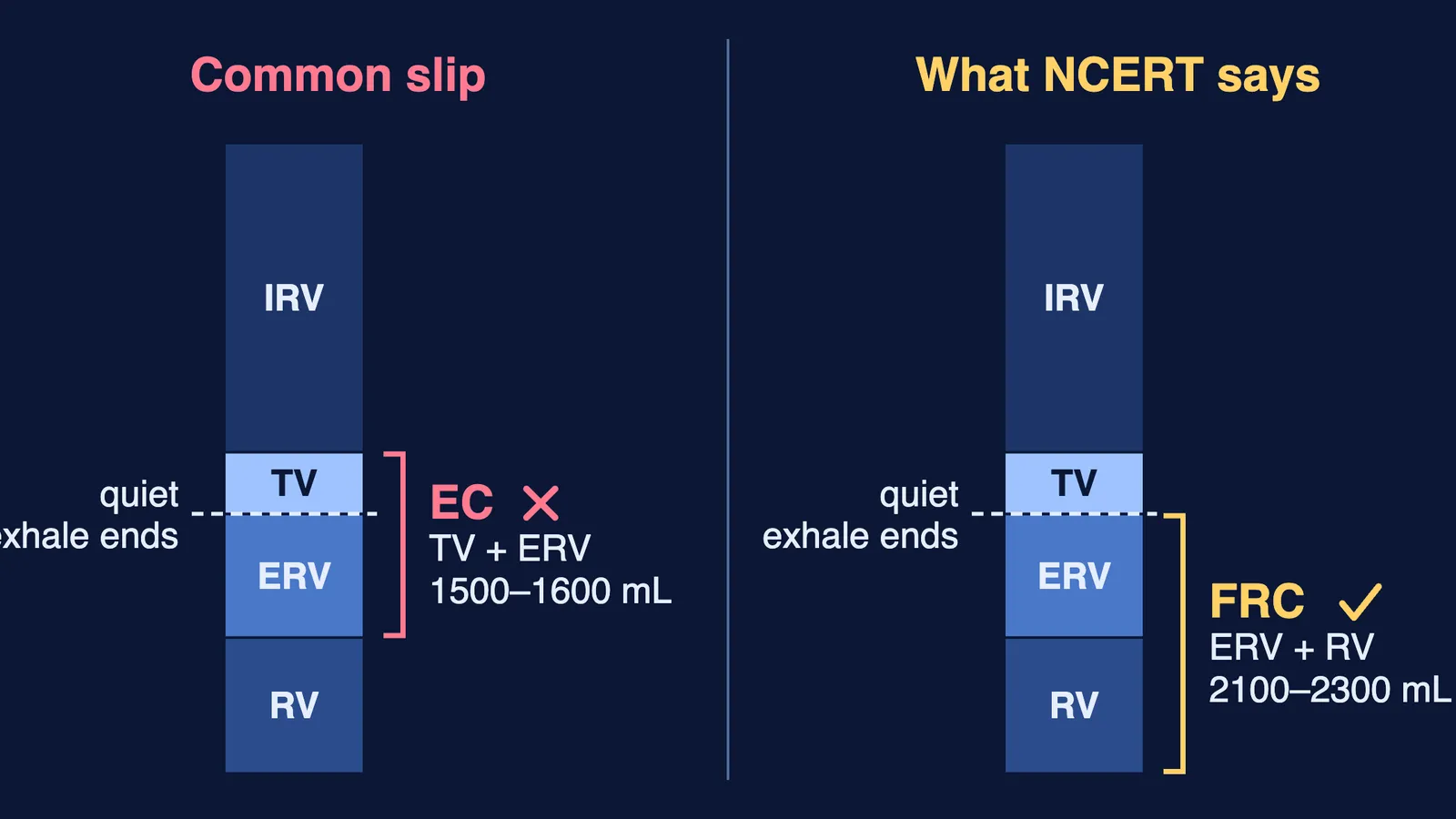
"The air left in the lungs after a normal breath out is the expiratory capacity."
Why it happens: "expiratory" and "after breathing out" sound like a match.
What NCERT says (14.2.1): expiratory capacity, TV + ERV, is the largest volume you can expire once a normal inspiration is complete. What remains inside at the end of a quiet expiration is functional residual capacity, ERV + RV. Adding NCERT's ranges gives 1500 to 1600 mL for EC and 2100 to 2300 mL for FRC, as the diagram above shows.
Check: does the sum include air you have already breathed out? If it contains TV, it cannot be the air left behind.
Habit: before choosing a capacity, ask "breathed out, or still inside?" For every capacity as a sum, see our lung volumes and capacities in NCERT values.
What goes wrong with gas transport?
"Deoxygenated blood has no oxygen left."
Why it happens: the name reads like "oxygen removed".
What NCERT says (Table 14.1, 14.4.1): deoxygenated blood still has a pO₂ of 40 mm Hg, against 95 mm Hg in oxygenated blood. Under normal conditions, every 100 ml of oxygenated blood gives the tissues only about 5 ml of O₂.
Check: if deoxygenated blood were empty, what would its pO₂ be in Table 14.1? Now read the value NCERT prints.
Habit: read "deoxygenated" as "lower in oxygen", never "zero oxygen".
"Most CO₂ rides on haemoglobin, just as oxygen does."
Why it happens: oxygen's pattern, with about 97 per cent carried by RBCs, gets copied onto CO₂.
What NCERT says (14.4, 14.4.2): bicarbonate, made with help from carbonic anhydrase, accounts for nearly 70 per cent of CO₂. Carbamino-haemoglobin carries 20 to 25 per cent, and about 7 per cent is dissolved in plasma.
Check: rank the three forms of CO₂ from the largest share to the smallest. (Bicarbonate, carbamino-haemoglobin, dissolved.)
Habit: keep O₂ and CO₂ carriage as separate lists; never move a percentage across.
"Warmer blood helps haemoglobin hold on to oxygen."
Why it happens: warmth sounds like more activity, so more binding.
What NCERT says (14.4.1): in the alveoli, high pO₂, low pCO₂, fewer H⁺ ions and lower temperature together favour oxyhaemoglobin formation. In the tissues, the higher temperature, with low pO₂ and high pCO₂ and H⁺, favours oxygen coming off.
Check: two blood samples share the same pO₂, but one is warmer. In which does oxygen come off haemoglobin more readily? (The warmer one.)
Habit: sort every factor into "lungs: load" or "tissues: unload" before you answer.
A 60-second self-check before you mark
To plan the rest of the unit, use our Human Physiology for NEET chapters, traps and study plan.
Not sure which of these slips is yours? Fermi's AI tutor works out what you already know and builds a plan for the session.


