On this page
Short-circuit the output of a small gadget and it may go dead, then work again once you unplug the faulty cable. No fuse was replaced. In many such circuits a small part called a resettable fuse, or polymer PTC, heated itself up, cut the current to a trickle and waited. This post works out, using I²R heating and a heat balance from Class 12, why such a part ignores 0.5 A, trips at 1 A, and then holds a short circuit to a few tens of milliamps for as long as the power stays on.
What is a resettable fuse made of?
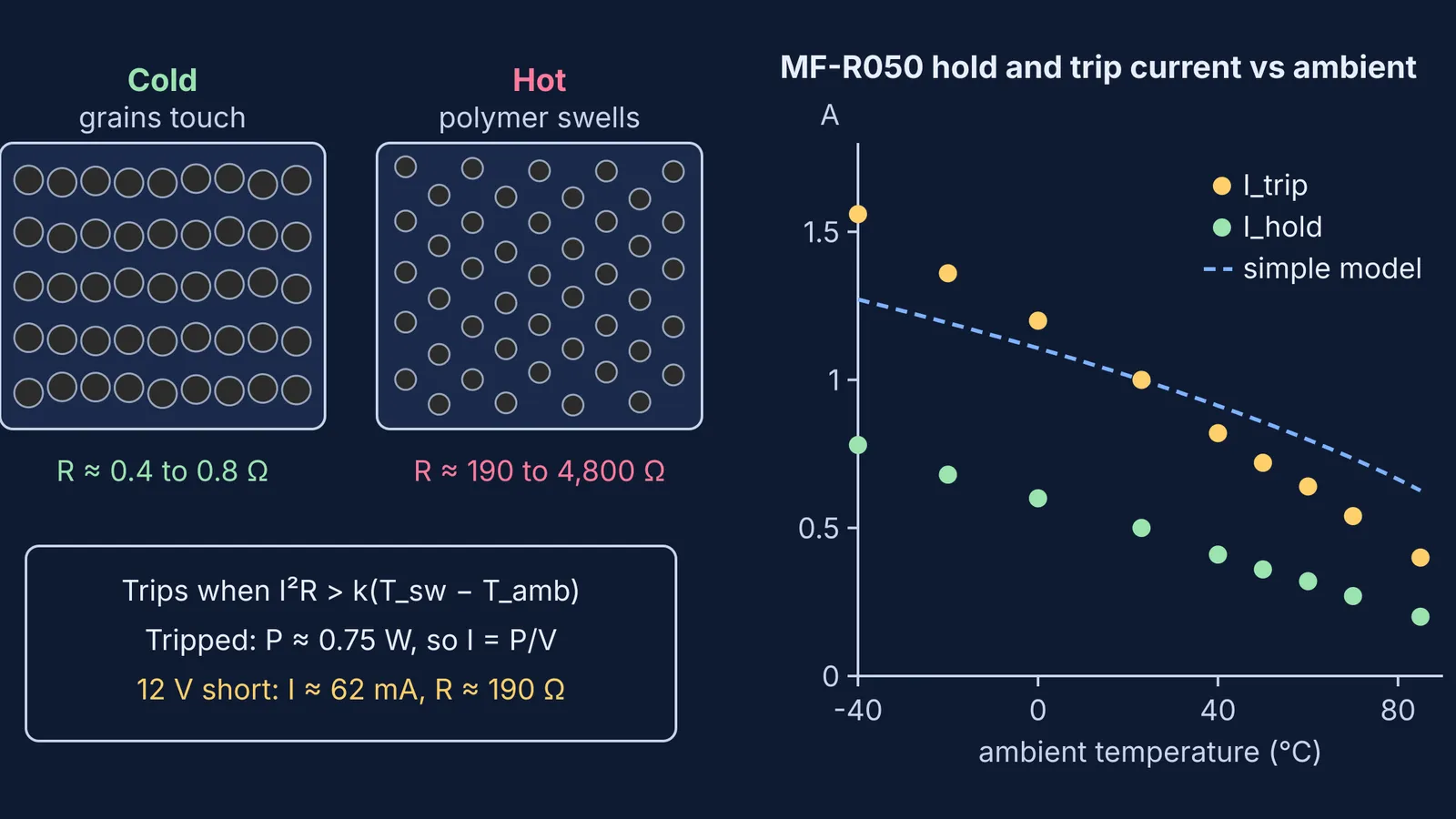
A polymer PTC (positive temperature coefficient) device is a plastic, typically a semi-crystalline polymer, filled with fine conducting particles such as carbon black. When it is cool the polymer is mostly crystalline and the particles are squeezed into chains that touch, so current flows easily. When it gets hot enough the crystals melt, the plastic swells, the chains are pulled apart and the resistance jumps by several orders of magnitude over a few degrees. The temperature where this happens is called the switching temperature.
This is very different from the gentle rise you see in metals, where R = R₀(1 + αΔT) and α is about 0.004 per K for copper. That linear law is covered in the temperature coefficient of resistance. A polymer PTC is nearly flat, then almost a cliff.
What do the numbers on a resettable fuse datasheet mean?
We will use a real part, the Bourns MF-R050, from the Bourns MF-R series datasheet. At 23 °C it lists:
Hold current, I_hold = 0.50 A. The largest current it carries without tripping.
Trip current, I_trip = 1.00 A. The smallest current that is certain to trip it.
Resistance before use: 0.41 to 0.77 Ω. Different parts from the same batch vary.
Resistance one hour after a trip: up to 1.17 Ω. It does not fully recover at once.
Tripped power dissipation: 0.75 W typical. The heat it makes while holding a fault.
Maximum time to trip: 4.0 s at 2.5 A.
Ratings: 60 V and 40 A maximum. Beyond these it may be damaged.
Between 0.50 A and 1.00 A the datasheet makes no promise. A given part may or may not trip there.
Why does a polymer PTC trip at 1 A but not at 0.5 A?
The device makes heat at a rate I²R and loses heat to its surroundings at a rate roughly proportional to how much hotter it is than the air, k(T − T_amb). It settles where the two match. It trips when even at the switching temperature it is still making more heat than it can lose.
The values of k and the switching temperature below are illustrative round numbers, not datasheet values. Real switching temperatures depend on the polymer; 125 °C is a typical round figure.
Find k. In the tripped state the device sits just above its switching temperature and sheds the datasheet's 0.75 W. Take T_sw = 125 °C and T_amb = 23 °C: k = 0.75/(125 − 23) = 7.4 × 10⁻³ W/K.
At 0.5 A. Use R = 0.77 Ω, the top of the range, since a warm part has a higher resistance. Heating = 0.5² × 0.77 = 0.19 W. Temperature rise = 0.19/0.0074 = 26 K, so it settles near 49 °C, far below 125 °C. No trip.
At 1.0 A. Heating = 1.0² × 0.77 = 0.77 W. To lose that the device would have to be 105 K above ambient, at 128 °C, past its switching temperature. It trips.
The model's trip current. Set I²R = k(T_sw − T_amb) = 0.75 W: I = √(0.75/0.77) = 0.99 A, close to the datasheet's 1.00 A.
Doubling the current quadruples the heating. That is why the gap between hold and trip is a factor of 2 in current: the heating differs by a factor of 4.
Why does it hold a short circuit at a few milliamps instead of opening?
A wire fuse melts and leaves a gap, as worked in why fuse rating depends on wire radius. A breaker opens a mechanical contact, as in why an MCB trips. A polymer PTC never opens. It stays in the circuit and stays hot by its own heating.
Suppose a 12 V supply is shorted, so the whole 12 V is across the tripped device.
Power to stay hot. About 0.75 W, the datasheet's typical tripped dissipation.
Current. I = P/V = 0.75/12 = 0.0625 A, about 62 mA.
Resistance. R = V²/P = 144/0.75 = 192 Ω, about 250 to 470 times its cold value.
At 60 V, the part's limit: I = 12.5 mA and R = 4,800 Ω.
This is a stable latch. If the current fell, the device would cool slightly, its resistance would drop sharply, and the current would rise again. If the current rose, it would heat, its resistance would shoot up, and the current would fall. It stays on the steep part of its curve until you remove the voltage. Only then does it cool and reset.
Why does a resettable fuse trip sooner in a hot room?
In a hot box the device has less room to warm before reaching its switching temperature, so less current is needed. The simple model gives I_trip ∝ √(T_sw − T_amb). At 60 °C it predicts 1.00 × √(65/102) = 0.80 A.
The datasheet's derating table says 0.64 A at 60 °C and only 0.40 A at 85 °C, where the model predicts 0.63 A. Real parts derate faster than the simple model because the resistance creeps up well before the switching temperature and the loss coefficient is not constant. The lesson is practical: pick a resettable fuse from the derating table at the hottest temperature inside your enclosure, not from the 23 °C rating.
How long does it take to trip?
At 2.5 A with R = 0.5 Ω the heating is 2.5² × 0.5 = 3.1 W. If the small device has a heat capacity of about 0.1 J/K (an illustrative round value), it needs about 0.1 × 102 = 10 J to warm by 102 K, which takes about 10/3.1 = 3.3 s if you ignore the heat it loses. That sits within the datasheet's 4.0 s maximum. Larger currents trip much faster, because heating grows as I².
After the fault, the resistance one hour later can be up to 1.17 Ω instead of 0.77 Ω, about 1.5 times higher, and it recovers slowly over a long time. A higher resistance means more heating at the same current, so a recently tripped part trips a little sooner.
If you want more heating and power problems like these, the Fermi Problem Library has a step-by-step solver that explains the reasoning.
Quick checklist
A polymer PTC is a plastic full of carbon; heat swells the plastic and breaks the conducting chains.
It trips when I²R exceeds the heat it can lose at its switching temperature.
MF-R050: holds 0.50 A, certain to trip at 1.00 A at 23 °C.
Tripped, it dissipates about 0.75 W, so on a 12 V short it passes about 62 mA.
It resets only when the power is removed and it cools.
Use the derating table: 0.64 A trip at 60 °C, not 1.00 A.