

On this page
Ask a classmate to match *Calotes*, *Hemidactylus* and *Chameleon* to their common names and you may get a shrug, because all three answers are "some kind of lizard". That is exactly why this line of NCERT makes good MCQ material. The risk is mixing up common names and spellings, not forgetting that reptiles exist.
What are the reptile examples in NCERT?
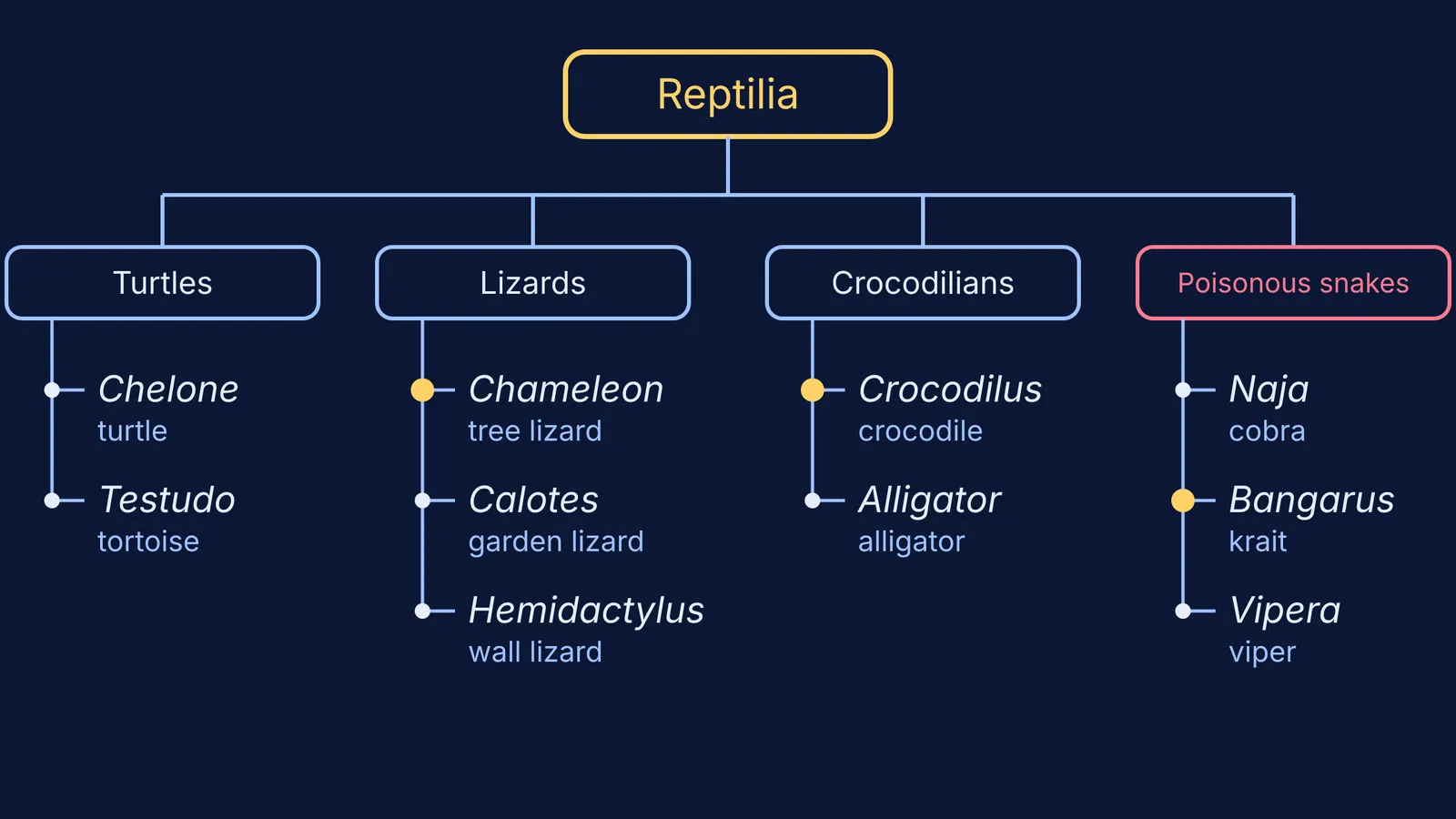
The examples sentence in section 4.2.11.5, Class Reptilia, of NCERT's Class 11 chapter Animal Kingdom names 10 genera. Sorted into the four groups you already recognise by sight, they become a memory table:
Turtles and tortoises (2): *Chelone* (turtle), *Testudo* (tortoise)
Lizards (3): *Chameleon* (tree lizard), *Calotes* (garden lizard), *Hemidactylus* (wall lizard)
Crocodilians (2): *Crocodilus* (crocodile), *Alligator* (alligator)
Poisonous snakes (3): *Naja* (cobra), *Bangarus* (krait), *Vipera* (viper)
The same page's Figure 4.22 draws four of them: *Chameleon*, *Crocodilus*, *Chelone* and *Naja*, so make sure you can name those from a picture.
NCERT pairs these names with the class features that options like to mix in. Reptiles have dry, cornified skin with epidermal scales or scutes. They have no external ear opening; a tympanum represents the ear. The heart is usually three-chambered but four-chambered in crocodiles. Fertilisation is internal, and they are oviparous with direct development.
Why does NCERT write Chelone, Testudo and Vipera?
Several of NCERT's names are older genus names that zoologists have since changed. They are not wrong for a textbook exam, but they explain why a zoo label or a search result can disagree with your book.
The green turtle is now *Chelonia mydas*; the Reptile Database entry for the green turtle lists *Chelone mydas* (Boulenger, 1889) among its older names.
The Indian star tortoise was described as *Testudo elegans* in 1795 and is now *Geochelone elegans*, according to the Reptile Database entry for the star tortoise. Living *Testudo* tortoises) are found in North Africa, Western Asia and Europe.
Russell's viper appears in older papers as *Vipera russelii* and is now *Daboia russelii*, as the Reptile Database entry for Russell's viper shows.
The standard spellings are *Crocodylus*, with *Crocodilus* listed as an old variant, and *Bungarus* for kraits. NCERT prints *Crocodilus* and *Bangarus*.
"Chameleon" is a common name; the genus is *Chamaeleo*, and the Indian chameleon is *Chamaeleo zeylanicus*.
The practical rule: recognise NCERT's spelling first, because exams that follow NCERT build their options from it, and know the modern spelling so it does not throw you if it appears.
Which naming traps should you watch for in MCQ options?
The lizard swap. *Calotes* is the garden lizard, *Chameleon* the tree lizard and *Hemidactylus* the wall lizard. *Calotes* changes colour (the Reptile Database lists "changeable lizard" among its names), which tempts students to call it a chameleon. *Hemidactylus* is a gecko, family Gekkonidae, per its Reptile Database entry. Hook: H for the house wall.
The alligator is not Indian. Alligators are native only to the United States and China. India's mugger and saltwater crocodiles are *Crocodylus*; the gharial is *Gavialis*, a different genus.
**The king cobra is not *Naja*.** It belongs to *Ophiophagus* and is not a true cobra. The spectacled cobra is *Naja naja*. We cover the king cobra's odd habits in why the king cobra is the only snake that builds a nest.
The krait is poisonous. NCERT lists *Bangarus* with the cobra and viper; the common krait, *Bungarus caeruleus*, is an elapid with neurotoxic venom.
Limbless does not mean reptile. NCERT's limbless *Ichthyophis* sits in Amphibia; here is why Ichthyophis is a limbless amphibian, not a snake.
The heart exception. A "four-chambered heart" option points to crocodiles, not to reptiles in general.
How can you memorise all ten in one sitting?
Use the count as a hook: two shells, three lizards, two crocs, three fangs. Then run three short rounds on a blank sheet:
Sort. Write the four group headings and fill in the genera from memory. Check against the list above.
Pair. Cover the common names and say each one aloud for every genus. The lizard row and the snake row are where errors hide.
Reverse. Go from common name to genus, then write *Bangarus* and *Crocodilus* the NCERT way.
Repeat the reverse round the next day and again a week later, mixing these ten with other classes so you cannot lean on the order of the list.
If the class features blur together, the Fermi Concept Library covers every concept in biology, each with its own lesson and its place in the map. For worked problems with a step-by-step solver that explains the reasoning rather than printing an answer, try the Fermi Problem Library.
Once the reptiles stick, do the same with the next class: Pteropus, Macropus, Balaenoptera and the other NCERT mammal names.


