

On this page
If you are revising digestion for NEET-UG or Class 11, rennin looks like a one-line fact. It is also a favourite trap: swap "infants" for "adults" and the statement still sounds right. Here is what rennin does, why the textbook ties it to babies, and a check that catches the trap.
What is the role of rennin in infants?
The NCERT line you are tested on is reproduced word for word in CBSE's Class XI Biology reading material on digestion and absorption (2025-26): "Rennin is a proteolytic enzyme found in gastric juice of infants which helps in the digestion of milk proteins." The same page says peptic or chief cells secrete pepsinogen, HCl provides the pH of 1.8 at which pepsins work best, and the stomach stores food for 4-5 hours. For which cell makes what, see our guide to gastric gland cells and what they secrete.
Rennin's other name is chymosin. The UniProt entry for calf chymosin lists "preprorennin" as an alternative name and says the enzyme is made in the fourth stomach of young, unweaned ruminants.
How does rennin curdle milk?
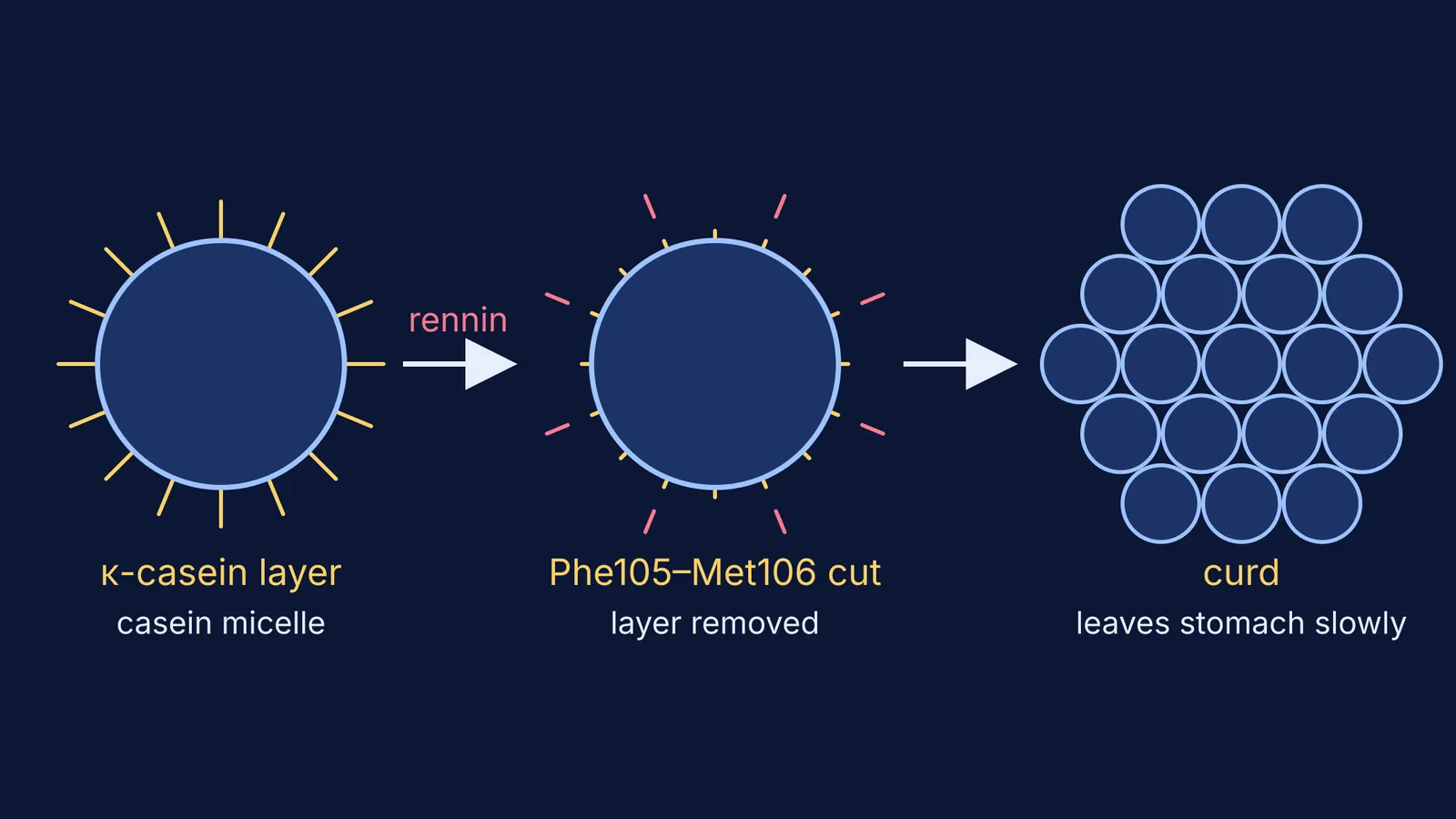
Milk protein comes in two main kinds: caseins, packed into tiny particles called micelles, and whey proteins, which stay dissolved. A surface layer of κ-casein keeps the micelles apart, so milk stays liquid.
Chymosin "clots milk by cleavage of a single 104-Ser-Phe-|-Met-Ala-107 bond in kappa-chain of casein", according to UniProt. That one cut, between phenylalanine 105 and methionine 106, removes the protective layer. Without it, the micelles clump together into a soft solid: the curd.
Why does curdled milk stay longer in the stomach?
A review by Thom Huppertz and Loo Wee Chia in the International Dairy Journal (2021) explains the timing. In the stomach, caseins coagulate into a curd while whey proteins stay dissolved, so whey empties into the intestine faster. In the authors' words, "The gastric coagulation leads to delayed gastric emptying of casein and fat."
The slower exit is useful. The same review says a gastric curd gives a controlled transit of protein through the stomach and a more sustained release of amino acids into the blood, and keeps the intestine from being overloaded, which matters for groups such as infants. The review, which focuses on cow's milk, credits this stomach curdling to pepsin breaking the proteins that keep micelles apart, so rennin is not the only enzyme that curdles milk. For how long different meals stay put, read how long food stays in the stomach.
Do human babies really make rennin?
The HUGO Gene Nomenclature Committee lists the human chymosin gene as CYMP, "chymosin, pseudogene", with the alias "rennin pseudogene". A pseudogene is a gene copy that is not expected to make a working protein.
Yet a 1987 study by Henschel, Newport and Parmar found something chymosin-like in newborns. In gastric juice taken within 10 hours of birth from 5 premature babies, 2 had mostly a chymosin-like enzyme, 1 had almost only pepsins and 2 had a mix; 5 samples from a further 17 infants reacted with calf anti-chymosin serum, though that test pointed to much lower enzyme activity. A 2012 review of protein digestion in premature and term infants says this protease disappears from gastric fluid at 10 days after birth and is not found in adult gastric fluid, while pepsin is present in the fetal stomach as early as 16 weeks of gestation.
For your exam, the answer is NCERT's: rennin, infants, gastric juice, milk proteins. If the stomach enzymes still blur together, the Fermi Concept Library gives each biology concept its own lesson and its place in the map, so you can see how related ideas connect.
How do you answer the rennin MCQ trap about adults?
Try this worked example. Which statement about rennin is correct?
(a) It is found in the gastric juice of adults and digests milk fat.
(b) It is secreted by the pancreas to digest casein.
(c) It is found in the gastric juice of infants and helps digest milk proteins.
(d) It converts pepsinogen into pepsin.
The answer is (c), the NCERT sentence almost word for word. Each wrong option breaks at least one rule:
(a) fails twice: NCERT says infants, and rennin is proteolytic, so it acts on protein, not fat.
(b) names the wrong gland: rennin is in gastric juice, while the pancreas sends trypsinogen and other enzymes to the intestine.
(d) swaps roles: NCERT says pepsinogen becomes pepsin on exposure to hydrochloric acid. Activation like this is covered in why digestive enzymes are made in inactive form.
Use the same four questions on any enzyme statement:
Who: infant or adult?
Where: which gland or juice?
What: which substrate, protein, fat or starch?
Does what: digests food, or activates another enzyme?
If any one part does not match NCERT, the statement is false.
To practise this kind of elimination on more questions, the Fermi Problem Library has worked problems with a step-by-step solver that explains the reasoning rather than printing an answer.


