

On this page
You scrape your knee on the school ground. Within minutes the edge of the cut goes pink, and by evening it is puffy, warm and sore. Nothing has gone wrong: this is the inflammatory response, and every sign has a cause you can trace to a molecule or a cell. Learn the chain once and you can explain it in a board answer, or to a worried younger sibling.
Why does a wound become red and swollen?
Any tissue damage sets off inflammation, with or without germs. OpenStax's *Anatomy and Physiology* puts it simply: stub a toe or cut a finger and inflammation follows, with “its four characteristics: heat, redness, pain, and swelling” (OpenStax Anatomy and Physiology 2e, section 21.2).
The Latin names, rubor, calor, tumor and dolor, go back to the Roman writer Aulus Cornelius Celsus, around AD 25 (Tracy, 2006). Many textbooks add a fifth sign, loss of function or altered function, which is why a swollen finger is hard to bend (OpenStax Microbiology, section 17.5).
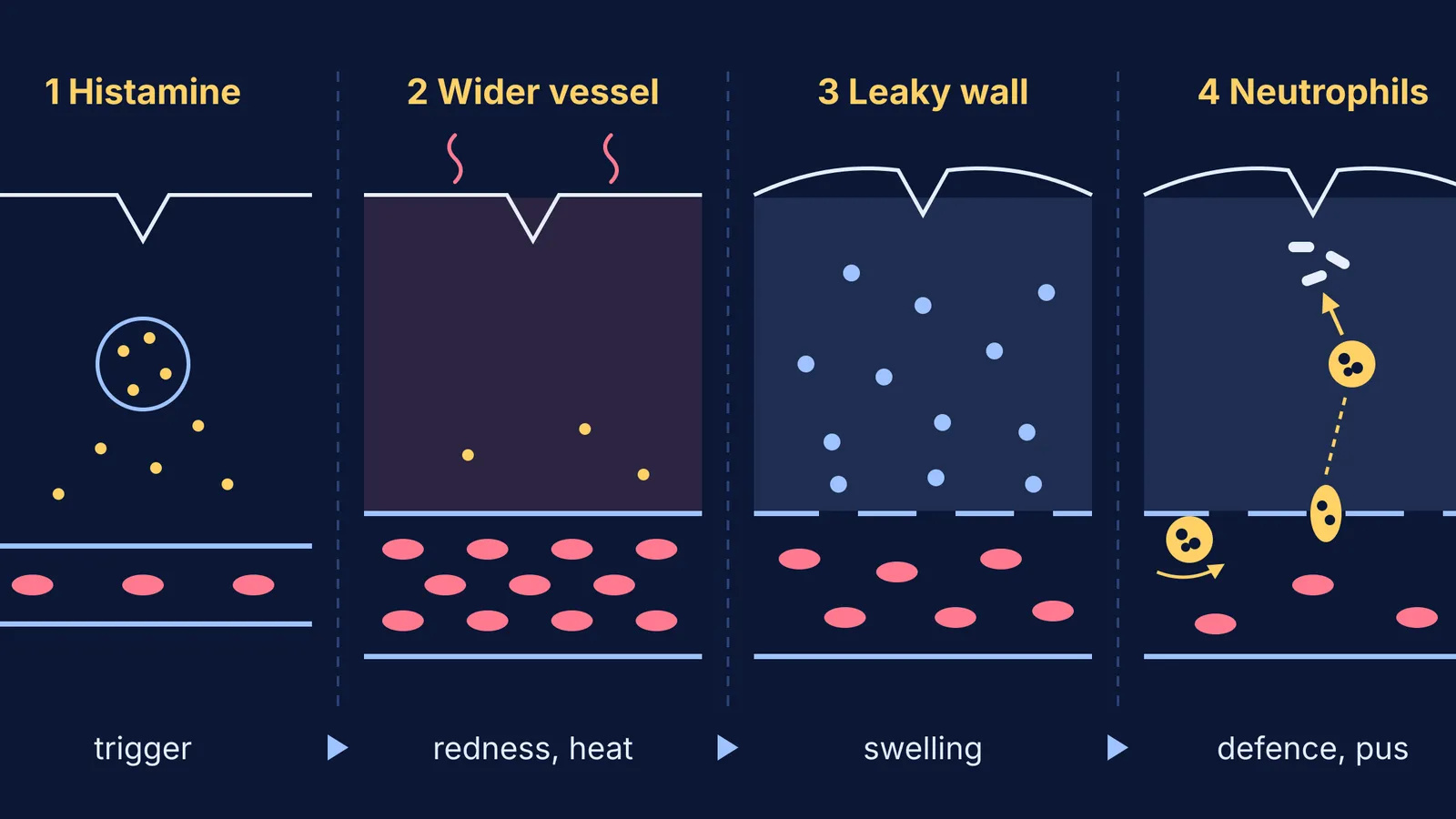
The whole response is a chain of four links, shown in the diagram above:
Damaged cells trigger mast cells to release histamine.
Histamine widens local blood vessels, which gives redness and heat.
Histamine makes capillary walls leaky, which gives swelling.
Chemical signals pull neutrophils out of the blood to fight microbes, which can leave pus.
What does histamine do after a cut?
Mast cells sit in connective tissue, packed with granules. When injured cells spill their contents, mast cells release “potent inflammatory mediators such as histamine, leukotrienes, and prostaglandins” (OpenStax Anatomy and Physiology 2e).
Histamine has two separate jobs, and the same textbook describes both. First, it “increases the diameter of local blood vessels (vasodilation), causing an increase in blood flow.” Second, it “increases the permeability of local capillaries, causing plasma to leak out and form interstitial fluid.”
Keep these two jobs apart in your head. One explains the colour and warmth; the other explains the puffiness.
Why does an inflamed area feel hot and painful?
Redness and heat both come from vasodilation: the extra blood flowing through the injured patch shows through the skin as pink and is felt as warmth (OpenStax Microbiology). This is local heat. It is not fever, which is a whole-body change in temperature; for a fever that keeps its own schedule, see why malaria fever comes every alternate day.
Swelling is the leaked plasma sitting in the spaces between cells, called oedema. Another messenger, bradykinin, keeps capillaries dilated, “flooding tissues with fluids and leading to edema” (OpenStax Microbiology).
Pain has chemical causes too. Prostaglandins relax the smooth muscle of vessel walls and are “a major cause of the pain associated with inflammation” (OpenStax Anatomy and Physiology 2e), and the inflammatory events stimulate pain receptors in the tissue (OpenStax Microbiology).
Why do neutrophils arrive, and what is pus?
Neutrophils are white blood cells of the innate immune system and “major effectors of acute inflammation” (Kolaczkowska and Kubes, 2013). In skin wounds they are the first immune cells recruited, and about 50% of all cell types in a wound one day after injury are neutrophils (Su and Richmond, 2015).
Leukotrienes are “particularly good at attracting neutrophils from the blood” by chemotaxis, movement towards a rising concentration of a chemical (OpenStax Anatomy and Physiology 2e). To leave a vessel, a neutrophil follows the leukocyte adhesion cascade: it rolls along the wall, is activated, sticks firmly, then crawls and squeezes through (Ley and colleagues, 2007). Textbooks call this squeezing out diapedesis.
When microbes get in, the fight leaves debris. Pus forms “from the accumulation of neutrophils, dead cells, tissue fluids, and lymph” (OpenStax Microbiology). For another innate defender that works without antibodies, read what natural killer cells do.
Some redness around a fresh cut is normal. The NHS page on cuts and grazes lists when to get urgent help, including a cut that is swollen, red and getting more painful, pus coming out of it, or feeling generally unwell or having a high temperature after a cut.
How do you write this as a board or NEET answer?
Here is a worked example. Question: a student's cut finger is red, warm, swollen and painful. Explain each sign (4 marks).
Redness and heat: mast cells release histamine, which causes vasodilation and increases blood flow to the site.
Swelling: histamine increases capillary permeability, so plasma leaks into tissue spaces (oedema); bradykinin keeps capillaries dilated and adds to it.
Pain: prostaglandins and other mediators stimulate pain receptors.
Then neutrophils, attracted by chemotaxis, leave the blood by diapedesis and engulf microbes.
Common mistakes to avoid:
Saying histamine kills germs. It acts on blood vessels, not microbes.
Mixing up the cause of redness (more blood flowing in) with the cause of swelling (fluid leaking out).
Calling neutrophils lymphocytes or antibodies.
Our post on human health and disease mistakes in NEET covers more traps from the same chapter.
If vasodilation and permeability still blur together, the Fermi Concept Library gives every concept in biology its own lesson and its place in the map, so you can see where inflammation sits within innate immunity.


