

On this page
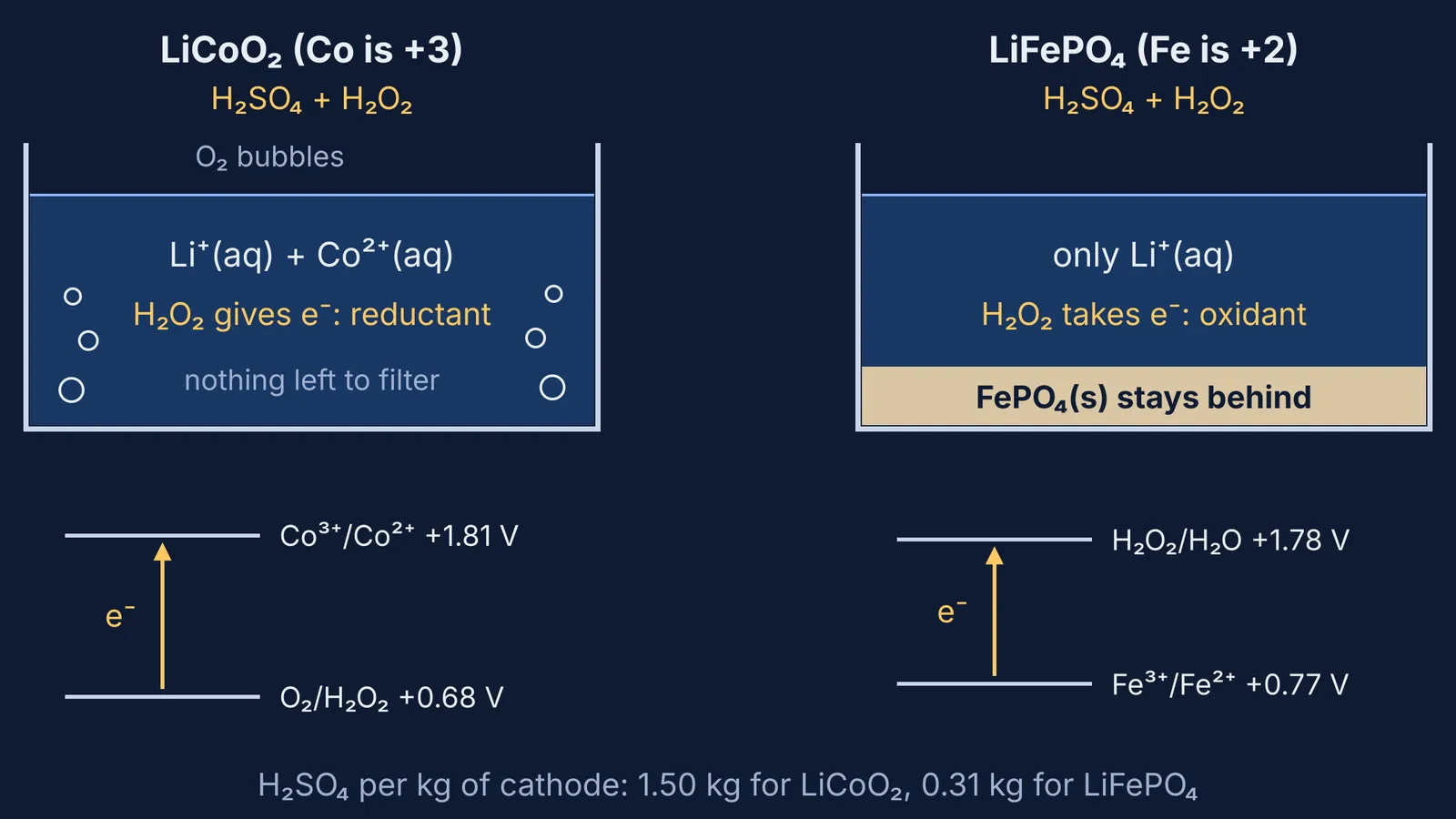
Lithium iron phosphate (LiFePO₄, usually called LFP) cells are now common in electric buses, many electric two-wheelers and cars, and grid storage. Our post on recycling phone batteries with acid and H₂O₂ followed the cobalt route and said in one line that LFP is "recycled differently". This post is that difference. Recyclers use the same two reagents, sulphuric acid and hydrogen peroxide, but H₂O₂ does the opposite job, and the result is a leach that dissolves lithium and leaves almost everything else behind.
This is industrial chemistry. Never open, cut, crush or puncture a lithium cell at home, whatever its chemistry. A damaged cell can short-circuit, overheat and catch fire. Hand used batteries to an authorised collection point, as our guide to why old phones and batteries don't belong in the dustbin explains.
Why does India need LFP batteries recycled?
India's Battery Waste Management Rules, 2022 (PIB release) make producers responsible for collecting the batteries they sell, including electric-vehicle batteries, and set minimum targets for the share of material that recyclers must recover, counted on the battery's dry weight. The rules have been amended several times since 2022, so check the current text before quoting a target.
For LFP, those rules matter more than metal prices. Lithium is only 6.94 / 157.76 = 4.4% of LiFePO₄ by mass, against 7.1% in LiCoO₂, and there is no cobalt or nickel to pay for the process. A good LFP process therefore has to recover lithium cleanly and use as little reagent as possible.
What are the oxidation states in LiFePO₄?
Assign them the usual way. Li is +1. Phosphate, PO₄³⁻, carries −3 (P is +5 and each O is −2). The compound is neutral, so iron is +2: 1 + x − 3 = 0 gives x = +2.
In LiCoO₂, cobalt is +3 and the recycler must bring it down to Co²⁺. In LiFePO₄, iron is already at the low state, so the useful move is the other way: take an electron away and make Fe(III).
Here is the neat part. When an LFP cell is charged, the cathode does exactly this reaction: LiFePO₄ → FePO₄ + Li⁺ + e⁻. Lithium leaves, iron goes from +2 to +3, and the crystal framework stays almost the same. The recycler does with a chemical oxidant what the charger does with electricity.
Why is H₂O₂ an oxidising agent in LFP recycling?
Oxygen in H₂O₂ is −1, halfway between −2 (water) and 0 (O₂), so it can act either way, as our post on how H₂O₂ acts as both an oxidising and a reducing agent explains. Which job it does depends on its partner. Compare NCERT's standard reduction potentials:
H₂O₂ + 2H⁺ + 2e⁻ → 2H₂O, E° = +1.78 V
Fe³⁺ + e⁻ → Fe²⁺, E° = +0.77 V
The couple with the higher E° is reduced; the lower one runs in reverse and is oxidised. So H₂O₂ takes electrons (O: −1 → −2) and Fe(II) gives them up (Fe: +2 → +3). In the cobalt case the order flips: Co³⁺/Co²⁺ is +1.81 V and O₂/H₂O₂ is only +0.68 V, so H₂O₂ is oxidised to O₂ instead.
The two half-equations for LFP are:
2LiFePO₄ → 2FePO₄ + 2Li⁺ + 2e⁻
H₂O₂ + 2H⁺ + 2e⁻ → 2H₂O
Add them: 2LiFePO₄ + 2H⁺ + H₂O₂ → 2Li⁺ + 2FePO₄ + 2H₂O. Charge is +2 on both sides. With sulphuric acid as the proton source:
2LiFePO₄ + H₂SO₄ + H₂O₂ → Li₂SO₄ + 2FePO₄ + 2H₂O
Check it. Li: 2 = 2. Fe: 2 = 2. P: 2 = 2. S: 1 = 1. H: 2 + 2 = 4 on the left; 4 in 2H₂O on the right. O: 8 + 4 + 2 = 14 on the left; 4 + 8 + 2 = 14 on the right.
Why does iron stay behind as FePO₄?
Iron(III) phosphate stays insoluble in dilute acid, while iron(II) phosphate dissolves in it. Once iron is oxidised, it stays in the solid together with the phosphate, while Li⁺ goes into solution as Li₂SO₄. That is called a selective leach.
Without the oxidant, acid has to dissolve the whole cathode, roughly LiFePO₄ + 3H⁺ → Li⁺ + Fe²⁺ + H₃PO₄. That uses three times as much acid and puts iron into the lithium solution, which then has to be removed.
Too much acid causes the same problem. A 2025 study of this leach in Molecules found that raising the acid above a near-stoichiometric dose did not improve lithium recovery but began to dissolve FePO₄, so iron leaching rose from well under 1% to about 3%. Its chosen conditions were an H₂SO₄ : Li mole ratio of 0.57 (the equation needs 0.50), 45 °C and 10 minutes, giving about 98% of the lithium in solution and under 0.5% of the iron. It used about four times the stoichiometric H₂O₂, because some H₂O₂ decomposes before it reacts. An earlier paper by Li and co-workers (2017) used the same idea with a stoichiometric amount of sulphuric acid. Conditions differ between studies, and this is one common hydrometallurgical route; some plants instead dissolve everything, and others regenerate LiFePO₄ directly without leaching.
Worked example: how much acid and H₂O₂ for 1 kg of LiFePO₄?
Take 1.00 kg of pure LiFePO₄ and assume the equation above runs completely.
Molar mass. LiFePO₄ = 6.94 + 55.85 + 30.97 + 4 × 16.00 = 157.76 g/mol. Moles = 1000 ÷ 157.76 = 6.34 mol.
Acid. H₂SO₄ needed = 6.34 ÷ 2 = 3.17 mol. At 98.08 g/mol, that is 311 g, about 0.31 kg. For 1 kg of LiCoO₂ the cobalt route needs 1.50 kg, nearly five times more, because there the acid has to carry cobalt into solution as well as lithium.
H₂O₂. Also 3.17 mol, or 3.17 × 34.02 = 108 g. As 30% (w/w) solution, 108 ÷ 0.30 = 0.36 kg.
n-factor check. Each Fe loses 1 electron (+2 → +3), so the n-factor of LiFePO₄ is 1. Each H₂O₂ gains 2 electrons (two O atoms, −1 → −2), so its n-factor is 2. Equal equivalents: 6.34 equivalents of H₂O₂ = 6.34 ÷ 2 = 3.17 mol, matching the equation. If you had written H₂O₂ as a reductant, as in the cobalt case, iron would have to accept electrons and drop to +1, which is not a real outcome here.
Solid left behind. FePO₄ = 55.85 + 30.97 + 64.00 = 150.82 g/mol, so 6.34 × 150.82 = 956 g of solid.
Lithium product. 6.34 mol Li gives at most 3.17 mol Li₂CO₃. At 73.89 g/mol, that is 234 g. Lithium carbonate is precipitated from the hot Li₂SO₄ solution with Na₂CO₃, exactly as in the LiCoO₂ route. If you want more practice with redox stoichiometry and n-factors like this, the Fermi Problem Library has a step-by-step solver that explains the reasoning.
Quick checklist
Iron in LiFePO₄ is +2; cobalt in LiCoO₂ is +3. Assign oxidation states first.
E°(H₂O₂/H₂O) = +1.78 V is above E°(Fe³⁺/Fe²⁺) = +0.77 V, so H₂O₂ oxidises Fe(II).
2LiFePO₄ + H₂SO₄ + H₂O₂ → Li₂SO₄ + 2FePO₄ + 2H₂O: half a mole of acid per mole of cathode.
FePO₄ stays solid, so only lithium dissolves; excess acid spoils this by dissolving iron.
Never open a lithium cell at home.


