On this page
An old phone sitting in a drawer looks harmless. Inside it, though, is a small chemistry set: metals worth recovering, metals that can be toxic, and a battery that still stores energy. That mix is why phones, chargers and batteries belong at an e-waste collection point, not in the kitchen dustbin.
The UN's Global E-waste Monitor 2024 defines e-waste as "any discarded product with a plug or battery". By that definition, many homes have a drawer full of it.
What is inside an old phone that makes it e-waste?
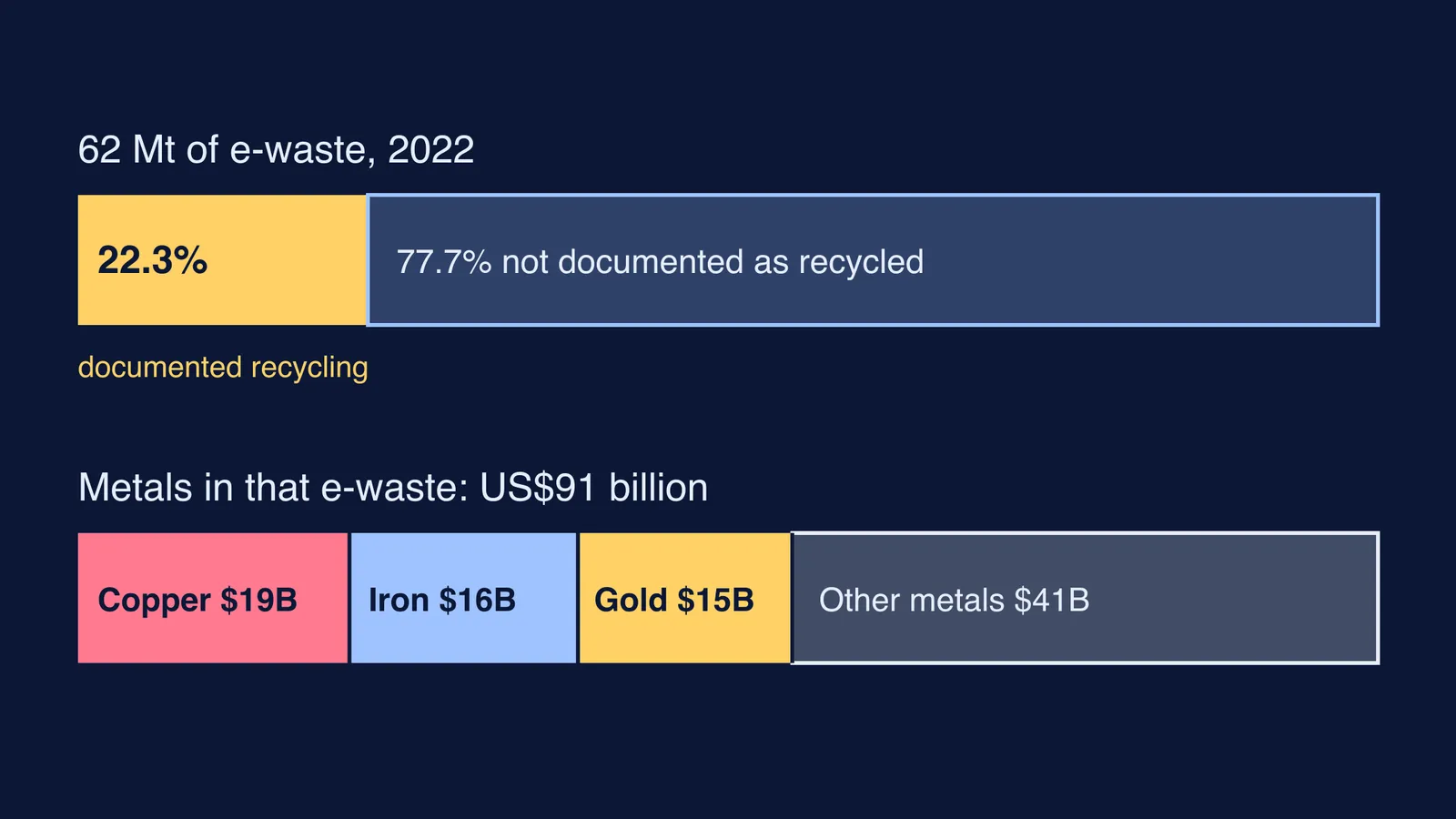
On the valuable side, the metals in the world's 2022 e-waste were worth about US$91 billion, including US$19 billion of copper and US$15 billion of gold, according to the UN Global E-waste Monitor press release. Copper is there because it conducts well (why copper is used in electric wires), and gold because it barely reacts (why gold and platinum do not corrode). In a dumpsite, that unreactive gold just sits there, useful to no one.
On the dangerous side are three heavy metals from your chemistry syllabus:
Mercury. The UN monitor names mercury as a hazardous substance in e-waste that "can damage the human brain and coordination system".
Lead. The WHO lead fact sheet says there is no known safe blood lead concentration, and that lead can permanently affect children's brain development.
Cadmium. The US CDC's ToxFAQs on cadmium say its main use is nickel-cadmium batteries, which can be used in phones and laptops, and that repeated exposure can damage the kidneys and is associated with weak, brittle bones.
Why should old phones and batteries not go in the dustbin?
Toxic metals escape when e-waste is handled badly. The WHO e-waste fact sheet) lists unsound methods such as open burning, acid baths and dumping on land or in water, says improper recycling can release up to 1,000 different chemical substances, and says exposure may be linked to effects on children's learning and behaviour, especially from lead.
Lithium-ion batteries can start fires. The US Environmental Protection Agency says these batteries, and devices containing them, should not go in household garbage or recycling bins, because they can be damaged or crushed in transport or sorting equipment, creating a fire hazard.
The metals are lost. In 2022, only 22.3% of the world's e-waste was documented as properly collected and recycled, and about 14 million tonnes were trashed, mostly into landfill, according to the UN monitor. For small IT equipment such as phones and routers, the documented rate was 22%.
How much e-waste does India produce?
A lot, and it is rising fast. In a reply in Parliament on 27 July 2023, the Ministry of Environment, Forest and Climate Change put India's e-waste at 7,08,445 tonnes in 2017-18 and 16,01,155 tonnes in 2021-22, more than double in four years (text of the reply, via Toxics Link).
India's E-Waste (Management) Rules, 2022 came into force on 1 April 2023. Producers must meet recycling targets only through registered recyclers, and recyclers must register on the Central Pollution Control Board (CPCB) portal. In plain terms, phone brands are now legally responsible for getting a share of what they sell recycled.
What should you do with an old phone? A 20-minute drawer plan
Do this as a family on a Sunday.
Collect. Put everything with a plug or battery on one table: phones, chargers, earphones, power banks.
Sort into four piles. Still works; broken; loose batteries; swollen or damaged batteries.
Protect your data. Back up photos, sign out of accounts, factory reset, and remove the SIM and memory card.
Make batteries safe. Following the EPA's advice, put each battery or battery device in its own plastic bag and tape over the terminals.
Leave damaged batteries alone. Do not charge, press or puncture a swollen battery; the EPA says to contact the manufacturer for handling information.
Hand it over properly. Give working phones to a relative first. Send the rest through the brand's take-back programme or an authorised collection centre.
A script for the shop counter: "I want to return this for recycling. Does it go to a CPCB-registered recycler, and can I have a receipt?" If the answer is vague, use the brand's own take-back service. Never sell to anyone who burns cables or strips circuit boards in the open.
How does e-waste connect to what you study?
E-waste is the metals chapter in real life. Reactivity explains why gold survives and copper corrodes; electrochemistry explains why a "dead" battery can still hold enough charge to spark; toxicity links to the environment chapters in biology. Plastics have their own sorting rules, covered in our guide to what the plastic recycling numbers 1 to 7 mean.
If cell chemistry feels abstract, the Fermi Simulation Lab has interactive simulations for ideas that are easier to see than to read. Then go and empty that drawer.