

On this page
You flip over a plastic bottle and see a number inside a triangle. It looks like a recycling symbol, but the presence of that mark does not guarantee your local facility can recycle it. Introduced in 1988, these numbers are Resin Identification Codes (RIC).
If you are studying chemistry for the CBSE Class 12 exams, you will recognise many of the names behind these codes as common thermoplastics. Here is what the numbers stand for and how they connect to the chemistry of polymers.
What is a Resin Identification Code?
The codes were created to give recyclers a consistent way to identify the specific synthetic polymers used in a product. In 2013, the standard (ASTM D7611) changed the official symbol from a triangle of chasing arrows to a solid equilateral triangle. This was done to clarify that the mark is an identification tool, not an instruction or a guarantee that the item can be recycled locally.
From a chemical perspective, the plastics numbered 1 through 6 are all thermoplastics. Thermoplastics are polymers with linear or slightly branched long chains that soften when heated and harden when cooled. Because their chains are not locked together by cross-links, they can theoretically be remoulded and recycled multiple times.
What do the numbers 1 to 7 on plastic mean?
The codes name the specific polymer resin used in production. Each has different physical and chemical properties, as well as a different likelihood of being accepted by curbside recycling programs.
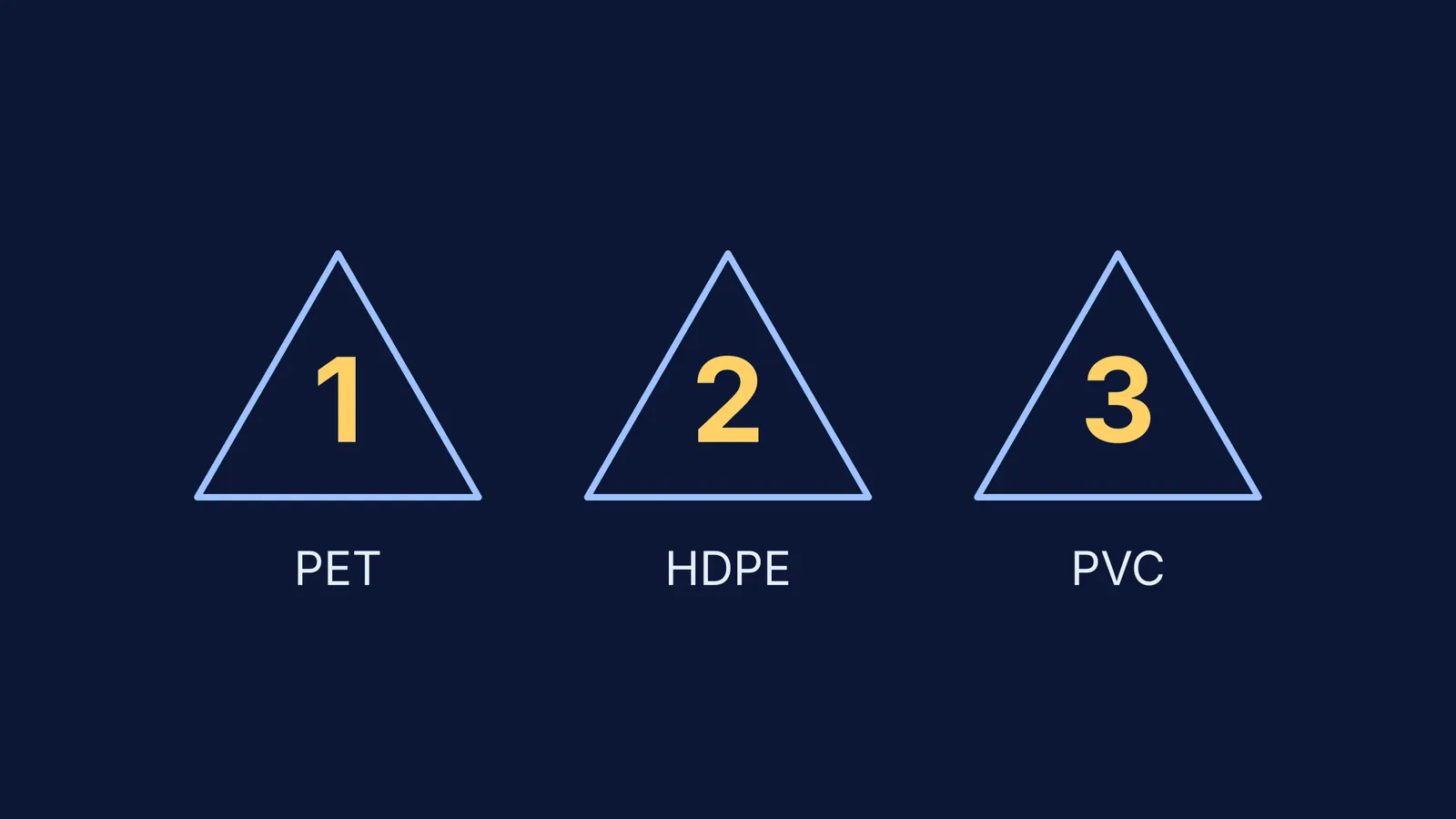
Code 1: PET or PETE (Polyethylene Terephthalate). This is a strong, lightweight and transparent polymer. It is the most common plastic for single-use water bottles, soft drink bottles, salad dressing containers and peanut butter jars. PET is widely accepted by recycling programs because it can be easily spun into polyester fibres for clothing or recycled back into new containers.
Code 2: HDPE (High-Density Polyethylene). HDPE is stiffer, stronger and more opaque than PET. It is used for heavier items like milk jugs, shampoo bottles, detergent bottles and motor oil containers. Like PET, HDPE is highly recyclable and widely accepted, making it one of the most successfully recycled plastics in the world.
Code 3: PVC (Polyvinyl Chloride). PVC is extremely tough and resists weathering, making it ideal for plumbing pipes, clear food wrap, medical tubing and some blister packs. However, it is rarely accepted in curbside bins. PVC contains chlorine, which can release toxic gases when burned and contaminate other plastic streams if melted down with them.
Code 4: LDPE (Low-Density Polyethylene). LDPE is softer and more flexible than HDPE. It is the primary material for grocery bags, bread bags, squeezable bottles and plastic wraps. While technically recyclable, curbside programs often reject LDPE because thin bags easily tangle in and jam mechanical sorting machinery. Many grocery stores provide dedicated drop-off bins for them instead.
Code 5: PP (Polypropylene). Polypropylene has a high melting point and withstands heat well. It is used for hot food containers, yogurt tubs, straws and medicine bottles. Its acceptance in municipal recycling is increasing as sorting technology improves, but you still must check your local rules.
Code 6: PS (Polystyrene). Polystyrene can be rigid or foamed (often known as Styrofoam). It is used for disposable coffee cups, foam packing peanuts and egg cartons. Because it breaks apart easily and is mostly air, it is notoriously difficult and unprofitable to transport and recycle. Most programs do not accept it.
Code 7: Other. This is a catch-all category for any plastic that does not fit into the first six codes, or for products made from multiple layers of different plastics. It includes polycarbonate (often used in reusable water bottles), bioplastics like polylactic acid (PLA), and various composites. Because the exact composition is unknown or mixed, these are almost never accepted in standard recycling bins.
Which plastic numbers can be recycled?
The code only names the material. Whether a piece of plastic actually gets recycled depends on your local hauler's capabilities and contamination limits. PET and HDPE (codes 1 and 2) are widely collected because facilities can easily process and sell them. PVC and polystyrene (codes 3 and 6) are harder to process and are not accepted in most programs.
How can you learn polymer types for exams?
In Class 12 chemistry, you must distinguish between thermoplastics and thermosetting plastics, and know how they are formed. Active learning is the best way to remember them. Pick up five plastic objects in your house, find their resin codes, and look up their chemical structures. Connecting a chemical name like polyethylene terephthalate to a physical water bottle makes it much easier to recall.
When revising addition and condensation polymers, it also helps to see the molecular differences in action. If you find it hard to picture how the long chains of a thermoplastic slide past each other while thermosetting plastics lock into a rigid network, the Fermi Simulation Lab lets you interact with molecular models to see the forces at play.
Understanding the history of these materials can also make the theory stick. Reading how Hermann Staudinger fought to prove that polymers are giant molecules, rather than just clusters of small ones, adds context to the long chains you draw in exams.


