

On this page
A dead phone battery is a small store of cobalt and lithium. Getting them back uses Class 11 and 12 ideas: oxidation states, H₂O₂ as a reducing agent, electrode potentials, n-factor and lithium's odd behaviour. Here is the industrial route for a lithium cobalt oxide (LiCoO₂) cathode, with a worked example.
Safety first. This is factory chemistry, not a home experiment. Never open, cut, crush or puncture a lithium-ion cell or a swollen battery at home. A damaged cell can short, overheat and catch fire. Hand used batteries to an authorised e-waste collection point, as our guide to why old phones and batteries don't belong in the dustbin explains.
Why does India now require battery recycling?
India's Battery Waste Management Rules, 2022, notified by the Ministry of Environment, Forest and Climate Change in August 2022 (PIB release), make producers responsible for collecting and recycling the batteries they sell. They also set minimum recovery targets for recyclers, counted as the weight of recovered materials out of the battery's dry weight. In the rules as notified, the target for portable batteries, the kind in phones, rises from 70% in 2024-25 to 80% in 2025-26 and 90% from 2026-27 onwards. The rules have been amended since, so check the current text before quoting them in a project.
Meeting them means dissolving the cathode and pulling the metals out one by one: hydrometallurgy.
How does a recycler get from a phone battery to black mass?
In a plant, cells are discharged, then shredded under controlled conditions, and plastic and metal foils are separated off. What is left is a dark powder of cathode oxide and anode graphite: black mass.
We use LiCoO₂ here because its chemistry is the cleanest to follow. It is the cathode that John Goodenough's group found in 1980, and many phone cells still use it. Mixed nickel-manganese-cobalt oxides (NMC) are leached similarly. Lithium iron phosphate (LFP) cells, with iron already +2 and no cobalt, are recycled differently.
Why can't sulphuric acid alone dissolve LiCoO₂ well?
Assign oxidation numbers: Li is +1 and each O is −2, so cobalt is +3.
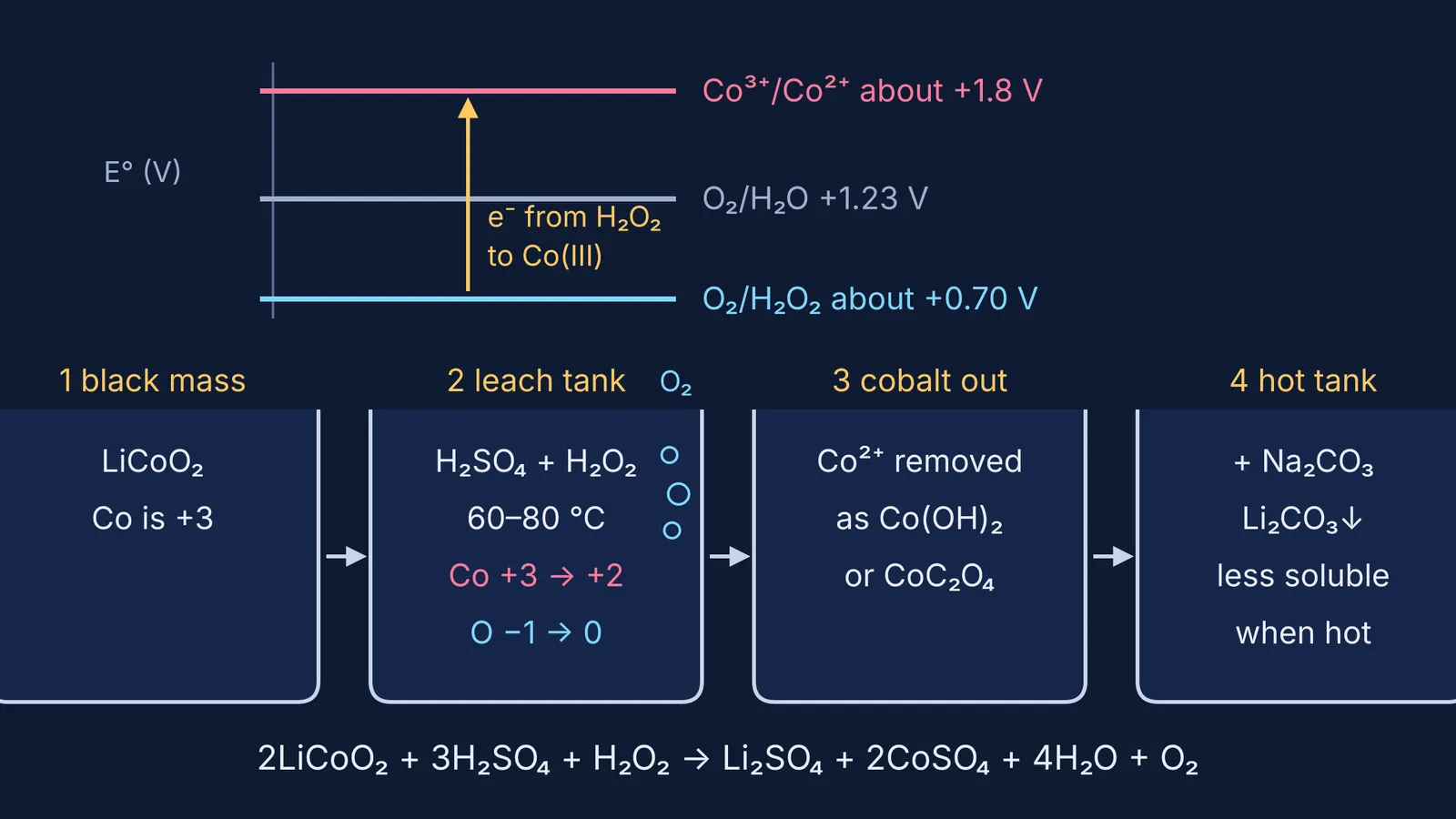
Acid can easily take the lithium out as Li⁺. Cobalt is the problem. If it left as Co³⁺(aq), that ion would sit at the top of the electrochemical series. NCERT's table gives E°(Co³⁺/Co²⁺) = +1.81 V, and some other tables list values a little higher. Compare O₂/H₂O at +1.23 V. Anything above +1.23 V can oxidise water to oxygen, so Co³⁺ does not survive in water: it grabs an electron and becomes Co²⁺.
So cobalt can only dissolve as Co²⁺, and someone has to supply that electron. With acid alone, the only donor is oxide oxygen in the solid, which is oxidised to O₂:
4LiCoO₂ + 6H₂SO₄ → 2Li₂SO₄ + 4CoSO₄ + 6H₂O + O₂
This is allowed on paper but slow, so acid alone leaves much of the cobalt in the residue. The fix is a reductant that gives up electrons easily.
Why is H₂O₂ a reducing agent in battery recycling?
Oxygen in H₂O₂ is −1, halfway between −2 and 0, so H₂O₂ can go either way. NCERT's rule is that it is oxidised to O₂ when its partner is a stronger oxidant. Co(III) is a much stronger oxidant: E°(O₂/H₂O₂) is only about +0.70 V, far below Co³⁺/Co²⁺. Electrons flow from H₂O₂ to cobalt:
2LiCoO₂ + 3H₂SO₄ + H₂O₂ → Li₂SO₄ + 2CoSO₄ + 4H₂O + O₂
Check it. Li: 2 = 2. Co: 2 = 2. S: 3 = 3. H: 6 + 2 = 8 on the left; 8 in 4H₂O on the right. O: 4 + 12 + 2 = 18 on the left; 4 + 8 + 4 + 2 = 18 on the right. As an ionic equation, 2LiCoO₂ + 6H⁺ + H₂O₂ → 2Li⁺ + 2Co²⁺ + 4H₂O + O₂, the charge is +6 on both sides.
The fizzing is O₂ from H₂O₂. If the roles of H₂O₂ still feel shaky, revise them in how H₂O₂ acts as both an oxidising and a reducing agent.
Laboratory studies often run this leach at around 60 to 80 °C with extra H₂O₂, because some decomposes before reaching the cobalt.
How are cobalt and lithium separated after leaching?
The liquor now holds Co²⁺ and Li⁺ (real plants first remove copper, aluminium and other metals).
Cobalt comes out first. Adding an oxalate gives pink CoC₂O₄, which is insoluble: Co²⁺ + C₂O₄²⁻ → CoC₂O₄. Alternatively, raising the pH with NaOH gives Co(OH)₂: Co²⁺ + 2OH⁻ → Co(OH)₂. Lithium stays in solution in both cases.
Lithium comes out last. Sodium carbonate is added to the hot solution: Li₂SO₄ + Na₂CO₃ → Li₂CO₃ + Na₂SO₄.
Why does this work? Most group 1 carbonates are very soluble, but Li₂CO₃ is only sparingly soluble, one of lithium's anomalous properties that make it resemble magnesium. Its solubility also falls as temperature rises: approximate handbook values are about 1.3 g per 100 g water at 20 °C and about 0.7 g at 100 °C. That is why the step is done hot. Cobalt must go first, because cobalt carbonate is also insoluble and would come down with the lithium.
Worked example: how much acid, H₂O₂ and Li₂CO₃ for 1 kg of LiCoO₂?
Take 1.00 kg of pure LiCoO₂ and assume the leach equation above runs completely.
(a) Reagents.
Molar mass of LiCoO₂ = 6.94 + 58.93 + 2 × 16.00 = 97.87 g/mol.
Moles = 1000 ÷ 97.87 = 10.22 mol.
H₂SO₄ needed = 3/2 × 10.22 = 15.33 mol. At 98.08 g/mol, that is about 1.50 kg.
H₂O₂ needed = 1/2 × 10.22 = 5.11 mol. At 34.02 g/mol, that is 0.174 kg, or about 0.58 kg of 30% (w/w) solution.
O₂ released = 5.11 mol. About 116 L at 22.7 L/mol (0 °C, 1 bar).
(b) n-factor check. Each Co gains 1 electron (+3 to +2), so the n-factor of LiCoO₂ is 1. Each H₂O₂ loses 2 electrons, so its n-factor is 2. Equal equivalents: 10.22 equivalents of H₂O₂ = 10.22 ÷ 2 = 5.11 mol, matching the equation. If you had treated H₂O₂ as an oxidant, cobalt would also have to be oxidised, and the electrons could not balance.
(c) Lithium yield.
10.22 mol Li gives 10.22 ÷ 2 = 5.11 mol Li₂CO₃.
Molar mass of Li₂CO₃ = 73.89 g/mol, so the maximum is 5.11 × 73.89 = 377 g.
Suppose the final liquor holds about 5 kg of water near 100 °C. At about 0.72 g per 100 g, 50 × 0.72 = 36 g stays dissolved.
Recovered at most about 377 − 36 = 341 g, roughly 90%.
Done at 20 °C instead (about 1.3 g per 100 g), about 65 g stays dissolved and the yield drops to about 83%.
To practise more problems like this with each step explained, try the Fermi Problem Library, a step-by-step solver that explains the reasoning.
Quick checklist
Cobalt in LiCoO₂ is +3, and Co³⁺(aq) oxidises water (about +1.8 V against +1.23 V).
H₂O₂ is the reducing agent here: O goes from −1 to 0, n-factor 2, two Co per H₂O₂.
Balanced: 2LiCoO₂ + 3H₂SO₄ + H₂O₂ → Li₂SO₄ + 2CoSO₄ + 4H₂O + O₂.
Remove cobalt first, then precipitate Li₂CO₃ hot, because it is less soluble when hot.
Never open a lithium-ion cell at home.


