

On this page
This set follows our first set of ray optics NEET practice questions and uses new set-ups and new numbers: plane mirrors, critical angle from the speed of light, mirrors in water, lens magnification, cut lenses, the reflecting telescope, finding an unknown lens in contact and the limit of emergence from a prism.
All 8 questions are original and single-correct, with four options in NEET-UG style. Each stays inside Unit 16 Optics of the Syllabus for NEET (UG)-2026 and NCERT Class 12 Physics Chapter 9, Ray Optics and Optical Instruments (Reprint 2026-27).
How should you use this ray optics set?
Give yourself 12 minutes for all eight, on paper, without a calculator.
Draw the ray or the setup before you write a formula.
Write u, v, f and R with signs, then check your answer and read the trap line.
If the chapter still feels new, start with how to prepare optics for NEET.
Easy: can you handle plane mirrors, critical angle and mirrors in water?
Q1 (easy). A laser beam on a lab bench strikes a plane mirror. Keeping the beam fixed, you turn the mirror through 12°. Through what angle does the reflected beam turn?
(A) 6° (B) 12° (C) 24° (D) 36°
Answer: (C). Turning the mirror by 12° turns its normal by 12°, so the angle of incidence and the angle of reflection each change by 12°. The reflected beam turns by twice the mirror's rotation, 24°. Trap: (B), which assumes the beam turns with the mirror.
Q2 (easy). Light travels at 1.8 × 10⁸ m/s inside a gemstone (take c = 3.0 × 10⁸ m/s). The critical angle for the gem-air surface is about:
(A) 53.1° (B) 36.9° (C) 41.8° (D) 31.0°
Answer: (B). The refractive index is n = c/v = 3.0/1.8 = 5/3. Then sin C = 1/n = 0.6, so C ≈ 36.9°. Trap: (C), the critical angle of ordinary glass (n = 1.5), used out of habit.
Q3 (easy). A concave mirror has a focal length of 15 cm in air. It is placed at the bottom of a tank of water (n = 4/3). Its focal length in water is:
(A) 20 cm (B) 11.25 cm (C) 15 cm (D) 7.5 cm
Answer: (C). A mirror's focal length is f = R/2, set only by its shape; reflection does not depend on the medium. It stays 15 cm. Trap: (A) or (B), which treat the mirror like a lens whose power changes with the surrounding medium.
Medium: can you work with lens magnification, cut lenses and telescopes?
Q4 (medium). A convex lens forms a real image, 4 times the size of the object, on a screen 50 cm from the lens. The focal length of the lens is:
(A) 12.5 cm (B) 10 cm (C) 16.7 cm (D) 40 cm
Answer: (B). A real image is inverted, so m = v/u = −4. With v = +50 cm, u = −12.5 cm. Then 1/f = 1/v − 1/u = 1/50 + 1/12.5 = 5/50, so f = 10 cm. Trap: (C), which writes 1/f = 1/12.5 − 1/50 by dropping the sign of u.
Q5 (medium). A thin equiconvex glass lens (n = 1.5) of focal length 20 cm is sliced into two identical plano-convex halves by a plane perpendicular to its principal axis. The focal length of each half is:
(A) 10 cm (B) 20 cm (C) 40 cm (D) 80 cm
Answer: (C). By the lens maker formula, 1/20 = 0.5 × (2/R), so R = 20 cm. Each half has one curved face and one flat face: 1/f = 0.5/20, so f = 40 cm. Trap: (B), the answer for a lens cut along its axis, where each half keeps both curved faces.
Q6 (medium). A reflecting telescope has a concave mirror objective with a radius of curvature of 4.0 m and an eyepiece of focal length 2.5 cm. In normal adjustment its magnifying power is:
(A) 160 (B) 80 (C) 81 (D) 40
Answer: (B). The mirror's focal length is R/2 = 2.0 m = 200 cm. In normal adjustment the magnifying power is fo/fe = 200/2.5 = 80. Trap: (A), which puts the radius of curvature in place of the focal length.
Hard: can you combine lenses and find the limit for a prism?
Q7 (hard). A convex lens forms a sharp image of a distant hill on a screen 20 cm behind it. A thin concave lens is then placed in contact with it, and the screen must be moved 10 cm farther away to get a sharp image again. The focal length of the concave lens is:
(A) −10 cm (B) −30 cm (C) −60 cm (D) −12 cm
Answer: (C). The convex lens has f = 20 cm, and the pair has f = 30 cm. Powers add in contact: 1/30 = 1/20 + 1/fc, so 1/fc = −1/60 and fc = −60 cm. Trap: (A), which takes the 10 cm shift of the screen as the focal length.
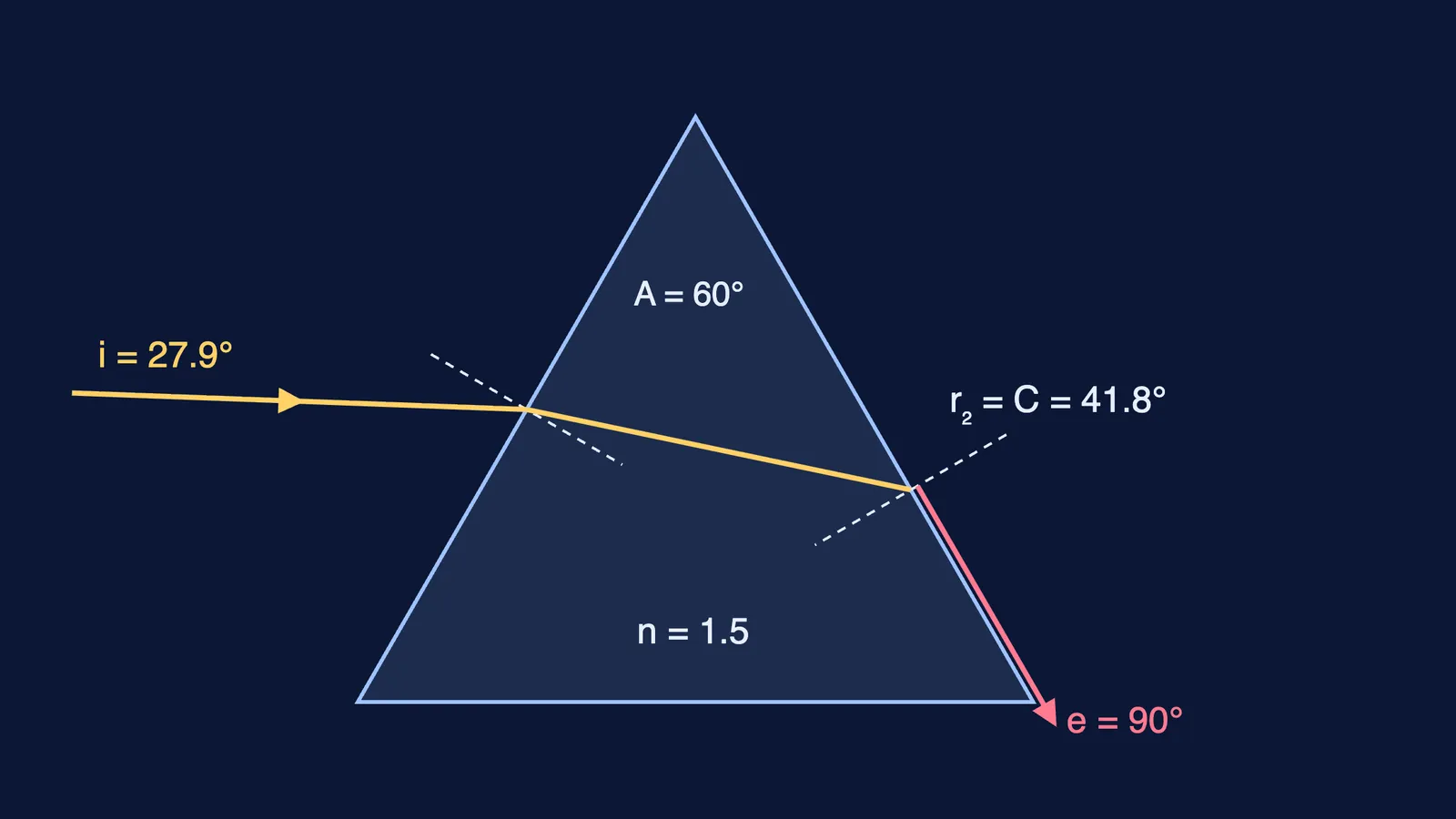
Q8 (hard). Light falls on one face of a 60° glass prism (n = 1.5). What is the smallest angle of incidence for which light still emerges from the second face?
(A) 18.2° (B) 27.9° (C) 41.8° (D) Any angle above 0°
Answer: (B). At the limit, the ray meets the second face at the critical angle, r2 = C, where sin C = 1/1.5, so C ≈ 41.8°. Since r1 + r2 = A, r1 = 60° − 41.8° = 18.2°. Then sin i = 1.5 × sin 18.2° ≈ 0.468, so i ≈ 27.9°, and the ray leaves grazing the face. Trap: (A), which stops at r1, the angle inside the glass.
What should you do after this set?
Sort each miss as a sign error (Q4, Q7), a wrong formula (Q3, Q5, Q6) or a set-up error (Q1, Q2, Q8), and revise the largest group first. Keep the ray optics formulas for Class 12 open while you do. If you cannot see where your working went wrong, the Fermi Problem Library has worked problems with a step-by-step solver that explains the reasoning rather than printing an answer.


