

On this page
NCERT says the slowest step of a reaction is the rate-determining step. On an energy profile, students are usually told to find it by measuring each step's activation energy from the species just before it and picking the largest. That rule works for most profiles you will see in an exam. It fails when an intermediate sits high up and falls back to the reactants faster than it moves on, or when it sits in a deep well below the reactants. Here is the reading that works in every case, with numbers.
What is the usual rule for finding the rate-determining step?
Our post on transition states and intermediates gives the common rule: look for the step with the highest activation energy, measured from the starting material for that step. A second rule you will also hear is "the step with the highest peak". In a simple profile both rules pick the same step, so nobody notices that they are different rules.
The IUPAC definition is more careful. It defines the rate-controlling step by its effect: the step whose rate constant has the strongest influence on the overall rate (IUPAC Gold Book, rate-controlling step). It says nothing about the size of a local barrier. That is the definition to test the two rules against.
Why can the largest local barrier pick the wrong step?
An intermediate has two exits: back to the reactants over the first transition state, or forward to products over the second. If the back exit is lower, the intermediate mostly goes back. Then the reaction is limited by the rare trip over the second barrier, even if that barrier looks small when measured from the intermediate.
Rate constants come from Gibbs energies of activation through the Eyring equation, k = (k_BT/h)e^(−ΔG‡/RT), so profiles for this purpose should be drawn in Gibbs energy, not enthalpy. At 298 K, RT = 2.48 kJ/mol. A useful consequence: the ratio of two rate constants depends only on the difference between their barriers.
Worked example: two profiles where the simple rules disagree
All energies below are Gibbs energies relative to the reactants at 298 K. They are illustrative numbers, chosen to show the effect, not data for any real reaction.
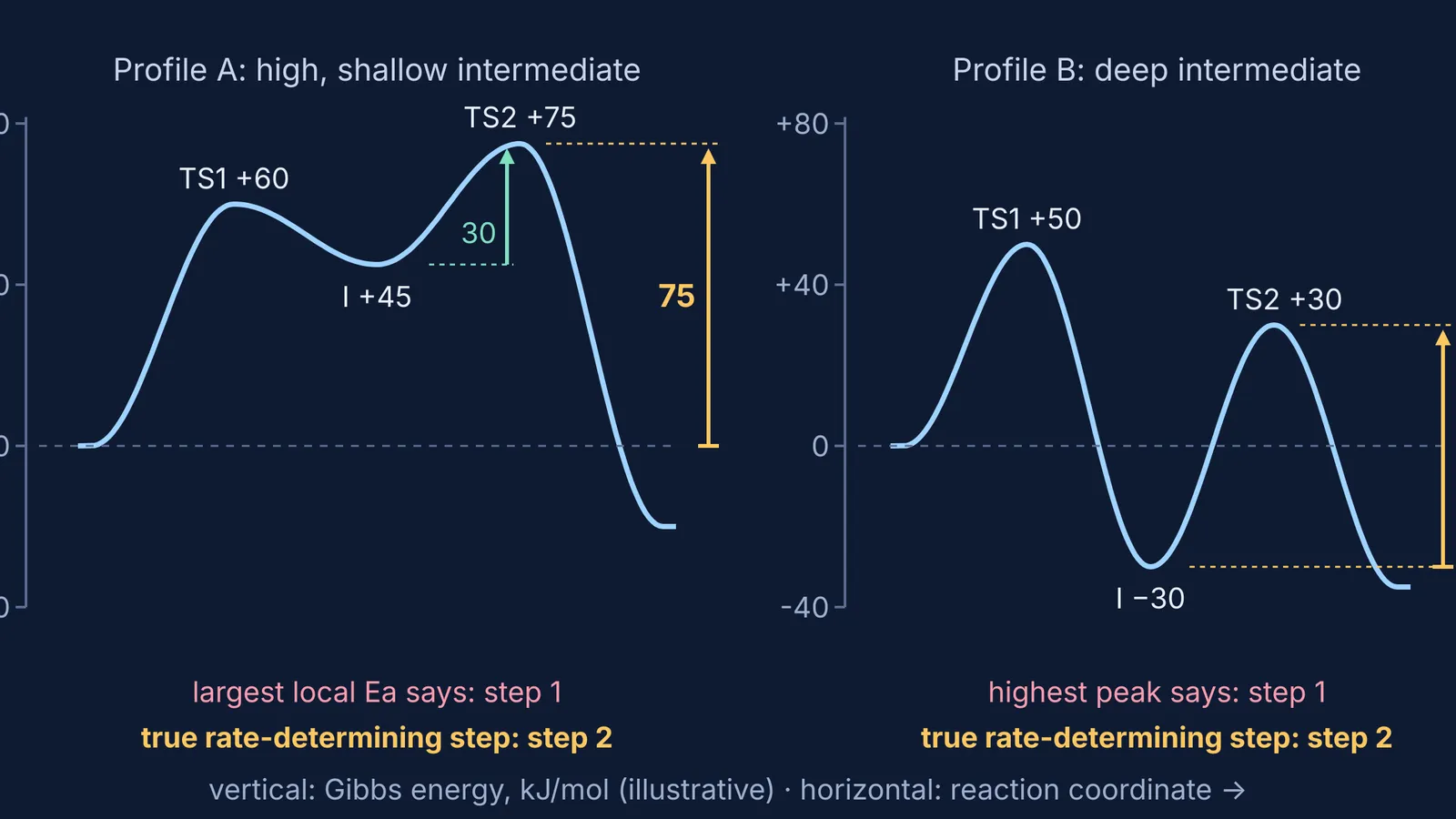
Profile A: a high, shallow intermediate. TS1 at +60 kJ/mol, intermediate I at +45, TS2 at +75.
Local barriers. Step 1: 60 − 0 = 60 kJ/mol. Step 2: 75 − 45 = 30 kJ/mol. The largest-local-Ea rule picks step 1.
Where does I go? Back to reactants over 60 − 45 = 15 kJ/mol; forward over 30 kJ/mol. So k₋₁/k₂ = e^((30 − 15)/2.48) = e^6.05 ≈ 425. I returns to the reactants about 425 times for every time it goes on.
Overall rate constant. The steady-state result is k(obs) = k₁k₂/(k₋₁ + k₂), derived in our post on the steady-state approximation. With k₋₁ ≫ k₂ this becomes k₁k₂/k₋₁. Adding exponents, the effective barrier is 60 + 30 − 15 = 75 kJ/mol: the height of TS2 above the reactants.
Size of the error. If step 1 controlled, the half-life at 298 K would be about 3.6 ms. The real half-life is about 1.5 s, roughly 425 times longer. Step 2 is rate-determining.
Profile B: a deep intermediate. TS1 at +50, I at −30, TS2 at +30.
Highest peak. TS1 (+50) is higher than TS2 (+30), so the highest-peak rule picks step 1.
Local barriers. Step 1: 50. Step 2: 30 − (−30) = 60. Here the largest-local-Ea rule happens to get it right.
What actually happens. Falling back from I means climbing 80 kJ/mol, so it almost never returns. Step 1 is faster than step 2 by e^(10/2.48) ≈ 56 times. For a reaction run once from pure reactants, I builds up, then decays to product. The half-life of step 1 is about 0.06 ms and of step 2 about 3.6 ms, so product formation is set by step 2.
So each simple rule fails on one of the two profiles. The rule that works on both: for each transition state, measure up from the lowest point the reaction passes through before it. The largest such climb marks the rate-determining step.
Profile A: TS1 is 60 above the reactants; TS2 is 75 above the reactants (I at +45 is not a low point). Step 2.
Profile B: TS1 is 50 above the reactants; TS2 is 60 above I. Step 2.
When do all the rules agree?
Take a third illustrative profile, Profile C: TS1 at +90, I at +70, TS2 at +75. TS1 is the highest peak; step 1 has the largest local barrier (90 against 5); and the climb from the reactants to TS1 is the largest climb. I falls back over 20 kJ/mol but goes on over only 5, so it goes forward about 425 times for every return. Step 1 controls by every rule.
This is the shape of the energy profile usually drawn for SN1 of a tertiary halide: slow ionisation to a high-energy carbocation that is captured quickly by the nucleophile. In profiles like this, with no intermediate below the reactants and the first transition state highest, the textbook rule and the careful rule give the same answer. Our post on the Hammond postulate explains why that first transition state looks like the carbocation.
Where does the corrected rule come from?
Joseph Murdoch's paper "What is the rate-limiting step of a multistep reaction?" took up exactly this question for teachers and students (Murdoch, J. Chem. Educ. 58, 32, 1981). One more point is worth a sentence: which step is slowest can change with concentrations, because a bimolecular step speeds up as its reactants become more concentrated.
For catalytic cycles running at steady state, Kozuch and Shaik turned the same idea into the energetic span model: the turnover rate is set by the gap between one key intermediate and one key transition state, not by any single step's barrier (Kozuch and Shaik, Acc. Chem. Res. 44, 101, 2011). That formula is for cycles. For a one-shot reaction like Profile B, describe it as consecutive steps: I builds up, then decays.
What should you write in a JEE, NEET or board exam?
Profile with no intermediate below the reactants: the step whose transition state is highest is rate-determining. This covers most NCERT and JEE graphs.
Intermediate below the reactants: write "the highest transition state relative to the lowest point before it", and measure from the intermediate.
High intermediate that falls back easily: compare the two exits. If going back is easier, the later step controls.
Definition question: the slowest step, as NCERT puts it, is still the expected answer.
If energy-profile questions keep catching you out, Fermi Test Prep offers JEE Main and Advanced preparation with an AI tutor. For more kinetics problems worked line by line, the Fermi Problem Library has a step-by-step solver that explains the reasoning.
Quick checklist
Draw profiles in Gibbs energy; k = (k_BT/h)e^(−ΔG‡/RT).
Ratio of rate constants = e^(ΔΔG‡/RT); 15 kJ/mol at 298 K is a factor of about 425.
High, shallow intermediate: if it falls back easily, the later step controls.
Deep intermediate: measure the next climb from the bottom of the well.
Rate-determining step: largest climb from the lowest preceding point to a transition state.


