On this page
A mechanism with a reactive intermediate gives you a problem. You cannot easily measure the intermediate's concentration, yet the rate law you write must not contain it. The steady-state approximation removes it.
What is the steady-state approximation?
The steady-state approximation means setting the rate of change of a reaction intermediate equal to zero so that the kinetic equations simplify (Wikipedia: Steady state (chemistry)). Put simply, the intermediate is consumed as quickly as it is generated (Chemistry LibreTexts: Steady-State Approximation). You will also see it called Bodenstein's quasi-steady-state approximation (same Wikipedia page).
The same idea sits under enzyme kinetics. In a 1925 note in the Biochemical Journal, G. E. Briggs and J. B. S. Haldane assumed that the concentration of the enzyme–substrate complex does not change on the time scale over which product formation is measured (Briggs and Haldane, 1925; summary of their derivation). Their analysis is taken as the basic approach to enzyme kinetics today.
Why is it fair to set d[I]/dt = 0?
Picture a bucket under a slow tap with a wide drain. The level stays low and changes only slowly as the tap flow changes. A reactive intermediate behaves the same way when it is used up much faster than it is made. For the simple chain A → I → P, a common rule of thumb is that the approximation is safe when k₂/k₁ > 10 (Wikipedia: Steady state (chemistry)).
The approximation does not say two things students often assume. It does not say [I] is zero, and it does not need the intermediate to be at equilibrium. The concentration only has to be low and roughly constant (same source).
How do you derive a rate law with the steady-state approximation?
Take this two-step mechanism:
Step 1 (reversible): A + B ⇌ I, forward rate constant k₁, backward rate constant k₋₁
Step 2: I → P, rate constant k₂
Now four lines, the same every time:
Write the net rate of change of the intermediate, with every step that makes or uses it: d[I]/dt = k₁[A][B] − k₋₁[I] − k₂[I].
Set it to zero: k₁[A][B] = (k₋₁ + k₂)[I].
Solve for the intermediate: [I] = k₁[A][B] / (k₋₁ + k₂).
Substitute into the step that makes product: rate = d[P]/dt = k₂[I] = k₁k₂[A][B] / (k₋₁ + k₂).
The final rate law contains only reactants and rate constants, so an experiment can test it. Make B a collision partner M that also takes part in the back reaction and you get the Lindemann mechanism for gas-phase reactions, with d[P]/dt = k₁k₂[A][M] / (k₋₁[M] + k₂) (Wikipedia: Lindemann mechanism).
What happens when one step is much faster?
The general answer contains two familiar shortcuts.
If k₂ ≫ k₋₁, the intermediate almost never falls back to A and B, and rate ≈ k₁[A][B]. Step 1 is rate-determining.
If k₋₁ ≫ k₂, step 1 settles near equilibrium before I moves on, and rate ≈ (k₁/k₋₁)k₂[A][B] = Kk₂[A][B], where K is the equilibrium constant of step 1. This is the pre-equilibrium result.
The Lindemann mechanism shows the same switch. It predicts second-order kinetics at low pressure and first-order kinetics at high pressure (Wikipedia: Lindemann mechanism), because [M] decides which term in the denominator wins.
How accurate is the steady-state approximation?
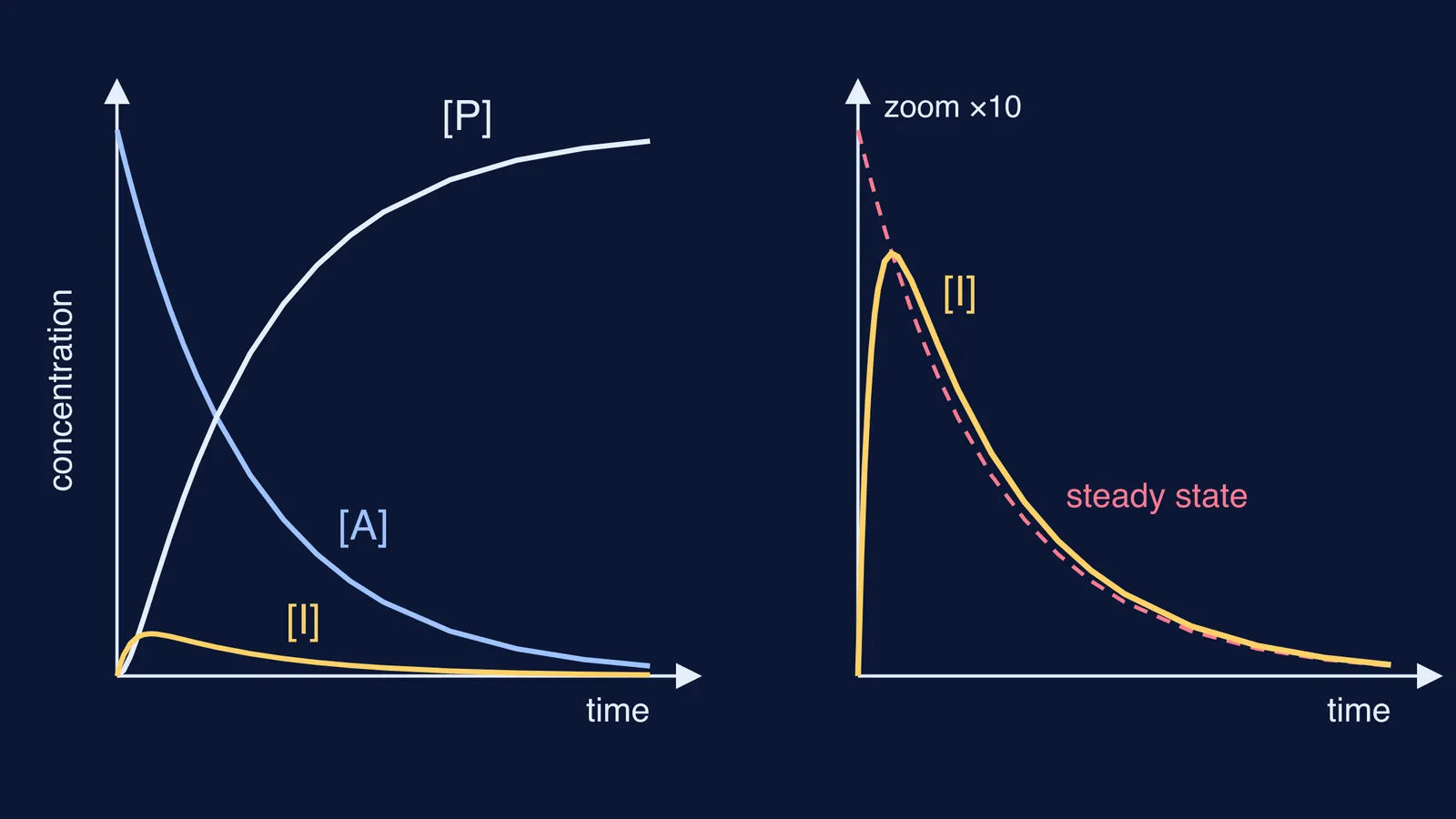
You can check it yourself on A → I → P, starting with pure A. Integrating the rate equations gives the exact result [I] = [A]₀ · k₁/(k₂ − k₁) · (e^(−k₁t) − e^(−k₂t)). The steady-state estimate is [I] = (k₁/k₂)[A]. Once the fast term e^(−k₂t) has died away, the exact value is k₂/(k₂ − k₁) times the estimate.
At the rule-of-thumb boundary k₂ = 10k₁ (Wikipedia: Steady state (chemistry)), that factor is 10/9, so the estimate runs about 10% low. At k₂ = 100k₁ it is about 1% low. The approximation also fails in the first instant after mixing, while the intermediate is still building up. The chart at the top of this page shows both effects.
Which mistakes cost marks?
Leaving out k₋₁[I]. If step 1 is reversible, the back reaction uses up I too.
Setting [I] = 0 instead of d[I]/dt = 0.
Applying the approximation to a reactant or product. It is only for intermediates made and used up inside the mechanism.
Stopping with [I] still in the rate law.
Assuming the slow step alone sets the rate without checking which limit applies.
If you get lost between line 2 and line 3 on a real question, the Fermi Problem Library has worked problems with a step-by-step solver that explains the reasoning rather than printing an answer. If the gap is earlier, in what an intermediate or a rate-determining step actually is, the Fermi Concept Library gives each concept in chemistry its own lesson.
Next time you meet a mechanism, write the four lines on paper before you read any solution.