

On this page
When you read a chemical mechanism, knowing the difference between a transition state and an intermediate tells you whether a species can be isolated or just theorised. On a reaction energy profile, one is a peak and the other is a valley.
What is the difference between a transition state and an intermediate?
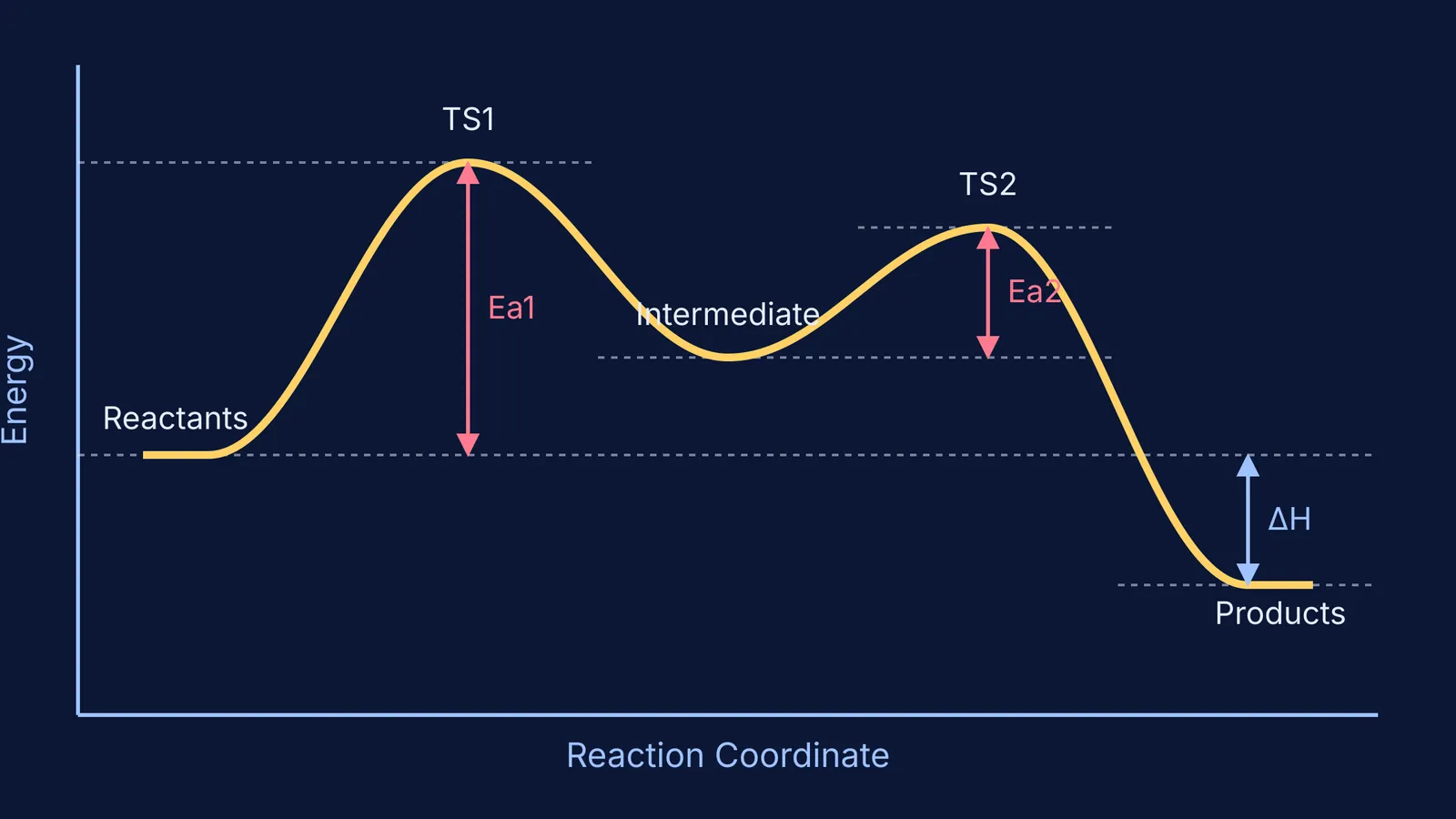
A transition state is the highest energy point along a reaction path. According to the IUPAC Gold Book, a transition state represents an assembly of atoms at a saddle point on the potential-energy surface. Because it sits at an energy maximum, it has a fleeting existence and cannot be isolated. In a transition state, bonds are partially formed and partially broken.
An intermediate, by contrast, sits in a local energy minimum (a valley) along the reaction path. The IUPAC defines an intermediate as a molecular entity with a lifetime appreciably longer than a molecular vibration, formed from reactants and reacting further to give products. Because they sit in an energy well, intermediates have fully formed bonds and can often be detected by spectroscopy or even isolated if the well is deep enough. For instance, low-temperature matrix isolation is a common technique used by chemists to trap highly reactive intermediates so their structures can be studied before they proceed to form the final products.
For example, an SN2 reaction is a single concerted step: it passes through one transition state and has zero intermediates. An SN1 reaction happens in two steps, forming a carbocation in the middle. That carbocation is an intermediate, flanked by two transition states. (When solving problems involving intermediates, you may also need to check for carbocation rearrangements: hydride and methyl shifts explained).
How do you find the rate-determining step on a profile?
A multistep reaction involves several energy peaks. The IUPAC defines a rate-controlling step (or rate-determining step) as an elementary reaction whose rate constant exerts a stronger effect than any other on the overall rate.
To find it on an energy profile, look for the step with the highest activation energy (Ea). The activation energy for a forward step is the vertical distance from the energy of the starting material for that step to the transition state (the peak) immediately following it. The step with the largest Ea is the slowest and acts as the bottleneck for the whole reaction. Because the rate of the overall reaction cannot be faster than its slowest step, increasing the concentration of reactants involved in the rate-determining step will typically speed up the entire process. Conversely, changes to fast steps that occur after the rate-determining step will have no significant effect on the overall rate of reaction.
If you are not sure how to read the peaks and valleys on your graph, Fermi's AI tutor can teach through it — drawing the figure, asking you to identify the rate-determining step, and checking your understanding as it goes.
How do you read the overall enthalpy change (ΔH)?
The peaks and valleys tell you about the pathway, but the thermodynamics of the reaction depend only on the start and end points. The overall enthalpy of reaction (ΔH) is the difference in energy between the final products and the initial reactants.
If the products are lower in energy than the reactants, ΔH is negative (an exothermic reaction).
If the products are higher in energy than the reactants, ΔH is positive (an endothermic reaction).
The depth of the intermediate valley does not change the overall ΔH. Whether you are plotting a simple substitution or a complex multi-step pathway like Fischer esterification: mechanism and how to push the equilibrium, the rule remains the same: transition states are the peaks you must climb over, and intermediates are the valleys where the reaction briefly rests. A catalyst can lower the activation energy by providing an alternative pathway with lower peaks, but it will never change the final energy difference (ΔH) between the products and the starting reactants.
Every chemical concept, from activation energy to Hess's Law, is mapped out in the Fermi Concept Library, each with its own lesson and its place in the wider map of chemistry.


