

On this page
In organic chemistry, a transition state is the fleeting moment of highest energy during a reaction. Because it lasts for only a fraction of a picosecond, you cannot isolate it in a flask or view it under a microscope. So how do chemists know what bonds are breaking or forming at that exact moment?
The answer lies in a rule first proposed by American chemist George Hammond, giving us a way to predict the invisible.
What does the Hammond postulate state?
According to the IUPAC Gold Book (10.1351/goldbook.H02734), the Hammond postulate states that if two states occur consecutively during a reaction and have nearly the same energy content, their interconversion will involve only a small reorganisation of molecular structure.
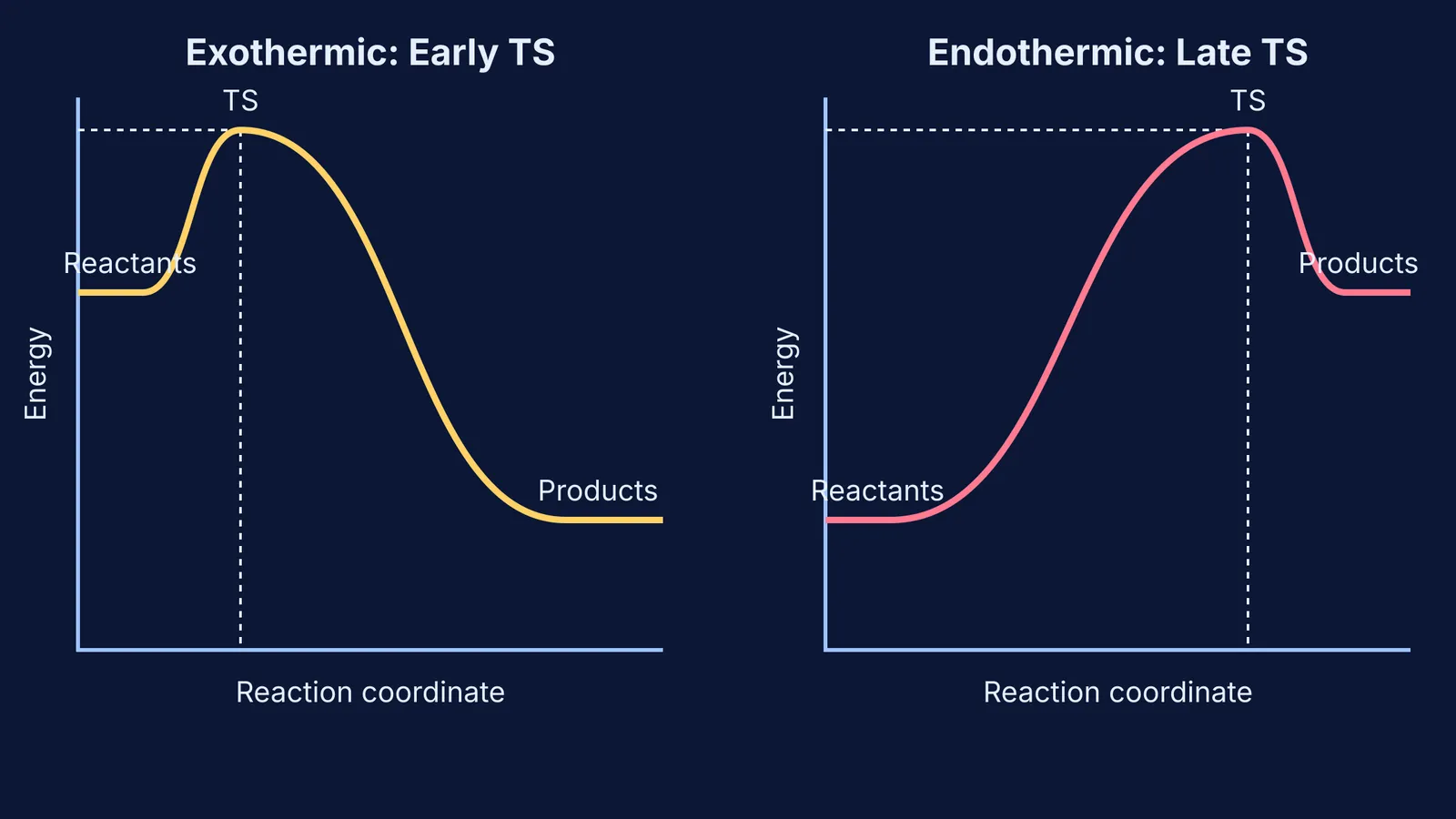
In simpler terms, a transition state resembles whichever stable species—the reactant, intermediate, or product—it is closer to in energy. Rather than guessing what the transition state looks like, you can look at the thermodynamics of the reaction step to infer its structure.
How does it predict early vs late transition states?
Every reaction step is either energy-releasing or energy-absorbing, and this tells you exactly where the transition state sits on the reaction coordinate.
Exothermic reactions: The reactants are higher in energy than the products. The energy peak is reached quickly, making the transition state closer in energy to the reactants. This is called an "early" transition state, and its structure looks mostly like the starting molecules. Bonds are only just beginning to break or form.
Endothermic reactions: The products (or intermediates) sit at a higher energy than the reactants. The transition state is closer in energy to these products. This is a "late" transition state, and it strongly resembles the newly formed species.
Why do stable carbocations form faster?
In mechanisms like SN1 substitutions or electrophilic additions to alkenes, the first step is forming a carbocation. Breaking a bond to create a positive charge is a highly endothermic process.
By the Hammond postulate, because the step is endothermic, the transition state resembles the carbocation intermediate. This means that in the transition state, the leaving group has almost completely left, and the carbon atom has already developed a significant partial positive charge.
Because the transition state looks so much like the carbocation, anything that stabilises the carbocation also lowers the energy of the transition state. For example, when a tertiary alkyl halide undergoes an SN1 reaction, the bulky alkyl groups push electron density toward the central carbon through the inductive effect and share their electrons through hyperconjugation. This makes the tertiary carbocation much more stable than a primary or secondary one.
Because the transition state closely resembles this carbocation, it enjoys the same stabilising effects. The activation energy drops, and the tertiary alkyl halide reacts rapidly. Without the Hammond postulate, we would have no structural reason to link the stability of the product to the speed of the reaction. If you have gaps in your understanding of these energetic trade-offs, the Fermi Concept Library has a lesson for every concept in chemistry.
How is this tested in exams?
When facing organic mechanisms in JEE or NEET, use the Hammond postulate as a thinking tool rather than just a definition to memorise.
Predicting the major product: Whenever an electrophile attacks a double bond, it could potentially form two different carbocations. The Hammond postulate justifies Markovnikov's rule by showing that the pathway through the more substituted, more stable carbocation has a lower energy hill to climb.
Comparing reaction rates: Exam questions often ask you to rank alkyl halides by their SN1 reaction speed. You can safely rank them by the stability of the carbocations they form, because the transition state mimics the intermediate.
Understanding resonance: This principle explains why allylic and benzylic halides react so rapidly. The resonance that stabilises the resulting carbocation also stabilises the late transition state leading up to it. If the intermediate is comfortable, the path to get there is easy.
Shifts and rearrangements: It also explains the driving force behind carbocation rearrangements. A hydride or methyl shift occurs because forming a more stable carbocation provides a thermodynamically downhill path with a low-energy transition state.


