

On this page
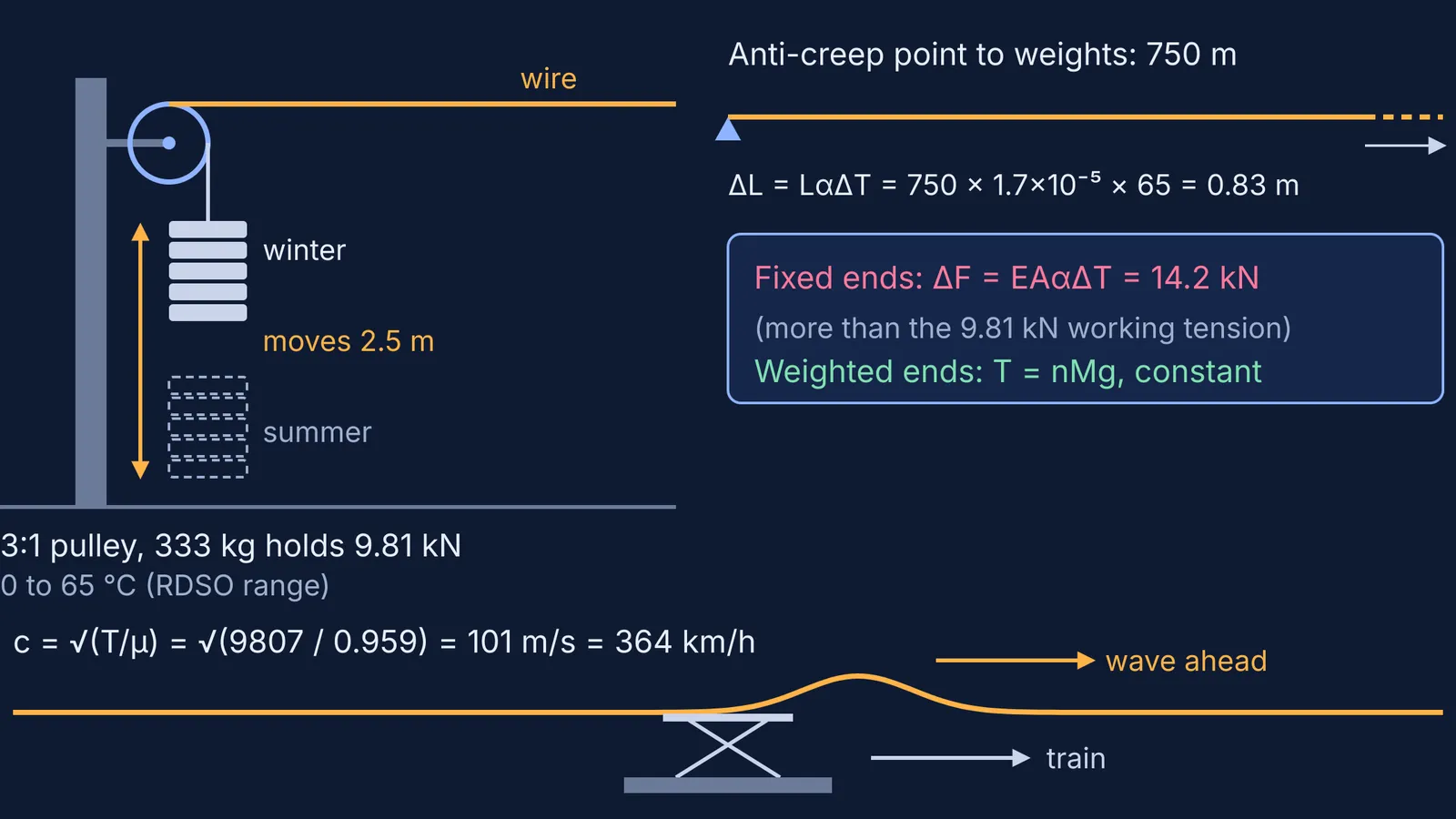
Look along the wires on any electrified line. At some masts you will see a stack of iron weights hanging beside the pole, joined to the wires through a set of pulleys. Indian Railways calls this the regulating equipment or auto-tensioning device (ATD). It pulls on the overhead wires with a fixed force all year. Three chapters explain why: thermal expansion, pulleys and waves on a string.
Safety first. These are live 25 kV lines. Never climb a mast, a wagon roof or a footbridge railing near them, never touch or poke anything towards them, and never go near the weights or a fallen wire. Electricity at 25 kV can jump across an air gap to a person who is close but not touching. Look only from a safe distance on the platform.
Why can't the overhead wire just be fixed at both ends?
How a train draws current from the wire through its pantograph is covered in how electric trains get power from the overhead wire. Here we only need the wire itself: a grooved copper contact wire of 107 mm² hanging below a catenary (messenger) wire. RDSO's specification for the cantilever assemblies lists this 107 mm² wire with a maximum of 1,200 kgf in each conductor, and says one tension length can be up to 1,500 m, with an anti-creep point at its middle.
Copper expands by about 1.7 × 10⁻⁵ per kelvin (NCERT's value). RDSO's amendment slip for the regulating equipment sets an ambient range of 0 °C to 65 °C for the three-pulley type, with a reference temperature of 35 °C. A wire that hangs freely in that range keeps changing length.
A power line on fixed towers turns that extra length into sag, as worked out in why electric wires sag more in summer. A contact wire cannot be allowed to do that. The pantograph presses up on it at speed, and it needs the wire at a steady height. So the ends are not fixed. They run over pulleys to weights that rise and fall as the wire grows and shrinks.
How much does the wire grow between winter and summer?
The wire is held at the anti-creep point in the middle, so each half grows outward from there towards its own weights. For one half:
ΔL = L α ΔT
With L = 750 m (half of 1,500 m), α = 1.7 × 10⁻⁵ K⁻¹ and ΔT = 65 K:
ΔL = 750 × 1.7 × 10⁻⁵ × 65 = 0.83 m
What happens to the tension if the ends were fixed?
A fixed wire cannot change length, so a temperature change becomes a change in stress. The thermal stress is EαΔT, and the force is that stress times the area. Take Young's modulus for hard copper as about 1.2 × 10¹¹ Pa (approximate):
ΔF = E A α ΔT = 1.2 × 10¹¹ × 107 × 10⁻⁶ × 1.7 × 10⁻⁵ × ΔT = 218 N per kelvin
Suppose the wire were strung at 1,000 kgf (9.81 kN) at 35 °C and then clamped. At 0 °C it would be 35 K colder and the tension would rise to 9.81 + 0.218 × 35 = 17.4 kN, well above RDSO's 1,200 kgf (11.8 kN) limit. At 65 °C it would fall to 9.81 − 0.218 × 30 = 3.26 kN, and the wire would droop between supports. The full swing, 14.2 kN, is bigger than the working tension itself.
How does a pulley block let a small weight hold a large tension?
A pulley block with a velocity ratio n multiplies force by n and divides movement by n, because work in equals work out (ignoring friction):
Mg × (distance the weight moves) = T × (distance the wire end moves)
So T = nMg, and the weight moves n times as far as the wire.
You can check the ratio from RDSO's own figures. The same amendment slip says a five-pulley ATD holds 2,400 kgf with a 480 kg counterweight (this device pulls the catenary and contact wire together). 2,400 ÷ 480 = 5, so it works at 5:1.
Worked example: a 3:1 pulley on one contact wire
Round illustrative values: tension 1,000 kgf (9.81 kN) on one contact wire, a 3:1 pulley, the half-length of 750 m and the 0–65 °C range from above.
Weight needed. M = T ÷ (n g) = 1,000 kgf ÷ 3 = 333 kg, a weight of 3.27 kN.
Wire movement. From above, ΔL = 0.83 m.
Weight movement. 3 × 0.83 = 2.49 m. On a hot afternoon the weights hang low; on a cold night they ride up 2.5 m.
Tension. Still 9.81 kN at every temperature, because it is set by the weight, not by the wire's length.
Check. 3 × 3.27 kN = 9.81 kN, and 3.27 kN × 2.49 m = 9.81 kN × 0.83 m, so work in equals work out.
Why does wire tension set a train's speed limit?
A kink in the wire travels along it like a wave on a string, at
c = √(T/μ)
where μ is the mass per metre. How c depends on T is covered in how wave speed on a string changes with tension. For the contact wire:
Mass per metre. μ = ρA = 8,960 kg/m³ × 107 × 10⁻⁶ m² = 0.959 kg/m.
Wave speed at 9.81 kN. c = √(9,807 ÷ 0.959) = 101 m/s = 364 km/h.
The pantograph pushes the wire up as it passes, sending a bump ahead of itself. As the train's speed approaches c, the pantograph catches up with its own bump. Contact force swings, the shoe can lose touch with the wire, and arcing wears both. Designers therefore keep the running speed well below c: a study of pantographs near this critical speed (ASCE, 2022) notes that the permissible speed is normally below 70% of it. For our wire that is 0.7 × 364 = 255 km/h.
This uses the contact wire alone; the catenary and droppers change the real figure a little. Two comparisons:
At RDSO's 1,200 kgf (11.8 kN) on the same wire, c = 111 m/s = 399 km/h.
If the ends were fixed and the summer tension fell to 3.26 kN, c would drop to 58 m/s = 210 km/h, and 70% of that is only 147 km/h.
So the weights do two jobs at once: they keep the wire level and they keep the speed limit from falling on hot days.
If you want to see a wave race along a string as you change the tension, try it in the Simulation Lab.
Quick checklist
The weights at masts hold the overhead wire at a constant tension, T = nMg, whatever the temperature.
Each 750 m half of a copper wire grows about 0.83 m over 65 K; a 3:1 pulley moves the weights 3 times as far.
With fixed ends, a 65 K swing would change the tension by EAαΔT = 14.2 kN, more than the working tension.
Wave speed in the wire is c = √(T/μ): about 364 km/h for 9.81 kN on 107 mm² copper.
Running speed is kept well below c, about 70% as a design guide.
Look from the platform only: these are lethal 25 kV lines.


