

On this page
Look at the spillway of a big dam and the gates are rarely flat slabs. They are curved steel faces, each held on two long arms that meet at a pin set into the concrete pier behind it. That curve is not styling. It makes the push of the water pass straight through the pin, so the water exerts no turning effect on the gate however deep it is. The pin and the piers take millions of newtons, and the hoist only has to deal with the gate's weight and friction.
What is a radial (Tainter) gate?
A radial gate is a strip cut from a cylinder. The US Bureau of Reclamation describes it as a cylindrical skin plate, stiffened by ribs and girders, with radial arm struts that carry the water load to the trunnions, the pins about which the gate rotates (USBR dam safety guidance, chapter G-1). A hoist swings the curved face up about the trunnion and water flows out underneath.
It is also called a Tainter gate, after Jeremiah Burnham Tainter, whose "sluiceway gate" patent was issued in 1886 (US patent 344,878). The design works because the skin plate is a true circular arc whose centre is the trunnion.
How much force does the water put on the gate?
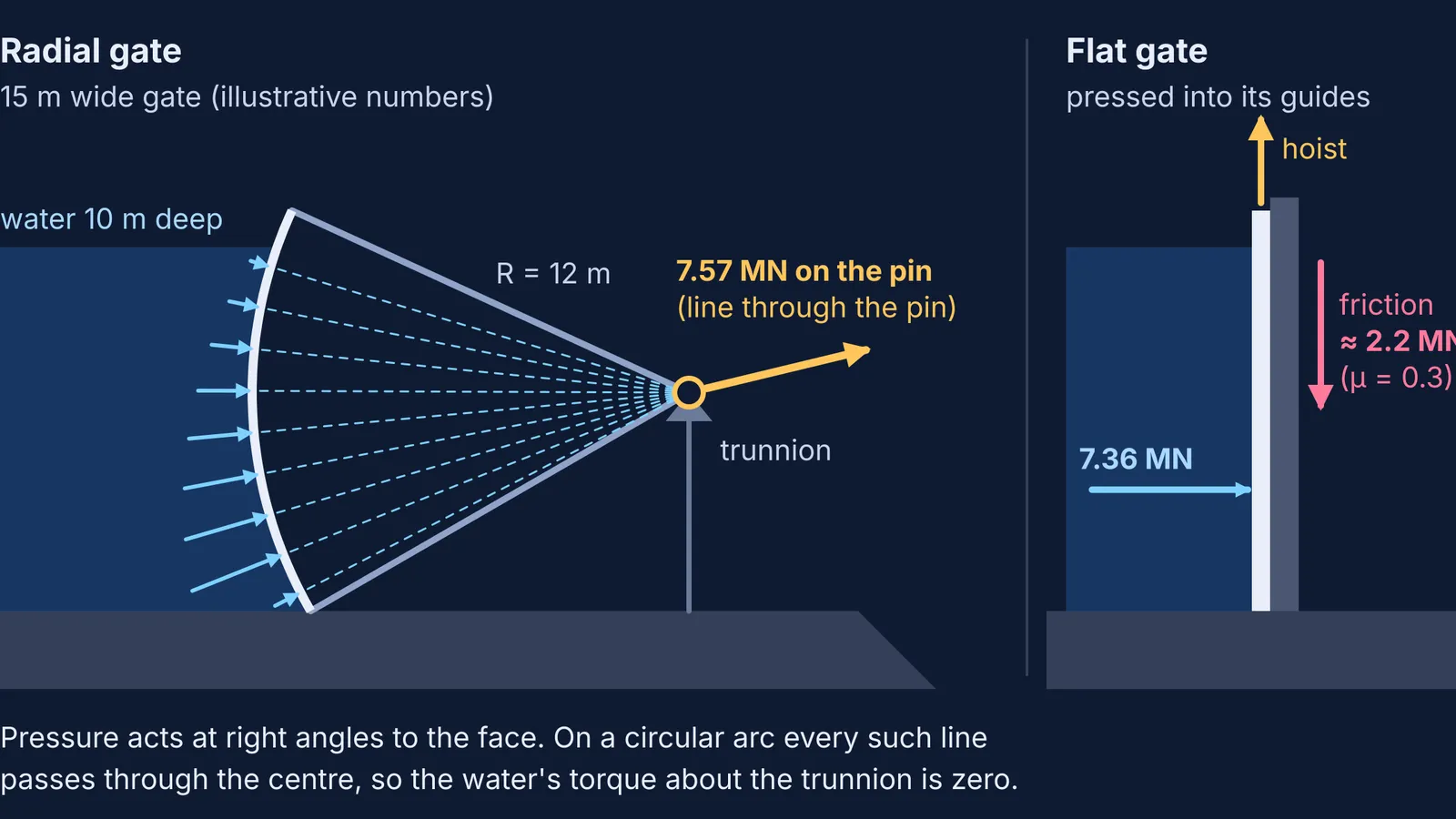
Take an illustrative gate: 15 m wide, radius R = 12 m, trunnion 6 m above the sill, water 10 m deep against it. Use ρ = 1000 kg/m³ and g = 9.81 m/s².
Pressure at the sill. p = ρgH = 1000 × 9.81 × 10 = 98.1 kPa. At the water surface it is zero.
Horizontal thrust. The horizontal force on any surface equals the force on its vertical projection, which here is a 10 m by 15 m rectangle. F_h = ½ρgH²w = 0.5 × 1000 × 9.81 × 10² × 15 = 7.36 MN. The same ½ρgh² result for a flat gate is worked in Visvesvaraya's automatic sluice gates, so it is not derived again here.
Vertical thrust. Below the trunnion level the curved face leans back over the water, so the water pushes it up. Above the trunnion level it pushes it down. Adding the two (by numerical integration in python) gives a net 1.77 MN upward.
Resultant. F = √(7.36² + 1.77²) = 7.57 MN, at tan⁻¹(1.77 / 7.36) = 13.5° above the horizontal.
Where does it act? Its line meets the arc where the radius is tilted 13.5° below the horizontal, which is 6 − 12 sin 13.5° = 3.19 m above the sill.
Units check: Pa × m² = N. The 7.57 MN resultant equals the weight of about 770 tonnes.
Why does the water's force pass through the hinge?
Two facts do all the work.
Pressure in a still fluid acts at right angles to any surface it touches. It has no sideways (shear) part.
A line at right angles to a circle passes through its centre. That is what a radius is.
So every small patch of the skin plate is pushed along a radius, towards the trunnion. A force whose line passes through a point has zero moment about that point. Add up thousands of patches and the total torque about the trunnion is still zero. The python integration for our gate returned a net torque of about 3 × 10⁻¹² N·m, which is zero to rounding.
This does not depend on the depth, the width or the liquid. Fill the reservoir higher and the force grows, but its line still passes through the pin.
The force does not vanish. It goes down the arms in compression, into the pin and then into the concrete pier. The load on the dam body itself is a separate question, covered for a large arch-gravity dam in how the Hoover Dam holds back its water.
How hard does the hoist have to pull?
With no torque from the water, the hoist has to turn the gate against three things: the gate's own weight acting about the trunnion, friction at the side seals, and friction at the trunnion pin.
Pin friction is the interesting one. The friction force at the pin is μ times the 7.57 MN reaction, but it acts at the pin's surface, only a short distance from the axis. USBR lists a typical friction coefficient of 0.3 for plain bronze bushings on a steel pin (USBR chapter G-1, table G-1-1). Take a pin radius of 0.15 m (an illustrative round value).
Friction moment. M = μFr = 0.3 × 7.57 MN × 0.15 m = 0.34 MN·m.
Force needed at the skin plate. The hoist rope acts about 12 m from the pin, so F = 0.34 MN·m / 12 m = 28 kN, the weight of about 2.9 tonnes.
Now compare a flat vertical gate of the same size that slides up in guides. The full 7.36 MN presses it into the guides. With a friction coefficient of 0.3 (an illustrative round value for comparison), the extra lifting force is 0.3 × 7.36 MN = 2.2 MN, the weight of about 225 tonnes. That is close to 80 times the radial gate's pin-friction penalty in this example.
Small does not mean negligible. On 17 July 1995 one of the eight spillway radial gates at Folsom Dam in California failed while it was being opened. The forensic team named two causes: arm members that were not stiff or strong enough, and higher trunnion friction caused by corrosion of the steel pins. USBR notes that those gates had not been designed for any trunnion friction load (USBR chapter G-1, section G-1.3).
What mistakes do students make with curved gates?
Saying the water force is zero. Only its moment about the centre is zero. The force is 7.57 MN in our example.
Taking moments about the sill or the gate's bottom edge. The pressure forces do have a moment about those points, and the integral gets messy.
Applying the zero-torque rule to a curve that is not centred on the hinge. If the arc's centre and the pin do not coincide, the rule fails.
Forgetting the vertical component. A curved face is pushed up or down as well as sideways; the resultant is not ½ρgH²w.
If you want to see how pressure on a surface turns into a resultant and a line of action, the Concept Library has the fluid pressure ideas laid out step by step. If you are curious about who designs and maintains gates like these, water resources engineering in civil: dams, floods and jobs covers the field.
Quick checklist
A radial gate is a cylindrical arc whose centre is the trunnion pin.
Pressure acts at right angles to the face, so every patch is pushed along a radius.
Each force passes through the pin, so the water's torque about it is zero at any depth.
The force itself is not zero: 7.36 MN horizontal and 1.77 MN vertical give 7.57 MN on the pin in our example.
Pin friction acts at a small radius: 0.34 MN·m, or about 28 kN at the hoist.
A flat sliding gate of the same size would need about 2.2 MN more to overcome guide friction.


