On this page
If fluids is your favourite physics chapter and you want work you can point at from a bridge, look at water resources engineering. It is the part of civil engineering that decides how much a reservoir holds, how a canal carries water to farms, when a river will flood and how a city's pipes deliver drinking water.
What is water resources engineering in civil engineering?
Water resources engineering is one of seven sections of the GATE 2026 civil engineering syllabus published by IIT Guwahati, and it has four parts: fluid mechanics, hydraulics, hydrology and irrigation. In plain terms:
Fluid mechanics and hydraulics: how water flows in pipes, pipe networks and open channels, including the hydraulic jump below a spillway.
Hydrology: rainfall, run-off, groundwater, reservoir capacity, and flood estimation and routing.
Irrigation: crop water requirements, canals, weirs, and gravity dams and spillways.
Urban water supply sits next door: the same syllabus puts water distribution systems and drinking water treatment under environmental engineering, so city water engineers draw on both.
Where do water resources engineers work in India?
India has 6,138 completed large dams and another 143 under construction, according to the Central Water Commission's National Register of Large Dams 2023. Each needs inspection and upkeep for decades, not just design.
The Central Water Commission (CWC) runs 360 flood forecasting stations and 1,543 hydrological observation stations, according to its 2026 flood preparedness presentation, up from 199 forecasting stations in 2016.
The main employers fall into four groups:
Central government. The Central Water Engineering Service is described as the only organised Group A central service dealing with the water sector, and UPSC recruits civil and mechanical engineers into it directly through the Engineering Services Examination (see the Central Water Commission overview on Wikipedia).
State water resources and irrigation departments, which plan, build and run canals and dams.
Municipal bodies and water utilities, for supply networks, treatment plants and stormwater drains.
Consultancies, contractors and hydropower companies that design and build dams, barrages and pipelines.
If a government job is your aim, read how PSU jobs after B.Tech work, through GATE and other routes. For the career at its biggest, read how K.L. Rao built major dams and planned the Ganga-Cauvery canal.
How do you specialise in water resources after B.Tech civil?
Class 11-12 with PCM, then an entrance exam such as JEE Main into a B.Tech or B.E. in civil engineering.
During B.Tech, take every fluids, hydrology and irrigation elective, and spend a summer with a state irrigation department or a water consultancy. Learn GIS early; it is in the same GATE syllabus.
An M.Tech in the area. IIT Roorkee's Department of Water Resources Development and Management offers 24-month M.Tech programmes in Water Resources Development, Irrigation Water Management, and Drinking Water and Sanitation. Check each institute's admission page for its current entry rules.
Jobs or exams: GATE for PSUs and M.Tech, the Engineering Services Examination for central service, or your state's engineering service exam.
For the wider picture, see career options after civil engineering in India.
How hard does water push on a dam? A worked example
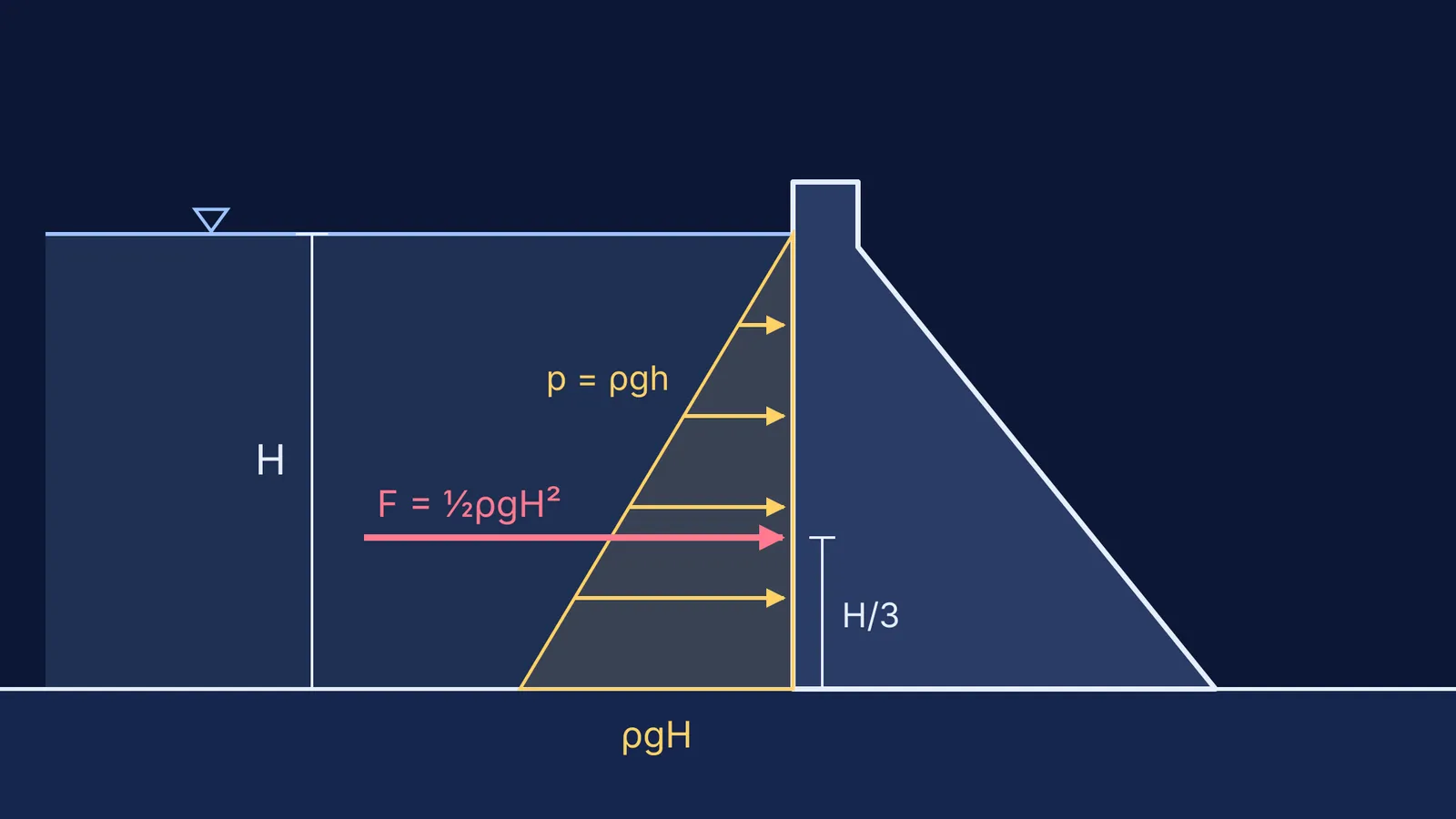
This is the first calculation in dam design, and it needs only Class 11 physics. Take a reservoir 30 m deep behind a vertical dam face, with ρ = 1,000 kg/m³ and g = 9.81 m/s².
Pressure grows with depth, p = ρgh. At the base, p = 1,000 × 9.81 × 30 ≈ 294,000 Pa, about 2.9 times atmospheric pressure.
The pressure diagram is a triangle, so the force on each metre of dam is its area: F = ½ρgH² = 0.5 × 1,000 × 9.81 × 900 ≈ 4.4 million newtons, roughly the weight of 450 tonnes.
A triangle's centroid sits a third of the way up, so F acts 10 m above the base, giving an overturning moment of about 44 MN·m per metre of dam.
Real design adds more loads, but the pressure triangle is where it starts.
If step 2 felt shaky, the Fermi Problem Library has worked problems with a step-by-step solver that explains the reasoning rather than printing an answer. If pressure itself is the gap, the Fermi Concept Library gives every concept in physics and mathematics its own lesson.
Is water resources engineering a good fit for you?
You enjoy fluids and calculus problems, not just the answers.
You are fine with site work far from cities. Monsoon months are busy: CWC's designated flood period runs from 1 June to 31 October for most basins up to the Krishna, and from 1 May in the Brahmaputra, Barak and Jhelum basins, per the same CWC presentation.
You like data and maps, because hydrology is statistics plus GIS.
You can explain a local water problem, such as a flooded underpass or a dry canal, by where the water comes from and where it goes.
Before choosing a college, ask a final-year civil student which water electives actually run and where past students interned.
Start this week: redo the dam example with your own reservoir depth.