

On this page
India’s vast network of dams, barrages, and canals represents one of the largest civil engineering undertakings in history. At the centre of this mid-twentieth-century transformation stood Dr. Kanuru Lakshmana Rao (Dr. K.L. Rao), who served both as chief designer of monumental hydraulic works and as Union Minister for Irrigation and Power. His career bridged structural mechanics and national planning, culminating in two defining feats: constructing the record-breaking Nagarjuna Sagar Dam and drafting the ambitious Ganga-Cauvery Link Canal.
Who was Dr. K.L. Rao?
Born in 1902 in Kankipadu, Andhra Pradesh, Rao overcame childhood hardships—losing his father at age nine and vision in one eye—to pursue civil engineering. He graduated from the College of Engineering, Guindy, becoming the first student to earn a master's degree in engineering from the University of Madras (K. L. Rao biography). In 1939, he completed his doctorate in reinforced concrete at the University of Birmingham in the United Kingdom.
Rao authored *Calculation, Design and Testing of Reinforced Concrete* (Pitman, 1949), a standard reference across British and Indian universities. He served as Chief Engineer at the Central Water and Power Commission before winning election to the Lok Sabha from Vijayawada for three terms. From 1963 to 1973, he served as Union Minister for Irrigation and Power under three Prime Ministers: Jawaharlal Nehru, Lal Bahadur Shastri, and Indira Gandhi. In 1963, he received the Padma Bhushan, later publishing his autobiography, *The Cusecs Candidate*.
How did K.L. Rao design the Nagarjuna Sagar Dam?
During the 1950s, modern gravity dams worldwide were cast in mass concrete using imported machinery. When designing the Nagarjuna Sagar Dam across the Krishna River, Rao made a bold choice: constructing a 124-metre-tall, 1,550-metre-long central spillway using local stone rubble masonry and surki (burnt clay pozzolana) mortar.
Built between 1955 and 1967, the dam employed tens of thousands of workers at peak construction, conserving precious foreign currency reserves. With a gross storage capacity of 11.47 billion cubic metres, Nagarjuna Sagar became the world's tallest masonry dam, irrigating over 8,000 square kilometres of parched land. Rao’s structural problem-solving mirrored Fazlur Rahman Khan and the tube design of skyscrapers and extended the regional irrigation tradition built by Arthur Cotton and the Godavari anicut.
What was the Ganga-Cauvery Link Canal proposal?
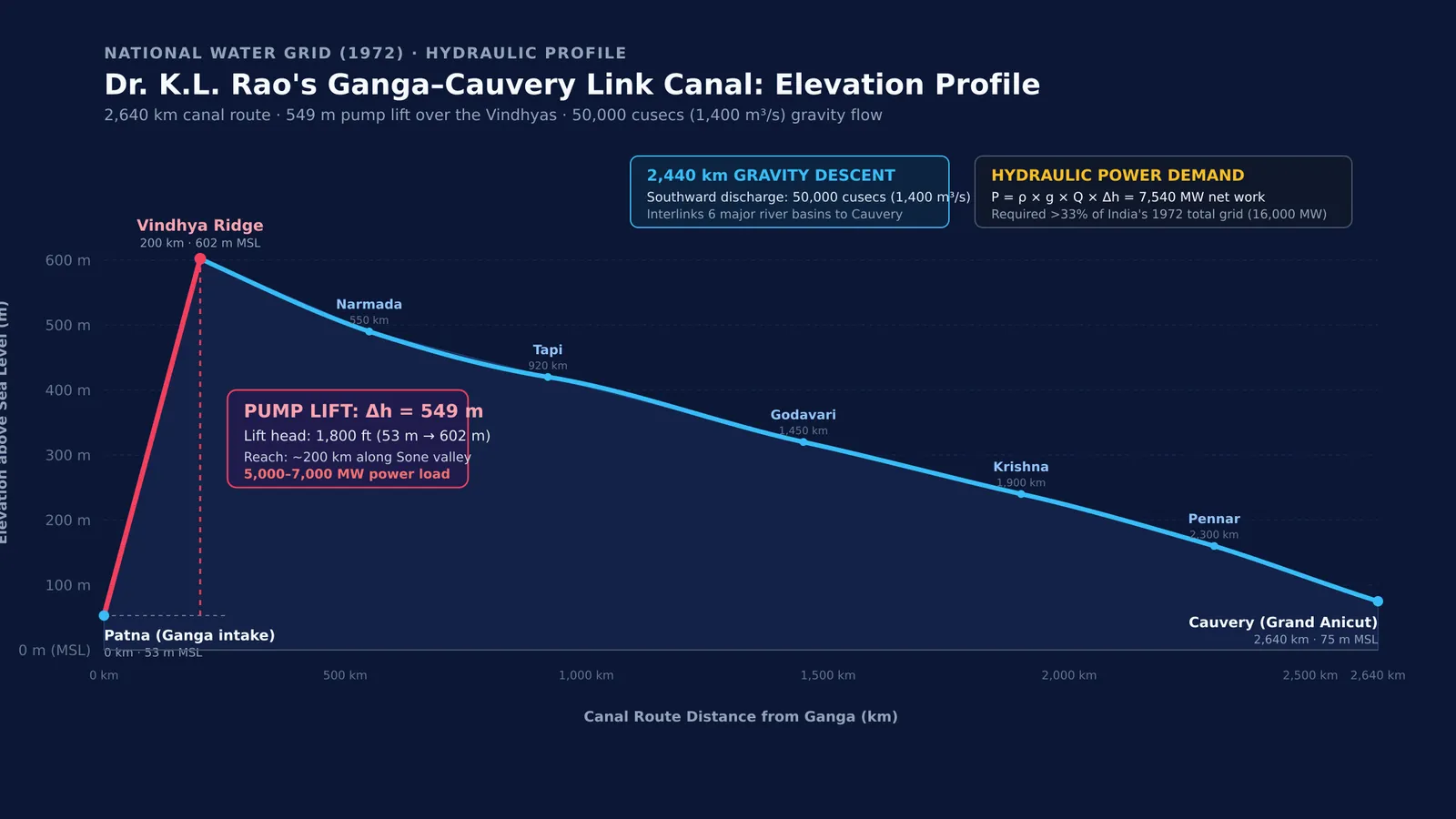
While directing national irrigation, Rao confronted the central paradox of Indian water: monsoon flooding in the northern plains alongside severe drought across peninsular basins. In 1972, he proposed a 2,640-kilometre canal connecting the Ganga near Patna to the Cauvery in Tamil Nadu (Radhakrishna, 2003).
The plan envisaged diverting 60,000 cusecs (roughly 1,680 cubic metres per second) of monsoon floodwaters for 150 days annually. While 10,000 cusecs served drought pockets in the Ganga basin, 50,000 cusecs (about 1,400 cubic metres per second) would be pumped across the Vindhyas. The canal would then flow south by gravity across the basins of the Sone, Narmada, Tapi, Godavari, Krishna, and Pennar rivers, joining the Cauvery upstream of the Grand Anicut to irrigate 4 million hectares.
Why was the 549-metre lift canal rejected?
The insurmountable barrier was gravitational potential energy (Radhakrishna, 2003). Patna sits at an elevation of 53 metres, while the Deccan plateau exceeds 600 metres. Moving 1,400 cubic metres per second across the Vindhyas required lifting the water by 549 metres (1,800 feet) over a 200-kilometre reach.
The net hydraulic power P required to lift volume discharge Q of fluid with density ρ against gravity g is:
P = ρ × g × Q × Δh
With ρ = 1,000 kg/m³, g = 9.81 m/s², Q = 1,400 m³/s, and Δh = 549 m, theoretical net hydraulic power exceeds 7,540 megawatts. Dr. Rao estimated that lifting the flow across staged pumping stations would require 5,000 to 7,000 megawatts of electric power (Radhakrishna, 2003). In 1972, India's entire power grid generated roughly 16,000 megawatts. Pumping the canal would have consumed over a third of national electricity, making the ₹12,500 crore project financially unfeasible.
How did K.L. Rao shape modern Indian river management?
Though the Central Water Commission shelved the direct canal, Rao's analysis transformed national water planning. His 1975 book, *India's Water Wealth*, provided the first comprehensive audit of India's water budget.
Recognising that massive lifts were impractical, the Ministry of Irrigation adopted the National Perspective Plan in August 1980, prioritising gravity transfers along natural river gradients. In July 1982, the government established the National Water Development Agency to study 30 river links. Today's planned Godavari-Cauvery link pursues Rao's goal while bypassing the Vindhya lift by drawing water from lower peninsular elevations.
How can students master the physics of fluid transport?
Dr. K.L. Rao's career illustrates how fundamental physical laws—hydrostatic pressure, conservation of energy, and power—govern multi-billion-rupee decisions, as seen in Pascal's law in hydraulic machines.
When calculating work done against gravity or solving fluid power problems, the Fermi Problem Library provides worked problems with a step-by-step solver that explains the reasoning rather than printing an answer. For concepts where visualising pressure heads and streamlines is difficult, the Fermi Simulation Lab offers interactive simulations for ideas that are easier to see than to read. To connect fluid mechanics with broader physics principles, the Fermi Concept Library maps every concept in physics, each with its own lesson and its place in the map.


