On this page
The Godavari carries huge floods for a few months and much less water for the rest of the year. In the 1840s Arthur Cotton called its delta, in present-day Andhra Pradesh, "so magnificent a country in such a state of ruin". Cotton, an officer of the Madras Engineers, proposed a low dam across the river near Rajahmundry to lift water into canals. This post covers how the dam was designed, what went wrong while it was built, the numbers behind it, and what a student can take from Cotton's way of working.
Who was Arthur Cotton?
A biography written by his daughter, General Sir Arthur Cotton, his life and work (1900), gives his birth date as 15 May 1803. He trained at the military seminary at Addiscombe and reached Madras in September 1821, aged eighteen. His first big works were on the Cauvery and Coleroon in Tanjore. Historian Aditya Ramesh, in The Historical Journal (2020), describes how his works on the Cauvery, starting with the old Grand Anicut, turned the Tanjore delta into one of the highest revenue-earning regions of British India.
Why build an anicut on the Godavari?
An anicut is a low dam across a river. It does not store a reservoir; it raises the water level enough to send it into canals. The 1915 Godavari District Gazetteer traces the idea back to 1789, and says it was revived in 1844 by the official Henry Montgomery. Cotton was ordered in 1845 to report on it, and the East India Company's Court of Directors sanctioned it in a despatch dated 23 December 1846.
In a letter reproduced in his daughter's biography, Cotton described surveying the river himself: "I find a site where an anicut twelve feet high will more than command the whole delta." He chose a site at Dowlaiswaram, at the head of the delta, next to a hill of sandstone that could supply the building stone.
How do you build a dam on sand?
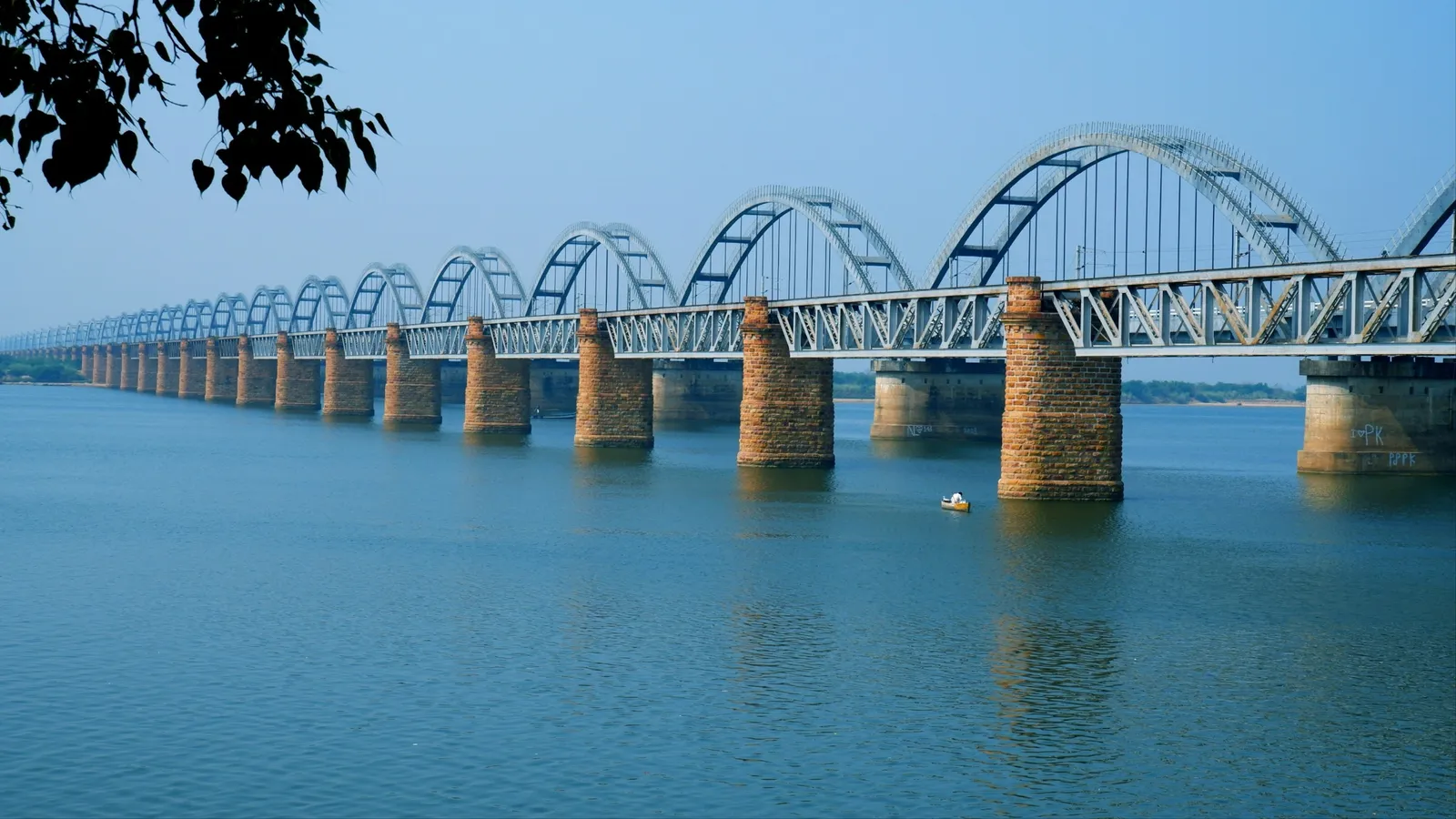
The river was nearly four miles wide there, with islands splitting it into four channels. The Gazetteer says the bed was "pure sand" and floods more than 25 feet deep swept past. There was no rock to build on.
Cotton's answer, as his daughter's biography explains, was a weir that was a stone coating over the sand of the river bed rather than a solid mass of masonry. Its model was the Grand Anicut on the Cauvery. Before work began he also switched to a broad crest with a long sloping apron of rough stone, partly because skilled masons were scarce.
Work started in April 1847, with more than 10,000 labourers gathered by July, according to the Gazetteer. In the dry months the river could be turned into one or two of its channels while the dam was built across the others. In 1850 the last open branch broke the temporary dam more than once before it was closed on 23 April. The work was virtually finished by 31 March 1852.
Did it work?
By the end of 1899, a US Geological Survey report on irrigation in India recorded 503 miles of main canals and 1,905 miles of distributaries on the Godavari system. They commanded 1,267,200 acres and actually irrigated 653,400. The report also gives the river's maximum recorded discharge at the head of the delta: 1,210,000 cubic feet per second.
The project also cost far more than Cotton said it would. He estimated twelve lakhs for the whole scheme, and the Gazetteer says flatly that he "very greatly under-estimated the cost of both dam and project". The crest also proved too low and was raised several times. Ramesh notes that a private canal company's prospectus later quoted publications that echoed "Cotton's exaggerated claims" about what irrigation could do for Indian land.
Worked example: how big is a Godavari flood?
Use the USGS figures above.
Convert the flood discharge to SI units. One cubic foot is 0.0283 cubic metres, so 1,210,000 x 0.0283168 = about 34,300 cubic metres per second.
Convert the irrigated area. One acre is 0.4047 hectares, so 653,400 acres = about 264,000 hectares.
Now a sample question. Suppose each hectare got one watering 10 cm deep (a sample figure, not a real irrigation schedule). That is 10,000 square metres x 0.1 m = 1,000 cubic metres per hectare, or about 2.64 x 10^8 cubic metres in all.
At peak flood rate: 2.64 x 10^8 / 34,300 = about 7,700 seconds, or just over two hours of flow.
The point is that the delta's problem was not the total amount of water. It was timing: the flood passes in weeks, and fields need water across a season. Raising the river so that canals can draw from it for months is what the anicut did. Discharge is area times velocity, as in our post on the continuity equation, so the same volume per second can be fast and shallow or slow and deep. A common mistake is to mix acres with hectares, or cubic feet with cubic metres, in the same line of working.
What can a student learn from Cotton's way of working?
Check your own data. In the letter quoted above, Cotton complained of "not having got one single level from my surveyors that wasn't altogether false", so he took or helped with every level himself.
Borrow from what already works. His dam on sand followed the logic of the old Grand Anicut on the Cauvery.
Keep watching after you build. The scour, the sinking apron and the low crest were found by watching the dam, and fixed over decades. For a later engineer's work on weirs and gates, read our profile of M. Visvesvaraya.
Be honest about cost. His optimism got the project built, but the Gazetteer's verdict on his estimates is a warning, too.
If unit conversions in flow problems keep tripping you up, the Fermi Problem Library has worked problems with a step-by-step solver that explains the reasoning rather than printing an answer.
Try it now: redo the worked example for one watering 5 cm deep, and say how the time at peak flow changes.