On this page
How do you store more water in a lake without building the dam higher? How do you share canal water so that more villages benefit? M. Visvesvaraya spent his career answering questions like these. This post uses his own account, Memoirs of My Working Life (1951), to explain three of his most famous pieces of work, with a short calculation of the forces involved.
Who was M. Visvesvaraya?
The Indian Biographical Dictionary of 1915 gives his birth year as 1861 and his schooling at Chickballapur and Central College, Bangalore. He took a BA from Madras in 1881, studied at the College of Science, Poona, and joined the Bombay public works service as an assistant engineer in 1884. After retiring from British service in 1909, he became Chief Engineer of Mysore and later Dewan of Mysore State.
Bengaluru's Visvesvaraya Industrial and Technological Museum says it was established in memory of Bharat Ratna Sir M. Visvesvaraya.
How did his automatic gates store more water?
Lake Fife at Khadakvasla supplied the Mutha Canal and the city of Poona. In his memoir, Visvesvaraya writes that the lake "overflowed every year up to a height of six to eight feet above the crest of the surplus weir". The surplus weir is the low section of a dam over which extra water spills.
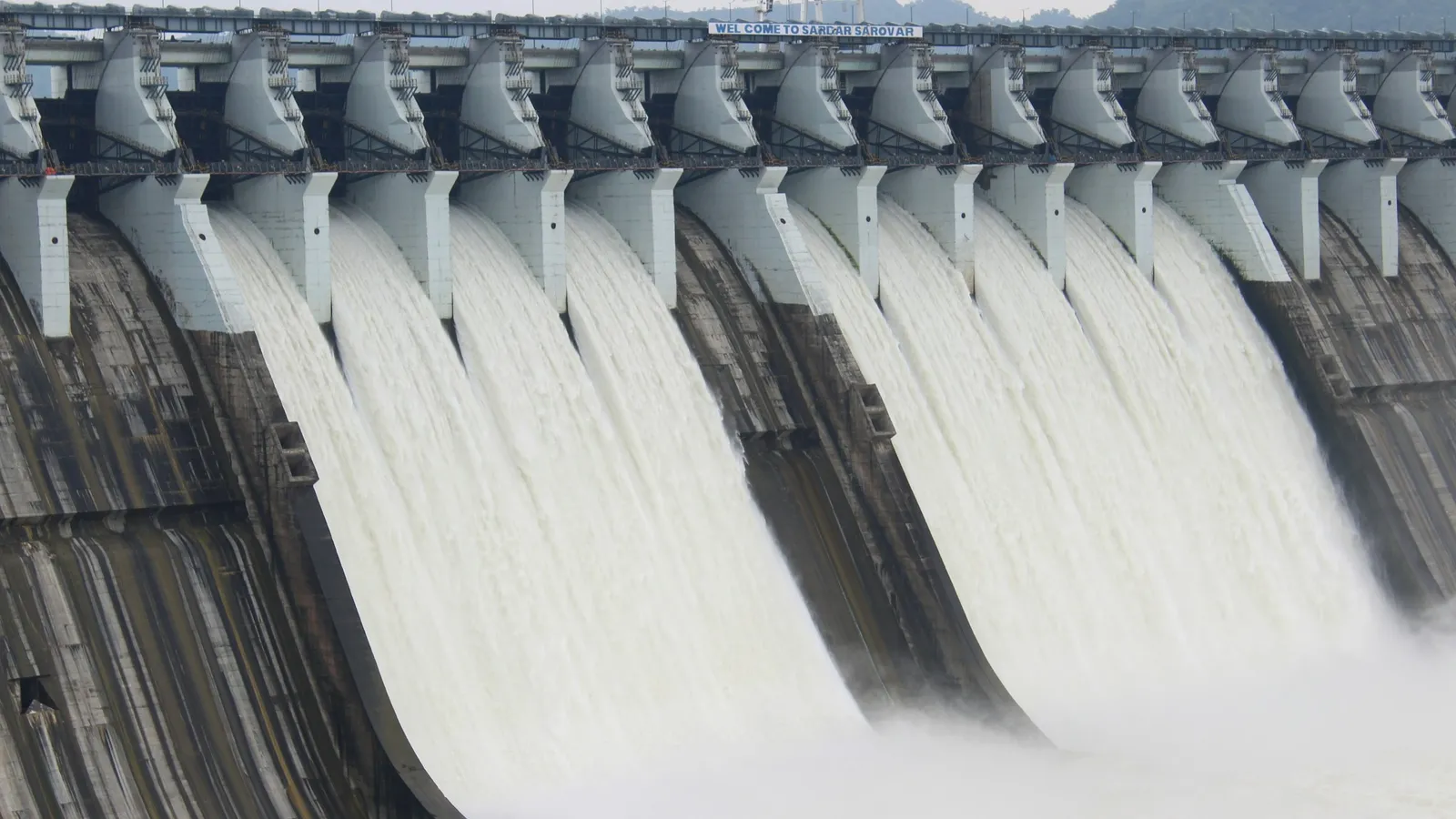
He designed a set of automatic gates that sat on the weir. They held water back until it rose to the height of earlier floods. Above that level, "the gates automatically opened and allowed the surplus water to escape", and they closed again when the water fell. The result, in his words, raised the storage level by about 8 feet and "increased the storage in the reservoir by about 25 per cent, without raising the dam".
He patented the design but writes that he refused a royalty from the government, since the work was done under his own supervision. The gates were fitted in 1901-03, and gates of the same pattern were later used at the Tigra dam near Gwalior and on the Krishnarajasagara dam.
How much force does 8 feet of water put on a gate?
This is a standard hydrostatics check, using a gate 1 metre wide and 8 feet (about 2.44 metres) tall.
Pressure rises with depth: p = rho x g x h. At the bottom, p = 1000 x 9.8 x 2.44, which is about 23,900 pascals.
Pressure is zero at the surface and largest at the bottom, so the average pressure on the gate is half the bottom value, about 12,000 pascals.
Force = average pressure x area = 12,000 x (2.44 x 1), which is about 29,000 newtons, or 0.5 x rho x g x h squared.
That is roughly the weight of three tonnes on every metre of gate width. Notice that force grows with the square of depth: double the depth and the force on the gate is four times larger. Our guide to fluid pressure and Bernoulli mistakes covers the same reasoning.
What was the block system of irrigation?
On many canals, farmers near the head took more water than they needed, and land further away went dry. Visvesvaraya prepared a scheme he called the "Block System of Irrigation". The memoir quotes the Indian Irrigation Commission of 1901-03 calling it "very complete and well considered".
A later committee described its aim: "to distribute the benefits of irrigation works over as large a number of villages as possible and at the same time to concentrate the irrigation given to each village to areas or blocks of a specified extent". The memoir quotes a 1908 statement that the system on the Nira Canal was a "complete success".
How was the Krishnarajasagara dam designed?
In Mysore, the Sivasamudram hydroelectric station on the Kaveri supplied power to the Kolar Gold Fields, about 90 miles away. The river's flow in the hot weather could drop below 100 cubic feet per second, so the supply was unreliable. Visvesvaraya planned a reservoir at Kannambadi, about 10 miles west of Srirangapatna, for both power and irrigation.
His memoir gives the design: a masonry dam 8,600 feet long and 130 feet high above the river bed, holding about 48,000 million cubic feet of water, to irrigate eventually 150,000 acres and supply power. In metric units, 130 feet is about 39.6 metres, and 48,000 million cubic feet x 0.0283 cubic metres per cubic foot is about 1.36 billion cubic metres.
The estimated first cost was Rs 253 lakhs, which he notes was more than the State had ever spent on a single project. Sanction did not come at first, and he writes that he considered leaving state service before the Maharaja approved the scheme. He later called the project "a miniature T.V.A.", after the Tennessee Valley Authority in the United States, because it combined irrigation and power.
What can a student take from how he worked?
Solve the constraint you have. He could not raise the dam, so he changed what happened at the weir.
Measure before you argue. His case for the reservoir rested on flows, power demand and irrigated area, all stated in numbers.
Design for fairness, not just output. The block system was about how water was shared, not only how much there was.
When a hydrostatics problem trips you up, the Fermi Problem Library has a step-by-step solver that explains the reasoning rather than printing an answer.
Try it now: work out the force on the same 1-metre-wide gate if the water were 16 feet deep, and check that it is four times larger.