

On this page
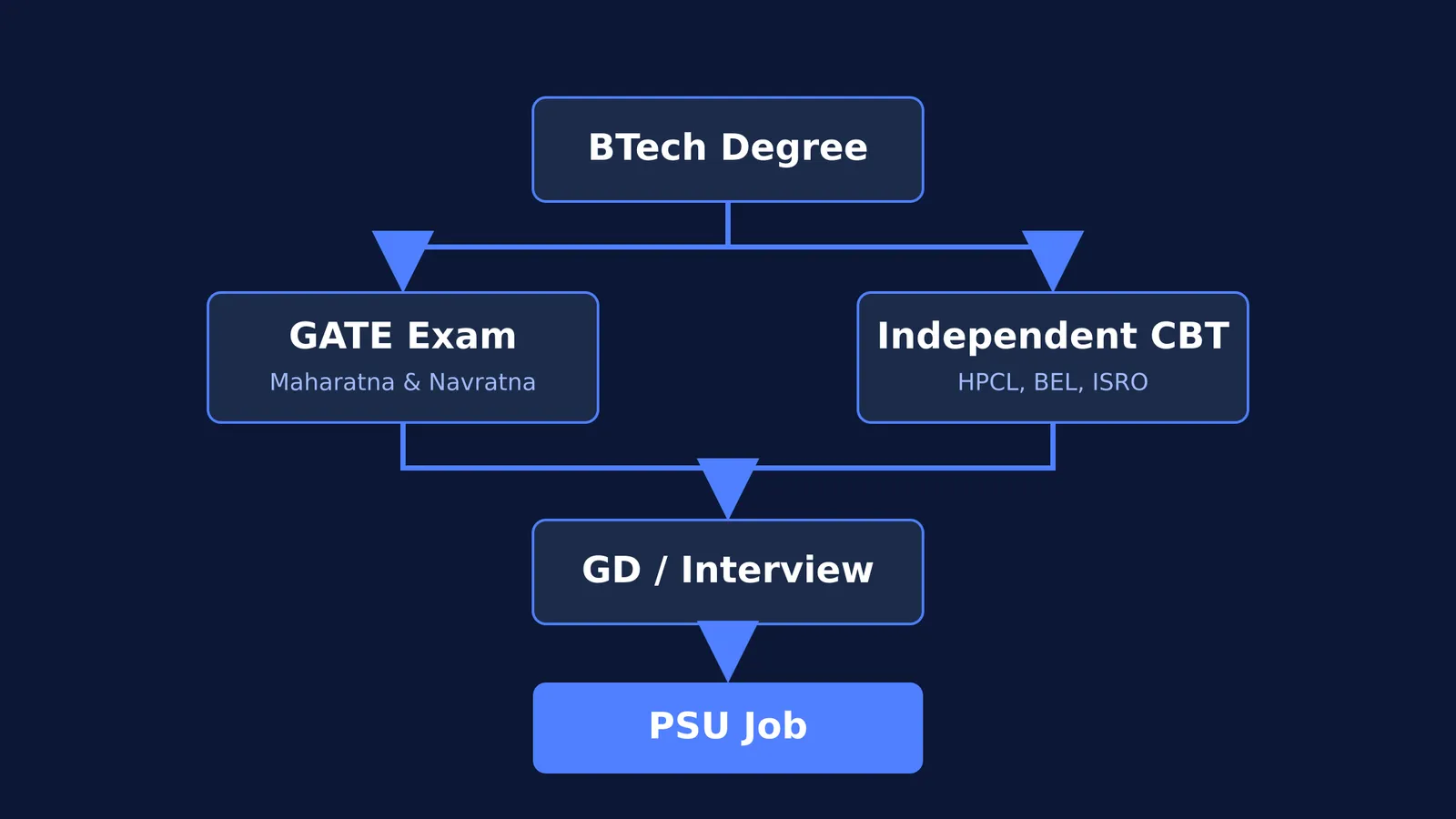
For engineering graduates, landing a job at a Public Sector Undertaking (PSU) offers job security, high pay, and the chance to work on national-scale projects. The recruitment landscape is divided into two distinct paths: companies that hire through the Graduate Aptitude Test in Engineering (GATE), and those that conduct their own independent exams.
Dozens of PSUs recruit graduate engineers every year. While GATE remains the dominant route, several major companies have recently shifted away from it, creating new opportunities for students who prefer a different exam format.
How to get PSU jobs after BTech?
Most PSU recruitment cycles follow a standard three-step process. First, candidates are shortlisted based on a written test—which is either the GATE exam or the company's own computer-based test (CBT).
Shortlisted candidates then face a Group Discussion (GD) or Group Task (GT), followed by a Personal Interview (PI). The PI focuses heavily on your final year project, industrial training, and core technical concepts. The final selection typically weights the written score heavily over the interview (GeeksforGeeks).
When you sit down to prepare, you need a clear plan—just as you would when balancing Class 12 board exams with JEE preparation. Fermi's AI tutor can work out what you already know and build a plan for the session, so you focus on the exact topics you need for these highly competitive exams.
What is the role of GATE in PSU recruitment?
The majority of India's 13 Maharatna and 25 Navratna companies use GATE scores to filter applicants (Department of Public Enterprises). If you are targeting top-tier Maharatnas like ONGC, IOCL, NTPC, or Power Grid, you generally need a top All India Rank to secure an interview call.
Most PSUs require the current year's GATE score. This means if you are applying for jobs in 2025, you must have a valid GATE 2025 score.
Because GATE tests deep conceptual understanding, surface-level memorisation will not work. If you find yourself stuck on difficult derivations or underlying principles, the Fermi Concept Library has every concept in physics, chemistry, biology, mathematics and computing, each with its own lesson and its place in the map.
Which PSUs recruit without GATE?
A growing number of major organizations now conduct their own independent exams. This is a crucial lifeline if your GATE attempt did not go as planned. Major organizations that frequently recruit without GATE include (Adda247):
Hindustan Petroleum (HPCL): Conducts its own CBT and group tasks.
Bharat Electronics (BEL): Recruits Probationary Engineers via independent exams.
ISRO and BARC: Both conduct their own rigorous technical tests.
Airports Authority of India (AAI): Hires Junior Executives through its own CBT.
Independent PSU exams are usually split between technical questions and general aptitude. If you need to practice numericals for these exams, the Fermi Problem Library has worked problems with a step-by-step solver that explains the reasoning rather than printing an answer.
What are the branch requirements?
PSUs are strict about branch eligibility. You must appear for the GATE paper that exactly matches your BTech degree (GeeksforGeeks). For instance, if you have a degree in Electronics and Communication, you cannot apply for roles meant strictly for Electrical Engineering. Interdisciplinary branches or specialized degrees often face limited options unless explicitly stated in the notification.
The core branch requirements for top recruiters are:
Mechanical (ME): ONGC, IOCL, NTPC, BHEL, GAIL, and SAIL.
Civil (CE): NHAI, NTPC, ONGC, PGCIL, and RITES.
Electrical (EE): PGCIL, NTPC, IOCL, and NHPC.
Computer Science (CS): BARC, ISRO, ONGC, BEL, and AAI.
A framework for your PSU strategy
To maximize your chances, divide your preparation using this framework:
Phase 1 (August to February): Focus entirely on GATE. Since the syllabus for GATE covers the entire technical syllabus for any other PSU exam, this preparation serves as your baseline.
Phase 2 (March to May): Once GATE is over, shift your focus to non-technical subjects like quantitative aptitude, logical reasoning, data interpretation, and current affairs. These sections make up a significant portion of independent PSU exams like HPCL and BEL, and they often determine who makes the final cut when technical scores are closely tied. Practice these sections daily to improve your speed and accuracy.
Phase 3 (June onwards): Monitor individual PSU websites for independent exam notifications. As exam dates approach, set up a schedule that respects whether you do your best work as a morning or night study session, and take your mock tests during the actual hours of the exam you are targeting to condition your body clock.
By balancing GATE preparation with a readiness for independent exams, you keep multiple doors open for a career in the public sector.