On this page
The Hoover Dam stands 726.4 feet (about 221 m) from foundation rock to the roadway on its crest, spanning the Colorado River between Arizona and Nevada, according to the US Bureau of Reclamation's Hoover Dam FAQ. Work began on 20 April 1931 and all features were finished by 1 March 1936. The dam is a lesson in three ideas from Class 11 physics: weight, the arch, and pressure that grows with depth. A fourth idea, that setting concrete gets hot, shaped how it was built.
What kind of dam is the Hoover Dam?
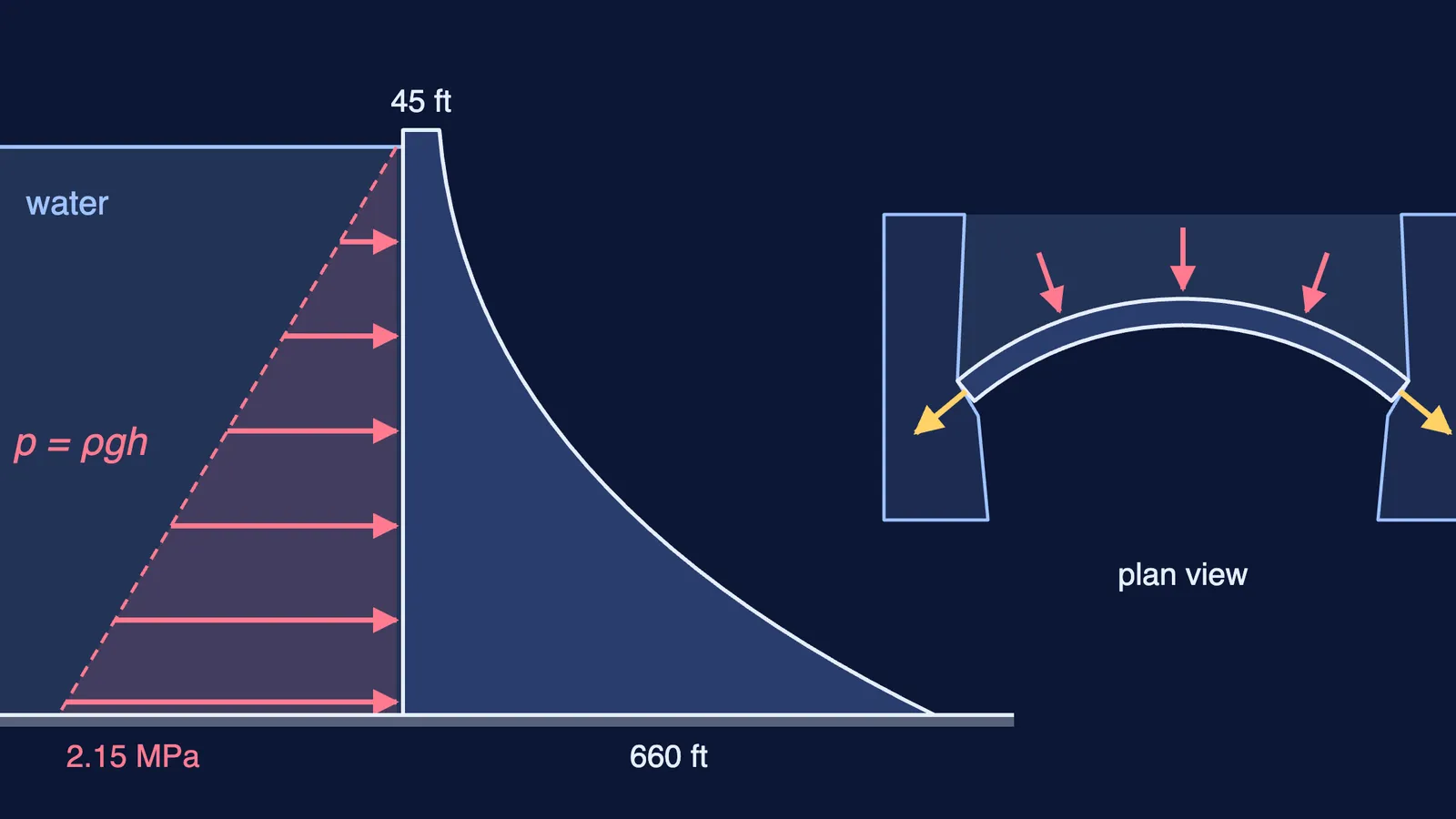
Reclamation describes it as "a concrete arch-gravity type, in which the water load is carried by both gravity action and horizontal arch action" (Hoover Dam FAQ). Those are two different ways of resisting the same push.
Gravity action: the dam weighs more than 6,600,000 tons, so its own weight presses it onto the rock and resists sliding and tipping.
Arch action: the dam curves between the canyon walls. As the National Park Service explains, water pushing on the concrete sends compressive forces along the wall into the cliffs on both sides.
How does water pressure change with depth?
The pressure due to the weight of a liquid at depth h is P = hρg, where ρ is the liquid's density and g is the acceleration due to gravity (OpenStax College Physics, section 11.4). It grows in a straight line with depth. This is gauge pressure, the pressure relative to atmospheric pressure (OpenStax, section 11.6). Our post on gauge pressure vs absolute pressure explains the difference.
OpenStax makes the point with a dam: the force on it depends only on the water's depth and the dam's size, not on how far the reservoir stretches. Lake Mead extends about 110 miles upstream when its surface is at elevation 1,221.4 feet (Reclamation's Lake Mead FAQ), yet the dam feels only the depth.
Worked example: how hard does the water push on the Hoover Dam?
Reclamation gives the maximum water pressure at the base of the dam as 45,000 pounds per square foot (Hoover Dam FAQ). One pound-force per square foot is 47.88 pascals (NIST conversion factors), so that is about 2.15 MPa. Take ρ = 1000 kg/m³ and g = 9.8 m/s².
Find the depth. h = P / (ρg) = 2.15 × 10⁶ / 9800 ≈ 220 m. That is close to the dam's full 221 m height, so the figure is for water standing near the top.
See the straight line. The gauge pressure is about 0.49 MPa at 50 m and 0.98 MPa at 100 m. Standard atmospheric pressure is 1.013 × 10⁵ Pa (same NIST table), so the base feels about 21 atmospheres.
Add up the force. Pressure rises from zero to its maximum, so the average is half the maximum. On a strip of dam 1 m wide, F = ½ρgH² = ½ × 1000 × 9.8 × 220² ≈ 2.4 × 10⁸ N, about the weight of 24,000 tonnes.
Find where it acts. The pressure diagram is a triangle, so the total force acts one-third of the way up, about 73 m above the base. That is the lever arm trying to tip the dam.
This triangle explains the shape. The Reclamation education page says the dam is 660 feet (about 201 m) thick at the bottom and 45 feet (about 14 m) wide at the top: thick where the push is greatest, thin where it is nearly zero.
To watch pressure grow with depth, the Fermi Simulation Lab has interactive simulations for ideas that are easier to see than to read. For JEE-style "force on a dam wall" questions, the Fermi Problem Library has worked problems with a step-by-step solver that explains the reasoning rather than printing an answer.
Why did the Hoover Dam's concrete need cooling as it cured?
Curing concrete gives off heat. Reclamation says that if the dam had been built in a single continuous pour, it would have taken 125 years for the concrete to cool, and the resulting stresses would have made it crack and crumble (Reclamation essay on the concrete). So the dam was built as a series of separate columns.
Small blocks. Reclamation estimates the dam is made of about 215 blocks, from about 60 feet square at the upstream face to about 25 feet square at the downstream face, and concrete placement in any one block was limited to five feet in 72 hours (Hoover Dam FAQ).
Pipes inside. More than 582 miles of 1-inch steel pipe were embedded in the concrete (same FAQ). River water ran through them first, then chilled water from a refrigeration plant (the essay); the FAQ says the plant could produce 1,000 tons of ice in 24 hours.
Grout last. Cooled concrete shrinks, opening gaps between columns. Workers forced grout into those joints, bonding the dam into one monolithic structure; the FAQ says cooling was completed in March 1935.
Concrete runs on a clock from the moment it is mixed; our post on why a concrete mixer truck keeps rotating shows the same race at a smaller scale.
The water held back here also makes electricity; read how dams make electricity from falling water for what happens next.