

On this page
You have seen one at a signal: a truck with a striped drum, still turning while it waits. The drum is buying time against a chemical clock, and the blades inside are a screw that works both ways.
Why does a concrete mixer truck keep rotating?
Ready-mixed concrete is cement, sand, stone and water, and once the water goes in, the cement starts to react. The Bureau of Indian Standards code for ready-mixed concrete, IS 4926:2003, asks that it be transported by methods that “will maintain the required workability and will prevent segregation”. In plain words: it must stay pourable, with no stones settling out of the paste.
The same code defines a truck mixer as one “capable of mixing the ingredients of concrete and of agitating the mixed concrete during transportation”. When concrete has been mixed before leaving the plant, it must be agitated during transit and re-mixed at the site for at least 2 minutes.
So the turning keeps the mix uniform and moving. It does not stop the chemistry.
What is happening to the cement inside the drum?
Cement hardens by hydration: its calcium silicates react with water to form calcium silicate hydrate (C-S-H) and crystals of calcium hydroxide, as University of Memphis civil engineering course notes explain.
The same notes track the reaction by the heat it gives off. There is a burst of rapid heat in roughly the first 15 minutes, then a dormant period of about 2 to 4 hours in which the cement stays plastic, then an acceleration in which the silicates hydrate rapidly and early hardening begins.
That dormant period is the window a ready-mix truck lives in. Indian cement standards test for it: for 33 grade ordinary Portland cement, IS 269:2013 requires an initial setting time of at least 30 minutes and a final setting time of no more than 600 minutes, measured on cement paste in a lab. Gypsum is added to cement partly to control how fast it sets; our explainer on the composition of Portland cement and why gypsum is added covers that chemistry.
How long can concrete stay in a transit mixer?
IS 4926:2003 says concrete should be discharged from the truck mixer within 2 hours of loading. The clock starts when mixing water is added, not when the truck leaves. A longer period may be allowed with retarding admixtures, in cool humid weather, or for chilled concrete. The code also asks the buyer to plan so that a full load can be discharged within 30 minutes of arriving on site.
When the truck itself does the mixing, the code sets a minimum unless there is data to justify something else: at least 60 revolutions of the drum, at not less than 7 revolutions a minute.
How do the spiral blades in the drum work?
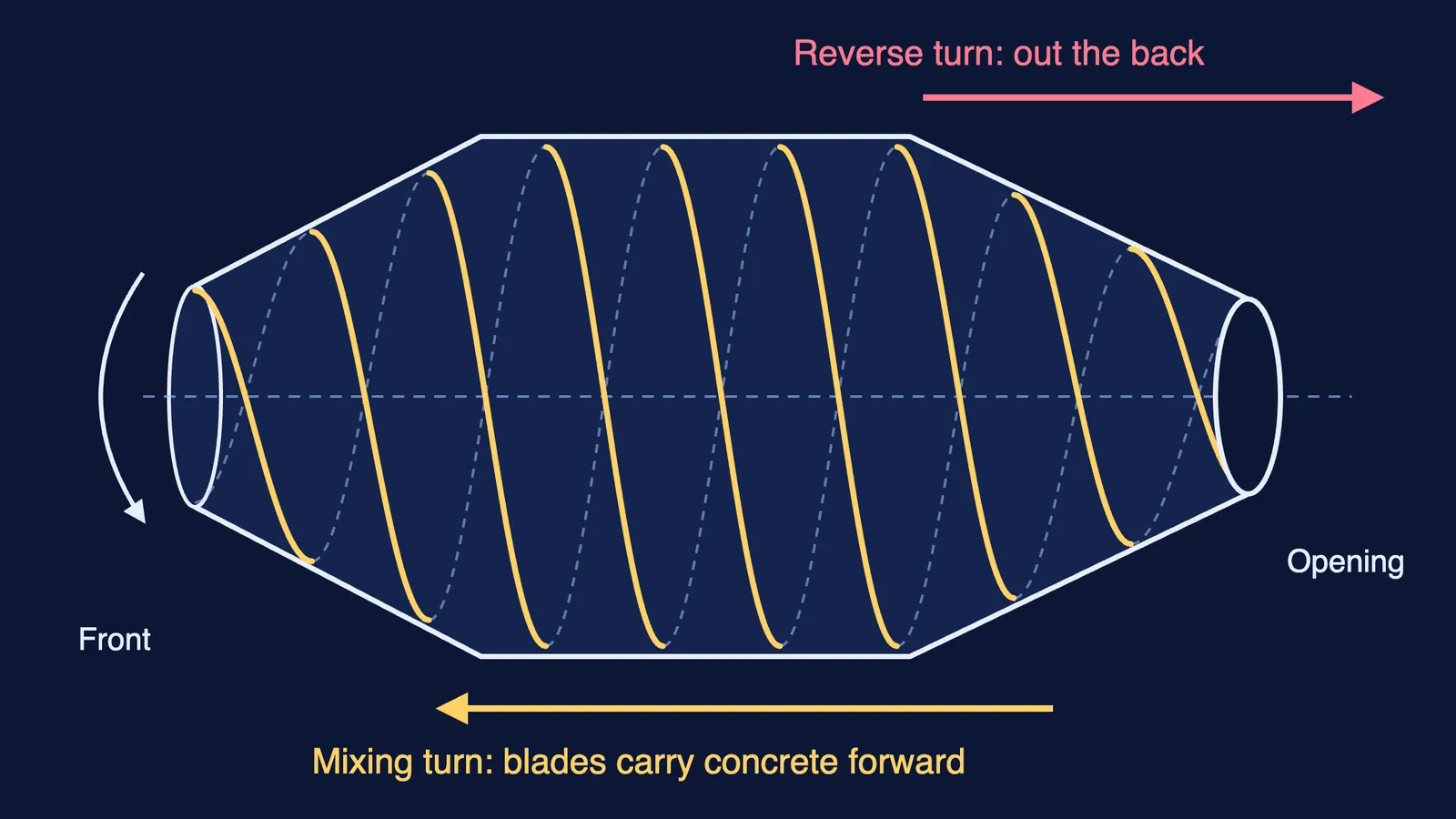
Inside the drum, blades fixed to the wall run in a spiral, like the thread of a screw. A mixer drum patent, US 9,427,714, describes two spiral blades set 180° apart that, when the drum turns normally, carry the concrete from the rear to the front while stirring it; when the drum turns in reverse, they carry it from the front to the rear and out of the opening. An older transit mixer patent, US 2,805,053, describes the same rearward discharge.
The drum is tilted so its rear opening points diagonally upward, as the US 9,427,714 patent notes. With the blades pushing the mix forward, the load stays in until the drum reverses. IS 4926:2003 says blades must be renewed or replaced when wear brings their height below two-thirds of the original.
This is the idea behind the Archimedes screw that lifts water: a helix turning about its axis moves material along that axis, and reversing the turn reverses the flow. If a turning helix is hard to picture, the Fermi Simulation Lab has interactive simulations for ideas that are easier to see than to read.
Worked example: does this load make the 2-hour window?
Using the limits in IS 4926:2003, say a site in Pune orders a load, and water meets cement in the truck at the plant at 9:00.
Mixing in the truck: 60 revolutions at 7 revolutions a minute takes 60 ÷ 7 ≈ 8.6 minutes, so the truck leaves at about 9:09.
Drive: 75 minutes through city traffic, arriving at 10:24.
Re-mix on site for 2 minutes: ready at 10:26.
Deadline: 9:00 plus 2 hours is 11:00. That leaves 34 minutes, enough for the 30-minute discharge the code asks the buyer to plan for.
Now add a 45-minute wait because the pump is not ready. Discharge would start at 11:11, past the deadline, however steadily the drum turns. The fixes are planning, not turning: have the pump ready before the truck leaves, or agree a retarding admixture with the supplier in advance.
To go further into hydration and setting, the Fermi Concept Library covers every concept in chemistry, each with its own lesson and its place in the map.


