On this page
Cement questions in chemistry and civil engineering courses usually come down to two things: what is in the grey powder, and why a few percent of gypsum goes into it. Here is the answer, with numbers from India's own cement standard and a worked calculation to try.
What is Portland cement made of?
Portland cement starts as limestone and clay, burned in a kiln at about 1300 to 1500 °C until it partly fuses into lumps called clinker, according to the Bureau of Indian Standards cement compendium. The clinker is cooled and ground to a fine powder with about 3 to 5 percent gypsum. Under IS 269, the only materials that may be added after burning are gypsum, water and at most 1.0 percent of approved agents such as air-entraining or colouring agents. Performance improvers such as fly ash, up to 5 percent in total, may also be added at grinding.
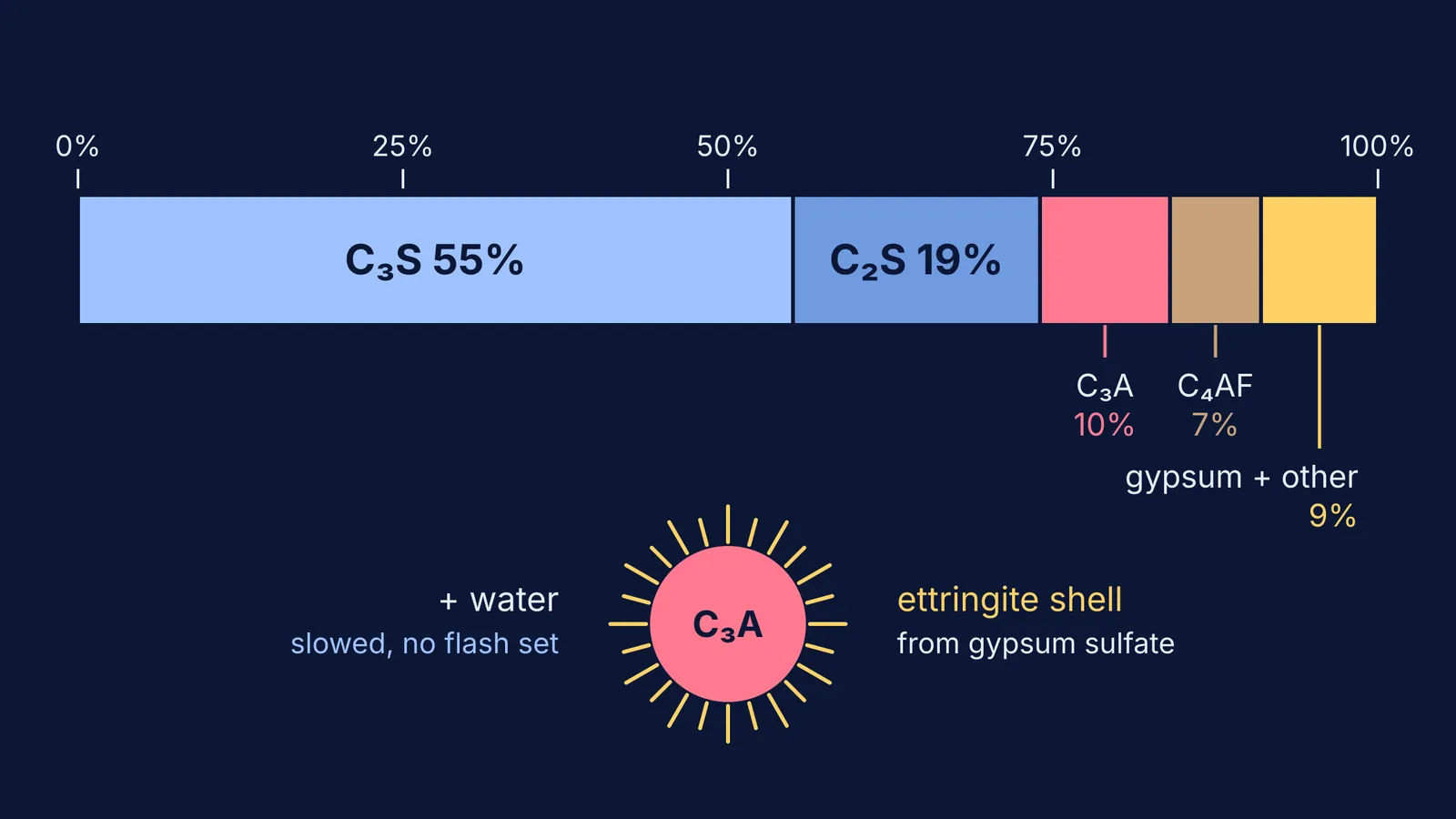
Chemists write the clinker minerals in shorthand, where C is CaO, S is SiO2, A is Al2O3, F is Fe2O3 and H is H2O, in cement chemist notation. A typical Type I Portland cement contains about 55% C3S, 19% C2S, 10% C3A and 7% C4AF, according to the Portland cement entry:
C3S, tricalcium silicate (alite): the main phase and the main source of early strength.
C2S, dicalcium silicate (belite): reacts slowly and adds strength later.
C3A, tricalcium aluminate: a small share that reacts very fast with water.
C4AF, tetracalcium aluminoferrite: the iron-bearing phase.
What happens when cement meets water?
Setting is hydration: clinker minerals dissolve and new, water-bearing solids grow from the solution, turning paste into a solid, as the Portland cement entry describes.
The silicates do most of the work:
Alite: 2 C3S + 7 H → C3S2H4 + 3 CH, with heat released (calcium silicate hydrate).
Belite: 2 C2S + 4 H → C3S2H3 + CH (cement chemist notation).
C-S-H, calcium silicate hydrate, is the main binding phase, the "glue" that gives concrete its strength; CH is calcium hydroxide. A 2016 Nature Communications study by Pustovgar and colleagues calls tricalcium silicate the principal component responsible for strength and describes C-S-H as poorly crystalline and nanostructured. Alite gives most of the early strength, in roughly the first 7 days; belite, which reacts more slowly, adds strength later, according to the calcium silicate hydrate entry.
Why is gypsum added to cement?
Left alone, C3A reacts with water so fast that the paste stiffens almost at once. This is called flash set, and gypsum is added to prevent it, as the Portland cement entry notes. Sulfate from the dissolving gypsum reacts with C3A to form ettringite, a needle-shaped mineral that builds a thin film over the C3A grains and slows their hydration, according to the ettringite entry.
The brake runs out. Alexandra Quennoz and Karen Scrivener followed C3A and gypsum mixtures with X-ray diffraction and found that once the gypsum is used up, ettringite and C3A rapidly dissolve and form monosulfoaluminate phases (Cement and Concrete Research, 2012). So the gypsum dose has to suit the C3A content: too little and the brake is gone early, while the total sulfate allowed is capped by the standard, as the IS 269 tables in the BIS cement compendium show.
How do you calculate C3A and C3S from an oxide analysis?
IS 269 gives Bogue-type formulas for cement used in railway sleepers, which must have C3A of at most 10.0 percent (9.0 for the OPC 43S and 53S grades) and C3S of at least 45.0 percent (BIS compendium). Each symbol is the oxide's percentage by mass of the whole cement:
C3A = 2.65 (Al2O3) − 1.69 (Fe2O3)
C3S = 4.07 (CaO) − 7.60 (SiO2) − 6.72 (Al2O3) − 1.43 (Fe2O3) − 2.85 (SO3)
Try it on a made-up sample: CaO 64.0%, SiO2 21.0%, Al2O3 5.0%, Fe2O3 3.0%, SO3 2.5%.
C3A = 2.65 × 5.0 − 1.69 × 3.0 = 13.25 − 5.07 = 8.2%.
C3S = 4.07 × 64.0 − 7.60 × 21.0 − 6.72 × 5.0 − 1.43 × 3.0 − 2.85 × 2.5 = 260.48 − 159.60 − 33.60 − 4.29 − 7.13 = 55.9%.
Check the limits for OPC 33, 43 or 53: C3A is under 10, C3S is over 45 and SO3 is under 3.5, so this sample meets all three.
How should you revise this for exams?
Before a test, check that you can:
Name the four clinker phases, their shorthand and one job each.
Write the alite and belite hydration equations.
Explain flash set: C3A reacts fast, ettringite coats it.
Say what forms when gypsum runs out: monosulfoaluminate.
Run the Bogue calculation without notes.
If a step in the chain feels shaky, the Fermi Concept Library has a lesson for every concept in chemistry, with its place in the map. For calculations, the Fermi Problem Library has worked problems with a step-by-step solver that explains the reasoning rather than printing an answer.