On this page
More than two thousand years ago, farmers in the Nile Delta were already lifting river water into their fields with a turning helix. The Greek historian Diodorus wrote that the people of the Delta "easily irrigate its whole area by means of a contrivance which was invented by Archimedes of Syracuse and is called, after its shape, a screw" (Diodorus Siculus, Library of History 1.34). The same idea has since drained Dutch polders and now lifts sewage in treatment plants.
How does an Archimedes screw lift water?
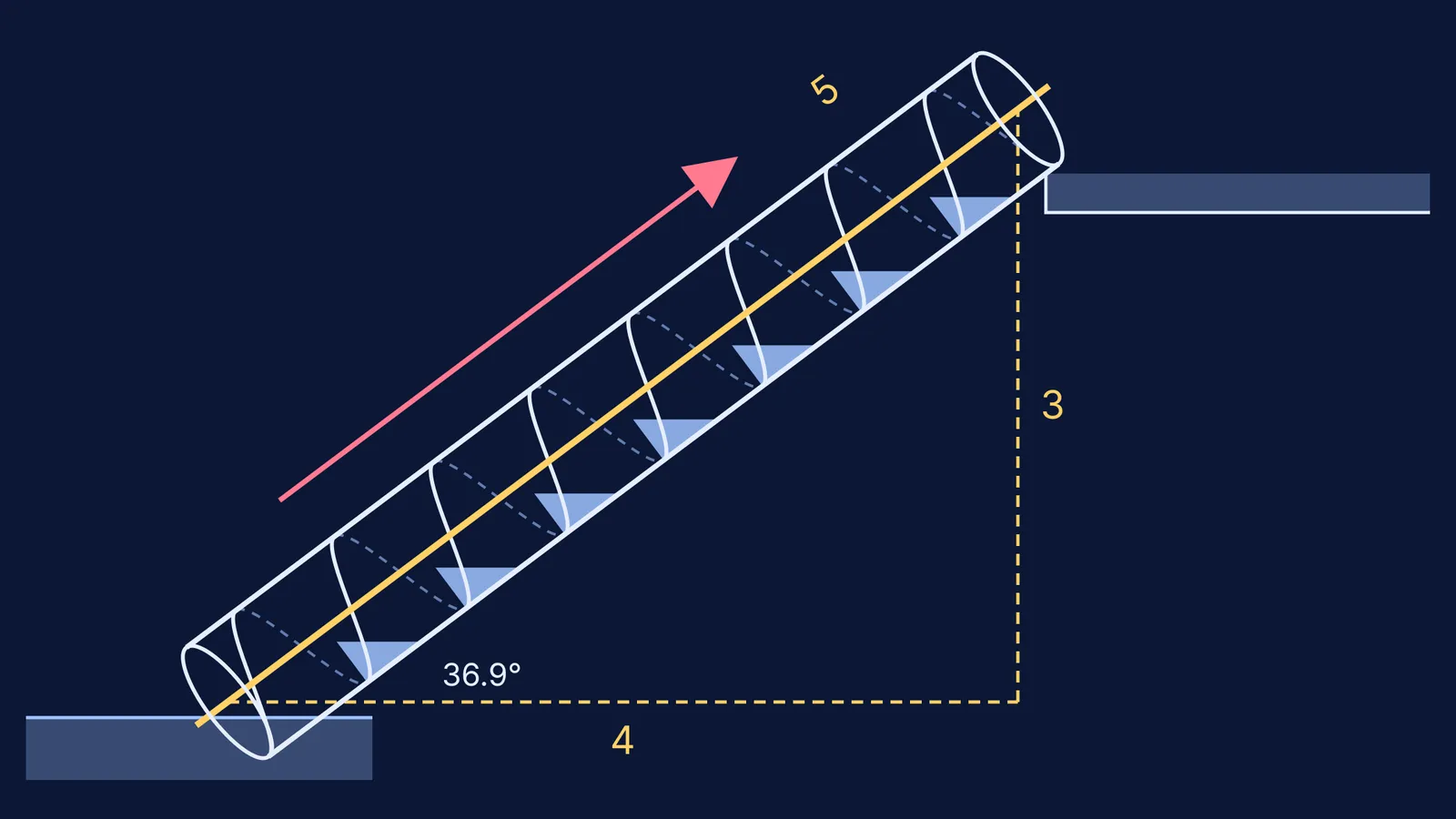
An Archimedes screw is a helical blade wound round a central shaft inside a tube, with the lower end dipped in water (Wikipedia: Archimedes' screw). Follow one turn of the blade and the trick appears:
Tilt the tube. Each turn of the blade now has a lowest point, near the bottom of the tube.
Water from the intake settles in that low corner, resting on the turn of blade below it, with a level surface.
Turn the shaft. The low corner of every turn moves up the tube, and the pocket moves with it.
At the top, the last pocket spills into a channel; a fresh one fills at the bottom on every turn.
The key point: the water never flows uphill. Each pocket always sits in a local valley; the screw just moves the valley.
If a helix is hard to picture from a flat page, the Fermi Simulation Lab has interactive simulations for ideas that are easier to see than to read.
Why does the tilt angle matter?
The Roman engineer Vitruvius gave a rule in his book on architecture: the screw should lean like the Pythagorean right triangle, so that if its length is divided into five parts, the top is raised by three of them (Vitruvius, On Architecture, Book X, chapter 6). He also describes eight channels wound round the shaft. A 3-4-5 slope means sin of the angle is 3/5, so the tilt is about 36.9 degrees.
The trade-off is geometry:
Too steep, and a turn of the blade no longer has a low corner, so the pockets spill backwards.
Too shallow, and you need a very long screw to gain a little height.
How much power does an Archimedes screw need?
Say a farmer wants to lift 600 litres of water every minute into a channel 3 m above a canal, using a 5 m screw at Vitruvius's slope.
Flow: 600 litres per minute is 10 litres per second. A litre of water has a mass of about 1 kg, so that is 10 kg every second.
Work per second: lifting mass m through height h takes m x g x h. With g = 9.8 m/s squared: 10 x 9.8 x 3 = 294 joules every second.
Power: 294 J/s is 294 watts of useful output.
Real input: assuming the screw is 75% efficient (a round figure for this example), the farmer must supply 294 / 0.75, about 392 W.
The screw's diameter and speed set how much water moves per turn, but the energy cost is fixed by mass, g and height. Practise the same idea with the power used climbing stairs, and compare the screw with how a hand pump lifts water.
If the step from "pockets of water" to m x g x h still feels slippery, the Fermi Problem Library has worked problems with a step-by-step solver that explains the reasoning rather than printing an answer.
Where are Archimedes screws still used today?
Spaans Babcock, a screw-pump maker, lists the reasons on its advantages of screw pumps page:
It can pump raw sewage without a coarse screen first; floating debris and heavy solids are simply lifted up.
It regulates itself: when the incoming water level drops, it automatically pumps less, so no control system is needed.
Its efficiency curve is flat on top, staying high even at 50% of capacity.
It can keep running when there is no water at the inlet, and lifetimes of 20 to 40 years are not unusual.
These are a manufacturer's claims, but they match the general account that screws suit sewage because they cope with varying flow and suspended solids (Wikipedia).
Scale is the other story. Mathematician Chris Rorres describes the J.U. Smitgemaal pumping station at Kinderdijk in the Netherlands, built in 1972 to drain polders into the Lek river; its three diesel-driven screws have a capacity of 1.35 million litres per minute (Rorres, Modern applications of Archimedes' screws).
Run the screw backwards, letting water fall through it, and it becomes a turbine; a 2015 review by Shaun Waters and George Aggidis traces this revival from pump to turbine (Waters and Aggidis, Renewable and Sustainable Energy Reviews).
To see it yourself, wrap clear tubing in a spiral round a bottle, dip one end in coloured water, tilt and turn. Then tilt steeper until the pockets stop climbing.