

On this page
Feel your pulse at the neck and then at the wrist, and the wrist beat comes a moment later. What travels is not blood racing along. It is a pressure wave on the elastic artery wall, and its speed is set by the same two things as a wave on a guitar string: stiffness and mass. That speed is called the pulse wave velocity, and doctors measure it because it tells them how stiff the large arteries have become.
What is pulse wave velocity?
When the left ventricle contracts, it pushes blood into the aorta faster than blood can leave at the far end. The aortic wall just beyond the heart bulges out. The stretched wall then pushes back, squeezing blood into the next stretch of artery, which bulges in turn. This bulge passes down the artery like a ripple. Pulse wave velocity is the speed of that ripple.
The blood itself moves much more slowly than the bulge, just as a wave crosses a rope quickly while each bit of rope only moves up and down.
Why does a stiffer artery carry the pulse faster?
For a wave on a string, v = √(T/μ): a larger restoring force (tension T) speeds the wave up, and a larger mass per length (μ) slows it down. If that formula is new, start with wave speed in a wire from stress and density.
An artery works the same way. The restoring force comes from the wall: its elastic modulus E and its thickness h. The inertia comes from the blood, of density ρ, inside a tube of diameter D. For a thin elastic tube filled with liquid, the Moens–Korteweg equation gives
c = √(Eh/(ρD))
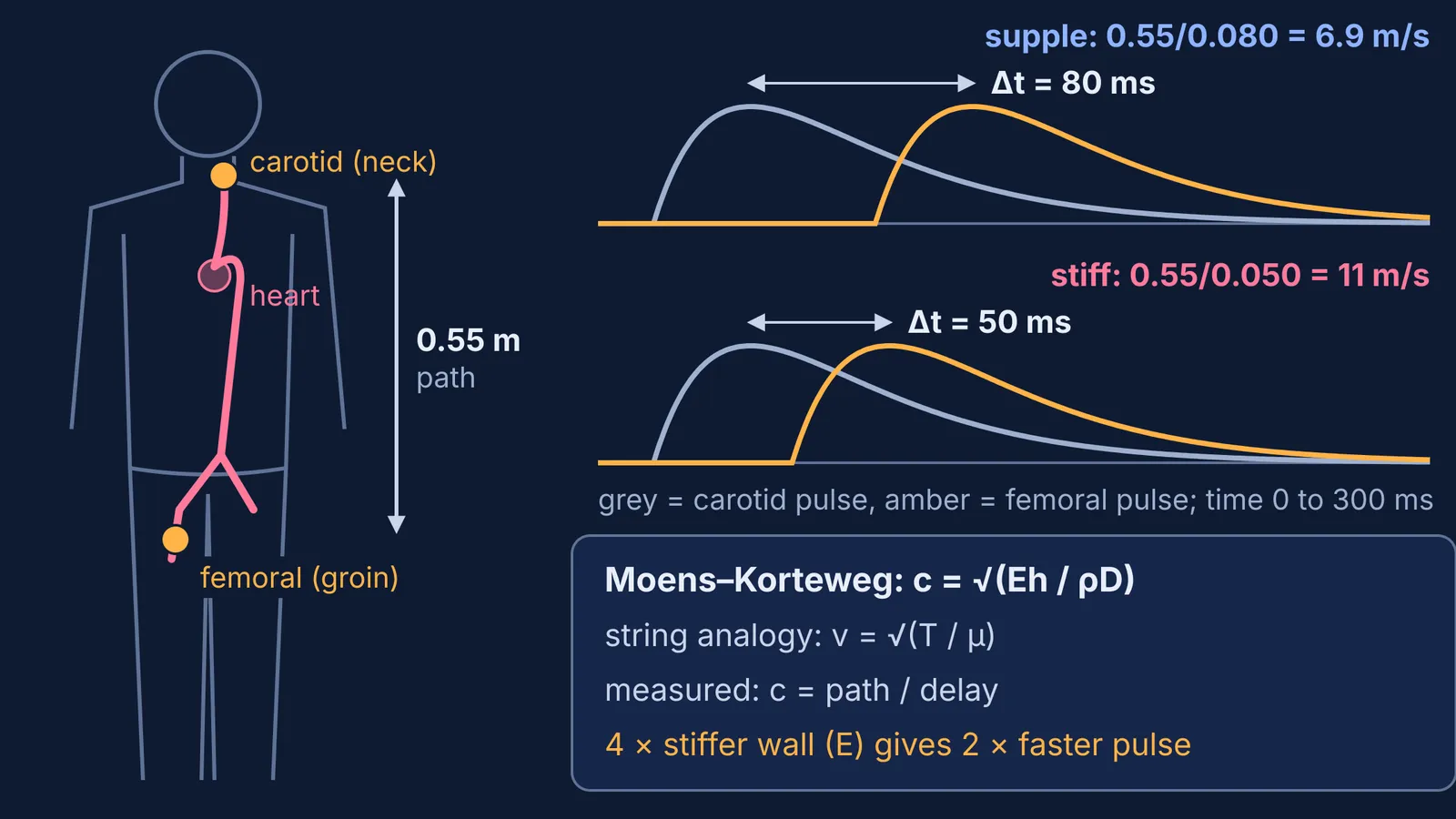
Units: Eh is in N/m and ρD in kg/m², so Eh/(ρD) is in N·m/kg = m²/s², and c comes out in m/s. A stiffer wall (larger E) or a thicker wall raises c. A wider tube or a denser liquid lowers it. Because c depends on √E, the wall has to become four times stiffer for the pulse to go twice as fast.
This equation is written as √(Eh₀/(2ρR₀)) in the PNAS study by Ma and colleagues on blood pressure and pulse wave velocity, where R₀ is the radius, so 2R₀ = D. The same paper points out the equation's two weak points for real arteries, which come up below.
Worked example: how fast is the pulse in a model aorta?
Take a model aorta with wall thickness h = 2 mm, diameter D = 25 mm and blood density ρ = 1,060 kg/m³. The wall modulus E varies a lot with age, pressure and position, so the three values below are illustrative round numbers chosen to show the trend, not measured ones.
Write ρD = 1,060 × 0.025 = 26.5 kg/m².
For E = 0.4 MPa: Eh = 0.4 × 10⁶ × 0.002 = 800 N/m. Then c = √(800/26.5) = √30.2 = 5.5 m/s.
For E = 0.8 MPa: Eh = 1,600 N/m, so c = √(1,600/26.5) = √60.4 = 7.8 m/s.
For E = 1.6 MPa: Eh = 3,200 N/m, so c = √(3,200/26.5) = √120.8 = 11.0 m/s.
Compare the first and last. E went up four times; c went from 5.5 to 11.0 m/s, exactly double, as √4 = 2 predicts.
Going the other way, a speed of 10 m/s in this model needs E = c²ρD/h = 100 × 26.5/0.002 = 1.3 MPa.
How do doctors measure carotid–femoral pulse wave velocity?
You cannot see E inside a living artery, but you can time the pulse. Sensors pick up the pulse at the carotid artery in the neck and the femoral artery in the groin. The delay between the two arrivals and the distance between the sites give c = distance/time.
The distance is the tricky part, because the wave does not travel in a straight line on the skin. A 2012 expert consensus document in the Journal of Hypertension recommends using 80% of the direct carotid-to-femoral distance as the path length, and it uses 10 m/s as the cut-off value for carotid–femoral pulse wave velocity.
Measure the straight neck-to-groin distance: say 69 cm.
Path length = 0.8 × 0.69 = 0.552 m, about 0.55 m.
Delay of 80 ms: c = 0.552/0.080 = 6.9 m/s.
Delay of 50 ms: c = 0.552/0.050 = 11.0 m/s.
At the 10 m/s cut-off, the delay over this path would be 0.552/10 = 0.055 s, or 55 ms.
A 5 ms timing error on a 50 ms delay is a 10% error in speed, which is why the method needs careful equipment.
These numbers are physics, not a health check. Pulse wave velocity is interpreted by doctors alongside blood pressure, age and other tests; a single number from a model or a home gadget is not a diagnosis. What a cuff reading measures is explained in systolic and diastolic blood pressure.
How long is one heartbeat's wave?
At 72 beats per minute the frequency is 72/60 = 1.2 Hz, so one beat lasts 0.83 s. With c = 6.9 m/s, the wavelength is λ = c/f = 6.9/1.2 = 5.75 m. That is more than three times the height of an adult. The whole arterial tree holds only part of one wave at any moment.
The pulse partly reflects where arteries branch and narrow, as a wave on a string reflects at a change of density. With reflecting sites under about 1 m away and c near 7 m/s, an echo returns in a few tenths of a second, inside the same beat, and sooner in a stiffer artery.
What does the simple formula leave out?
The Moens–Korteweg equation is a model, and the PNAS paper above names two of its assumptions that do not hold for human arteries:
The wall is not thin. The equation treats the wall as a thin shell, but artery walls are thick compared with their radius.
The artery changes size with pressure. The equation holds h and D fixed, but the radius changes noticeably as pressure rises and falls in each beat.
The equation also ignores blood viscosity, and real walls stiffen as they stretch, so the same artery carries the pulse faster at higher pressure. For another bedside measurement that runs on school physics, see thermodilution and cardiac output.
To see how tension and mass per length change a wave's speed, try a wave-on-a-string model in the Simulation Lab. For practice with wave-speed numericals, the Fermi Problem Library has a step-by-step solver that explains the reasoning.
Quick checklist
The pulse is a pressure wave in the artery wall and blood, not blood moving at that speed.
Moens–Korteweg: c = √(Eh/(ρD)), the artery version of v = √(T/μ).
Four times the stiffness gives twice the speed.
Clinics time the pulse from carotid to femoral and use 80% of the direct distance as the path.
A 10 m/s cut-off is used in the 2012 consensus; doctors interpret the result.
λ = c/f: at 6.9 m/s and 1.2 Hz, one beat's wave is 5.75 m long.


