

On this page
Pour a little water onto a non-stick pan and it forms a round drop. Pour more and it spreads into a flat pancake. Keep pouring and the pancake gets wider, but not deeper. Measured from the pan, it stays at about 4.5 mm whether you pour 50 mL or 250 mL. That fixed depth comes from a simple force balance at the edge of the puddle: water pressure pushing out against surface tension pulling in.
Why does a big puddle stop getting deeper?
Think about what holds the edge of a puddle in place. The water inside has weight, so it has hydrostatic pressure, ρgy at a depth y below the top surface. That pressure pushes the edge outwards, trying to spread the water thinner. Surface tension does the opposite. Spreading makes more liquid surface, and surface costs energy, so the surfaces pull the edge back in.
A deeper puddle pushes out harder, because both the pressure and the height of the wall it acts on grow with depth. The pull of the surfaces does not grow with depth at all. So there is exactly one depth at which the two balance. Extra water cannot make the puddle deeper without the push winning, so it goes sideways.
How do you balance the forces at a puddle's edge?
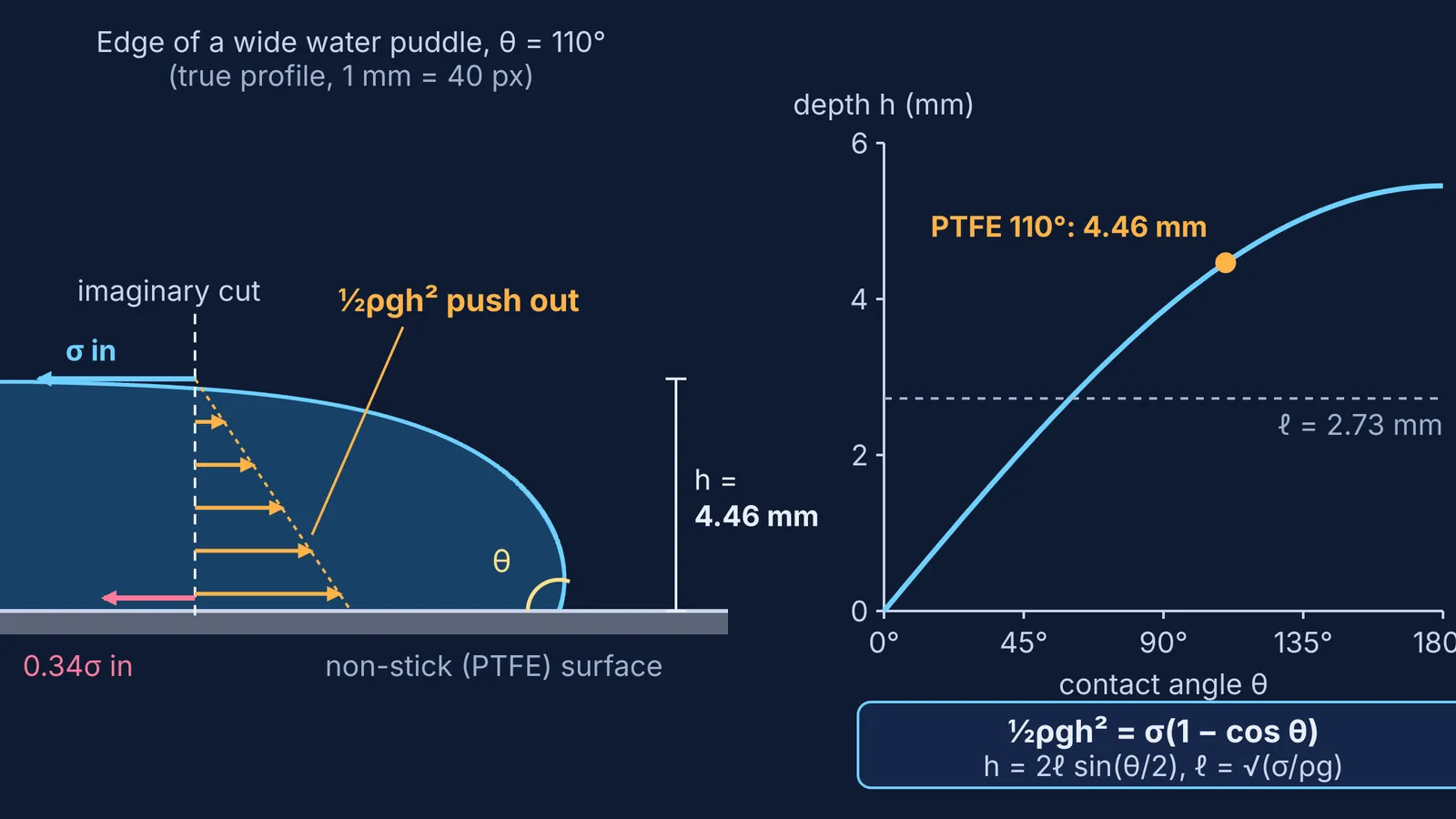
Cut the puddle with an imaginary vertical plane in its flat middle part, and look at the strip of water between that plane and the edge. Take a 1 m length of edge. Atmospheric pressure acts on every side and cancels, so only these horizontal forces matter.
Water pressure on the cut face. Pressure rises from zero at the top to ρgh at the bottom. The average is ½ρgh, acting on a face of height h, so the outward push is ½ρgh² per metre.
The top surface. At the cut, the liquid surface is flat and horizontal. It pulls the strip inwards with a force σ per metre, where σ is the surface tension.
The two solid surfaces. At the bottom of the cut, the wet solid (solid–liquid interface) pulls inwards. Beyond the edge, the dry solid (solid–air interface) pulls outwards. By Young's equation, which NCERT writes as S(la) cos θ + S(sl) = S(sa), the difference between these two is σ cos θ, pulling outwards. When θ is more than 90°, cos θ is negative, so this term actually pulls inwards. You can check the relation in NCERT Class 11 Physics, Mechanical Properties of Fluids.
Balance: ½ρgh² + σ cos θ = σ, so ½ρgh² = σ(1 − cos θ).
That gives the puddle depth h = √(2σ(1 − cos θ)/ρg). Since 1 − cos θ = 2 sin²(θ/2), you can also write it as h = 2ℓ sin(θ/2), where ℓ = √(σ/ρg) is the capillary length. The same result appears in the research literature on wetting, for example in Aradian, Raphaël and de Gennes, European Physical Journal E (2000), where the puddle thickness is written as e₀ = 2√(−S/ρg) with spreading coefficient S = σ(cos θ − 1).
The capillary length is the same 2.7 mm that decides when a water dome on a coin stops looking round. Drops much smaller than ℓ are shaped by surface tension; puddles much wider than ℓ are flattened by gravity, and only their edges stay curved.
Worked example: how deep is a water puddle on a non-stick pan?
Non-stick pans are coated with PTFE (Teflon). A measured water contact angle on smooth PTFE is about 110°, from a sessile-drop study in the International Journal of Adhesion and Adhesives (2018). The same paper notes that published values range from about 100° to 121°, so treat 110° as a typical figure. For water at 20 °C, NCERT gives σ = 0.0727 N/m; take ρ = 998 kg/m³ and g = 9.81 m/s².
Capillary length. ℓ = √(0.0727 ÷ (998 × 9.81)) = 2.73 × 10⁻³ m = 2.73 mm.
The angle factor. sin(110° ÷ 2) = sin 55° = 0.819.
Depth. h = 2 × 2.73 mm × 0.819 = 4.46 mm, about 4.5 mm.
Check with forces. Outward push ½ρgh² = 0.5 × 998 × 9.81 × (4.46 × 10⁻³)² = 0.0976 N per metre. Inward pull σ(1 − cos 110°) = 0.0727 × (1 + 0.342) = 0.0976 N per metre. They match.
Spread of 50 mL. Area = volume ÷ depth = 50 × 10⁻⁶ m³ ÷ 4.46 × 10⁻³ m = 0.0112 m² = 112 cm². A circle of that area is about 12 cm across.
Spread of 250 mL. Area = 560 cm², a circle about 27 cm across. Five times the water, the same depth, five times the area.
How does the contact angle change the depth?
The formula says depth rises with contact angle. The angles below are round illustrative values, not measurements of particular materials, because real angles depend on cleaning and surface finish.
θ = 30°: h = 2 × 2.73 × sin 15° = 1.41 mm.
θ = 60°: h = 2.73 mm, exactly one capillary length.
θ = 90°: h = 3.85 mm.
θ = 110° (PTFE, from the study above): h = 4.46 mm.
θ = 180°: h = 5.45 mm, twice ℓ, the upper limit for water.
Look what happens as θ goes to 0. The depth goes to zero, so there is no stable puddle at all: the water keeps spreading. This is what water does on very clean glass, which NCERT describes as water spreading out on glass. Highly water-repellent surfaces such as lotus leaves, which make water bead up, push the depth close to the 5.45 mm limit, although on those surfaces drops tend to roll off before they can pool.
You can see the contact angle itself at a tube wall in why mercury's meniscus is convex and water's is concave. If the idea of a pressure push and a surface pull fighting over one length is still fuzzy, the Concept Library explains surface tension and hydrostatic pressure, so you can read the two ideas side by side.
When does the 4.5 mm rule fail?
Small drops. The rule needs a puddle much wider than 2.7 mm. A drop a few millimetres across is closer to a sphere cap and is thinner than the formula says.
Contact angle hysteresis. A real edge has a range of stable angles. A puddle you have just poured has a larger, advancing angle; one that is drying has a smaller, receding angle. The depth can differ from the formula by tens of percent for this reason.
Pinned edges. On a wetting surface the edge can catch on a scratch or a speck of dirt and hold a puddle shallower than the formula.
Quick checklist
Large puddle depth: ½ρgh² = σ(1 − cos θ), so h = 2ℓ sin(θ/2) with ℓ = √(σ/ρg).
For water, ℓ ≈ 2.7 mm.
On PTFE (θ ≈ 110°) a water puddle is about 4.5 mm deep.
More liquid makes the puddle wider, not deeper.
θ near 0 means no puddle: the liquid keeps spreading.
The rule holds only for puddles much wider than ℓ, and real contact angles vary.


