On this page
Drip water onto a coin and it climbs into a shiny dome above the rim before it runs off. With soapy water, the dome gives up sooner. Here is how to measure that.
How many drops of water fit on a coin?
There is no fixed answer. It depends on the coin's size, how clean it is, your dropper's drop size and how gently you add each drop. Science Buddies' version of this activity uses a penny, a medicine dropper, tap water and dish soap: plain water makes a much larger, stable drop than soapy water. A ₹1, ₹2 or ₹5 coin works too; keep the same coin and dropper for every trial.
Why does water make a dome on a coin?
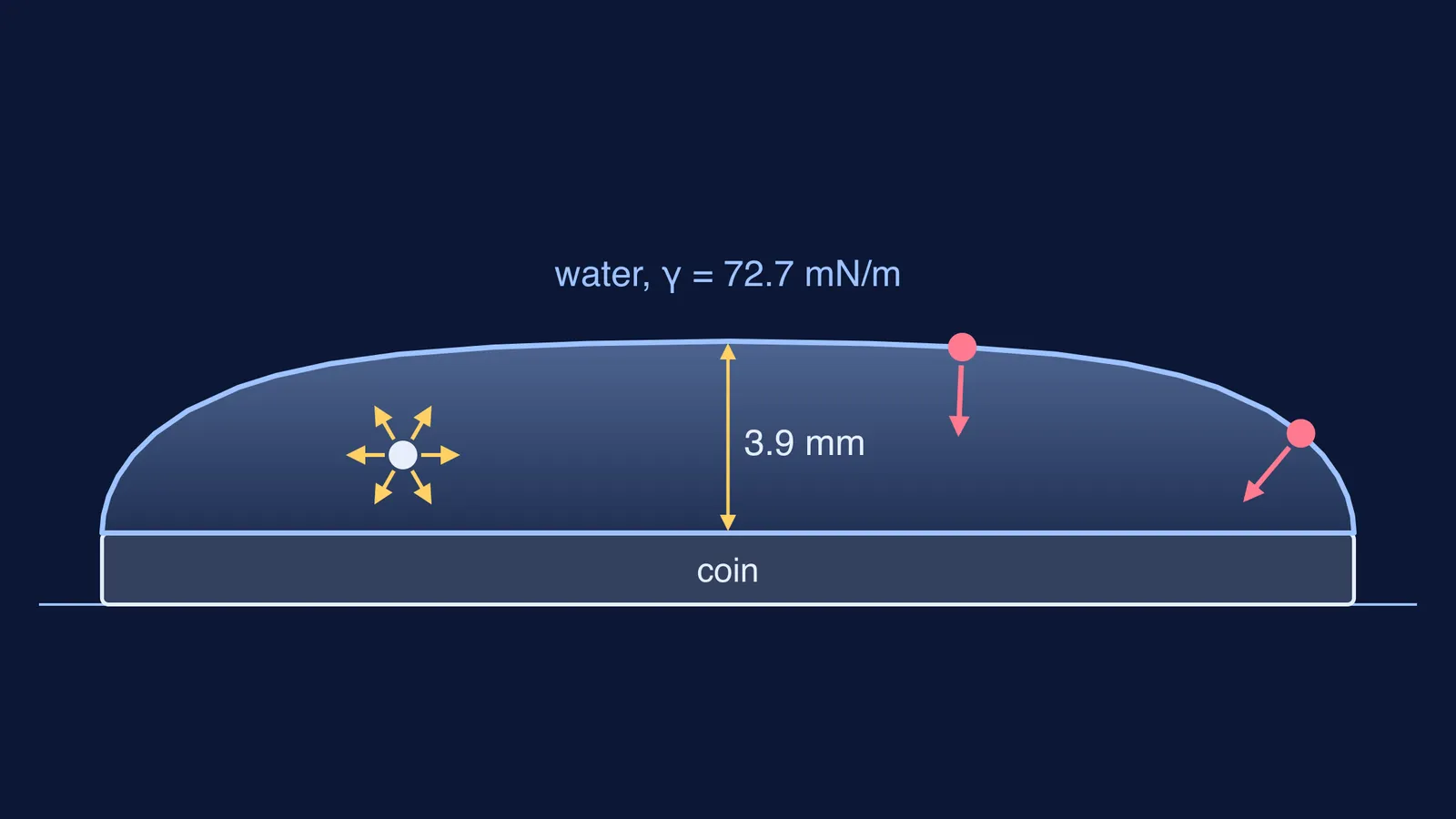
Water molecules attract one another. A molecule inside the drop is pulled equally in every direction. A molecule at the surface has no water above it, so, as the US Geological Survey explains, it feels a net pull inward. That pull makes the surface act like a stretched skin. How strong that skin is, measured as a force per unit length, is called surface tension.
The surface tension of pure water is 72.74 mN/m at 20 °C, according to the IAPWS release on the surface tension of water, which sets the international reference values.
The dome comes from a tug of war between that skin and gravity. Put the IAPWS value together with water's density from the USGS density table and you get the capillary length, the square root of surface tension divided by density times g. For water it is about 2.7 mm. Drops much smaller than this stay nearly round. Water spread over a coin, which is far wider, gets a flat top and rounded edges: the dome you see from the side. Our explainer on surface energy versus surface tension separates the two ideas.
What does soap do to the drop count?
Science Buddies defines soap as a surfactant: a material that decreases the surface tension of a liquid. With a weaker skin, the dome breaks after fewer drops.
More soap does not keep lowering surface tension forever. TeachEngineering's surfactant activity explains that added surfactant lowers surface tension, but once the critical micelle concentration (CMC) is reached, new surfactant forms micelles instead and surface tension no longer drops. A 2019 Langmuir paper by Wojciech Kwieciński and colleagues at the University of Twente states the same rule and uses 8.2 mM as the CMC of the common surfactant sodium dodecyl sulfate (Kwieciński et al., 2019). It also notes that lower surface tension usually means a lower contact angle, so a soapy drop spreads wider and sits lower. Our post on how contact angle sets the shape of a meniscus explains that angle, and our Class 10 guide to soaps and micelles shows how micelles form.
So here is your prediction: as you add more soap, your count should fall quickly, then stop falling.
How do you run the soap experiment at home?
You need one coin, a dropper, five cups, dish soap and a towel.
Put 100 mL of water in each cup. Leave Cup A plain. Add 1 drop of dish soap to Cup B, 2 to Cup C, 4 to Cup D and 8 to Cup E. Stir gently.
Wash and dry the coin and lay it flat on the towel.
Starting with Cup A, hold the dropper at the same height each time and count drops until water runs off the edge.
Dry the coin between trials and do three trials per cup.
Work from least soap to most, and rinse the dropper in plain water between cups.
Copy this results table into your notebook:
Cup A (plain): trials __, __, __; average __
Cup B (1 drop soap): trials __, __, __; average __
Cup C (2 drops): trials __, __, __; average __
Cup D (4 drops): trials __, __, __; average __
Cup E (8 drops): trials __, __, __; average __
Then plot the average against drops of soap.
How do you read your results?
A well above B: soap lowered the surface tension.
D and E about the same: you have probably passed the point where more soap stops helping. Dish soap is a mixture, so you cannot read off a CMC value, but the shape of your graph still shows it.
Big spread within one cup: that is your measurement error. A difference between cups counts only if it is bigger than this spread.
Plain-water counts that are low on a repeat: there is probably soap left on the coin or in the dropper.
For a sixth cup, try warm plain water. The IAPWS table lists 69.59 mN/m at 40 °C, a little lower than at 20 °C. Is your change bigger than your spread?
If you'd like to see an idea move before you test it, the Fermi Simulation Lab has interactive simulations for ideas that are easier to see than read. If a term like contact angle trips you up, the Fermi Concept Library gives each concept its own lesson.