

On this page
If you are studying for your Class 11 physics exams, or preparing for JEE and NEET, Chapter 10 (Mechanical Properties of Fluids) introduces two terms that sound different but describe the exact same behaviour of liquid surfaces.
Let's break down why physics uses both names, how they are related, and how to decide which one to use when solving numerical problems.
Are surface energy and surface tension the same?
Yes. For any given liquid at a specific temperature, its surface energy and surface tension have the identical numerical value (Wikipedia).
Surface tension (T) is a mechanical idea. It is the force acting per unit length along an imaginary line drawn on the liquid surface. Its SI unit is Newtons per metre (N/m).
Surface energy (U) is a thermodynamic idea. It is the work done to create a unit of new area, representing the extra potential energy possessed by surface molecules. Its SI unit is Joules per square metre (J/m²) (Wikipedia).
Why do we use both views?
Water molecules attract each other strongly. A molecule deep inside a glass of water is pulled equally in all directions by its neighbours. But a molecule on the surface has no water molecules above it, so it feels a net inward pull.
This inward pull causes the liquid to shrink to the smallest possible area. You can look at this shrinking behaviour from two perspectives:
The force view: If you place a light needle on water, the surface behaves like a stretched elastic membrane. It exerts an upward force along the length of the needle to support it. Here, it is easiest to think in terms of surface tension (force per unit length).
The energy view: If you want to break a large water drop into thousands of tiny droplets, you are drastically increasing the total surface area. Similar to calculating the elastic potential energy in a stretched wire, you must do work against these inward forces to stretch the surface. Here, it is easiest to think in terms of surface energy (work done per unit area).
If you are stuck on which method to use in a difficult problem, Fermi Problem Library acts as a step-by-step solver that explains the reasoning behind choosing force or energy for a specific physical setup.
How to prove they are numerically equal?
The easiest way to see that they are the same is the classic soap film experiment taught in school.
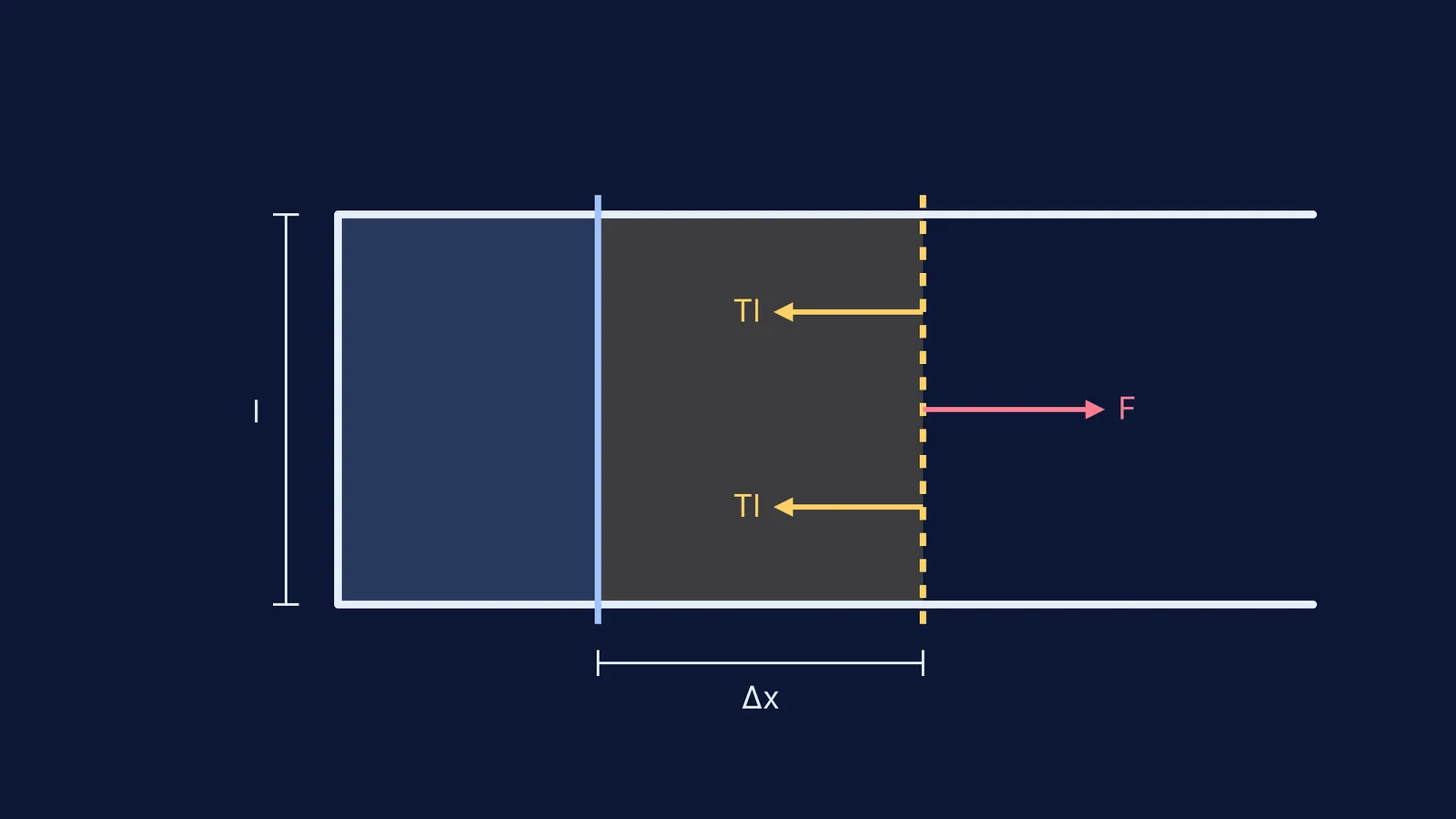
Imagine a U-shaped wire frame with a sliding wire of length l across the open end. You dip this frame into soap solution, forming a thin film.
The force: The soap film pulls the sliding wire inwards. Because a soap film has two surfaces (front and back), the total inward force is F = 2Tl.
The work: To stretch the film, you apply an external force to slowly pull the sliding wire outwards by a small distance Δx. While we often think of expanding gases as doing work in irreversible expansion, a liquid surface expanding also requires work. The work done is force times distance: W = 2Tl × Δx.
The new area: The area of the soap film increases. Since it has two sides, the total new area created is ΔA = 2 × (l × Δx).
The energy: Surface energy is the work done divided by the new area:
U = W / ΔA = (2Tl × Δx) / (2l × Δx) = T
The distances and lengths cancel out perfectly. The surface energy of the film is exactly equal to its surface tension.
How do you avoid the most common exam trap?
When solving problems involving soap bubbles or films, the most common mistake students make is forgetting the factor of 2.
A liquid drop (like a raindrop) has only one outer surface. A soap bubble (or a film on a wire) is hollow inside, so it has two surfaces: an inner one and an outer one.
Worked example: Blowing a soap bubble Suppose you need to find the work done to blow a soap bubble of radius R from a soap solution with surface tension T.
The surface area of a sphere is 4πR².
Because it is a bubble, it has two surfaces. Total surface area A = 2 × 4πR² = 8πR².
Since surface energy equals surface tension, the work done to create this new area is simply W = T × 8πR².
By remembering that surface energy is just the energy version of surface tension, you can switch seamlessly between balancing forces and calculating work done.


