

On this page
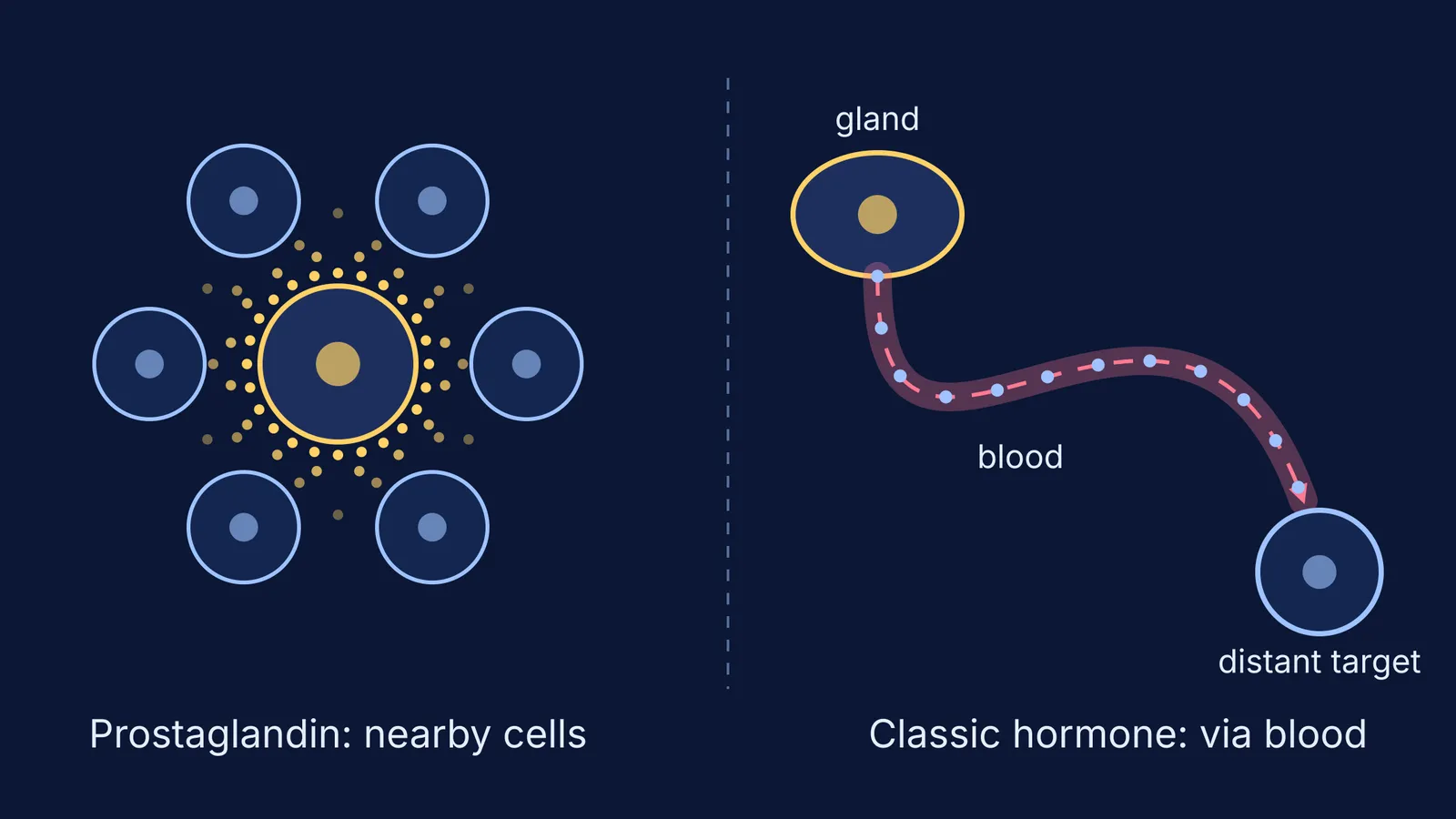
Insulin is made in the pancreas and acts on your liver and muscles. Adrenaline leaves the adrenal glands and reaches your heart within moments. That is the textbook picture of a hormone: one gland, the bloodstream, a distant target. Prostaglandins break almost every part of that picture, which is why biology books call them local hormones.
What makes prostaglandins different from classic hormones?
Prostaglandins are lipids made from arachidonic acid, a 20-carbon unsaturated fatty acid released from cell membranes, according to a review by Emanuela Ricciotti and Garret FitzGerald in Arteriosclerosis, Thrombosis, and Vascular Biology. The same review says they are “ubiquitously produced” and “act as autacrine and paracrine lipid mediators to maintain local homeostasis in the body.”
Three differences follow from that:
No dedicated gland. Almost every tissue makes them.
Made on demand. The enzyme COX-2 is switched on by inflammatory stimuli, hormones and growth factors, so production rises right where tissue is injured or inflamed.
Destroyed fast. In his 1982 Nobel lecture, John Vane described how his group found that almost all of an infusion of PGE1, PGE2 or PGF2α was inactivated in one passage through the lungs. The hormone angiotensin II, by contrast, passes through the lungs unaffected.
A signal that is mostly destroyed in one trip through the lungs cannot work as a body-wide messenger. It has to act close to the cells that made it. In the same lecture Vane used this to split hormones into “local” and “circulating” ones: “The local hormones are those which are largely removed by the lungs.” Prostacyclin, which his group found survives the lungs, is an exception. If the words paracrine and autocrine are new to you, our explainer on endocrine, paracrine and autocrine signalling sets out all three with examples.
How do prostaglandins cause pain and fever?
Pain. When you sprain an ankle, cells in the injured tissue make more prostaglandins. Ricciotti and FitzGerald write that hyperalgesia, the extra sensitivity to pain in inflamed tissue, “is mediated mainly by PGE2”, acting on sensory nerve endings at the site of inflammation and on nerve cells in the central nervous system (review). That is why the swollen spot hurts to touch.
Fever. Here the local action happens inside the brain. A 2007 study in mice by Michael Lazarus, Clifford Saper and colleagues in Nature Neuroscience found that deleting EP3, a receptor for PGE2, in one small brain region, the median preoptic nucleus, abolished the fever response. PGE2 acts on that temperature-control area and pushes the body's thermostat up. Why the body raises its temperature at all is covered in our piece on why fever helps fight infection.
Why do prostaglandins make the uterus contract?
Ricciotti and FitzGerald note that PGF2α in the female reproductive system plays a role in ovulation, “contraction of uterine smooth muscle and initiation of parturition” (childbirth) (review). The signal is made in the uterus and acts on the muscle of the same organ: local from start to finish.
The same local action explains period cramps. A systematic review in JBRA Assisted Reproduction describes how increased synthesis of PGE2 and PGF2α in primary dysmenorrhoea leads to irregular uterine contractions and reduced blood flow. If period pain regularly keeps you out of school, see a doctor or gynaecologist.
Where do aspirin-like painkillers fit in?
In 1971 Vane published a paper titled “Inhibition of prostaglandin synthesis as a mechanism of action for aspirin-like drugs”. Today the two cyclooxygenase enzymes, COX-1 and COX-2, are recognised as the targets of these drugs, the NSAIDs (review). Block the enzyme and nearby cells stop making the local signal. Paracetamol is a slightly different story, told in our explainer on how paracetamol reduces fever and pain.
How do you write this answer in an exam?
Use this four-step frame:
Define: Prostaglandins are lipid signalling molecules made from arachidonic acid in most tissues.
Contrast: Classic hormones come from a ductless gland and travel in the blood to distant targets.
Give the reason: Prostaglandins are made on demand, act on the same cell (autocrine) or neighbouring cells (paracrine), and are inactivated quickly; most PGE2 and PGF2α is removed in one pass through the lungs.
Give an example: PGE2 in pain and fever, PGF2α in uterine contraction; aspirin-like drugs block the COX enzymes that make them.
Then test yourself. Sort each signal into “travels in blood” or “acts locally”: insulin, PGE2 at a sprained ankle, thyroxine, PGF2α in the uterus, adrenaline. Answers: insulin, thyroxine and adrenaline travel in blood; the two prostaglandins act locally.
If the chain from membrane fatty acid to COX enzyme to pain still feels like a list to memorise, the Fermi Concept Library gives each concept in biology its own lesson and its place in the map. And if you are not sure where your gaps are, Fermi's AI tutor works out what you already know and checks your understanding as it goes.


