On this page
Proportional Reasoning-1 is Chapter 7, the last chapter, of Ganita Prakash Part I, NCERT's new Class 8 maths textbook (code hegp1, First Edition July 2025, reprinted January 2026). CBSE's 2026-27 curriculum page lists syllabi for Classes IX to XII only, so Classes 6 to 8 follow the NCERT book and this chapter is assessed by the school. All examples and questions below use our own numbers.
What does Proportional Reasoning-1 cover?
The Chapter 7 PDF runs from page 159 to page 177 in six sections:
Observing Similarity in Change.
Ratios: a : b means for every a units of one quantity there are b units of the other.
Ratios in their Simplest Form: divide both terms by their HCF.
Problem Solving with Proportional Reasoning, including Trairasika (the Rule of Three).
Sharing, but Not Equally!
Unit Conversions.
Ratios with matching simplest forms are proportional: a : b :: c : d.
Why do some resized pictures look stretched?
A picture keeps its shape only if width and height change by the same factor, not the same amount.
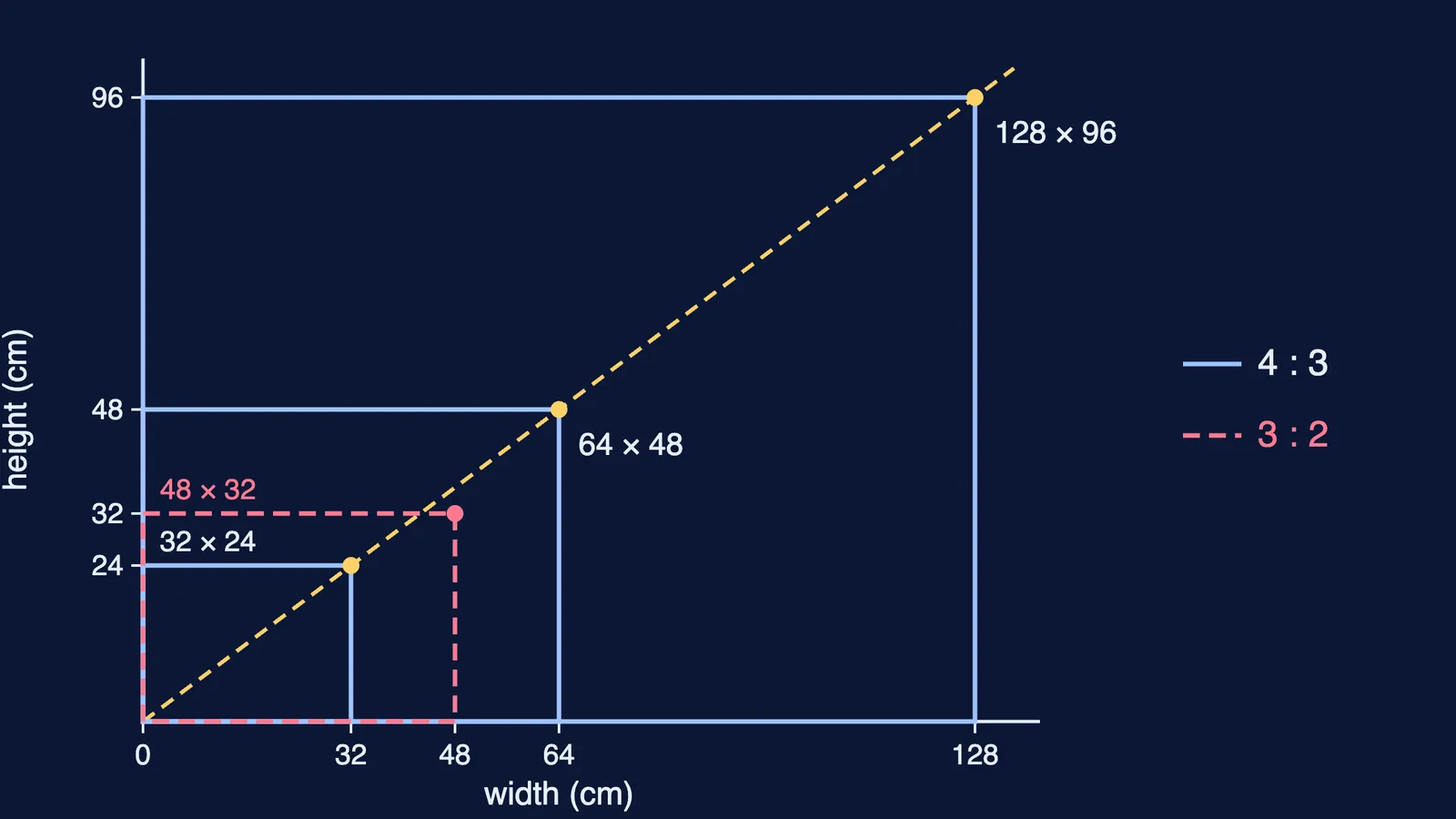
Worked example 1 (the diagram above). A poster is 64 cm wide and 48 cm high.
The HCF of 64 and 48 is 16, so the ratio is 4 : 3.
Halve the width and the height: 32 cm by 24 cm, still 4 : 3. Double the original: 128 cm by 96 cm, still 4 : 3. All three corners lie on one line from the origin, so the shapes look alike.
Now subtract 16 cm from the width and from the height instead: 48 cm by 32 cm. The HCF is 16, giving 3 : 2. Its corner falls off the line, so it looks flatter.
How does the Rule of Three work?
When three of four proportional quantities are known, the chapter writes a : b :: c : d with c = fa and d = fb for the same factor f. That gives ad = bc, which the book calls cross multiplication, so d = bc/a.
The chapter names the three known numbers in Āryabhaṭa's terms: pramāṇa (measure, a), phala (fruit, b) and ichchhā (requisition, c). The answer is the ichchhāphala (yield, d). Note: the 2026-27 reprint gives Āryabhaṭa's date as "199 CE". This looks like a misprint, so check the date with your teacher.
Worked example 2. A cyclist rides 18 km in 75 minutes. At the same speed, how far does she go in 2 hours?
Match units first: 2 hours = 120 minutes.
Set up 75 : 18 :: 120 : x.
Cross multiply: 75x = 18 × 120 = 2,160.
x = 2,160 ÷ 75 = 28.8 km.
Not every problem fits: when speed goes up, travel time goes down, so the book shows that speed and time cannot be set up this way.
How do you divide a quantity in a ratio?
To split x in the ratio m : n, make m + n equal groups. Each group is x ÷ (m + n), so the parts are m × x/(m + n) and n × x/(m + n) (NCERT, Chapter 7).
Worked example 3. Split a ₹3,500 prize in the ratio 3 : 4. There are 7 groups of ₹500, so the shares are ₹1,500 and ₹2,000.
Worked example 4 (unit conversion). A plot is 120 ft by 90 ft, an area of 10,800 sq ft. Using the book's table (1 acre = 43,560 sq ft and 1 sq m = 10.764 sq ft), that is about 0.248 acre, or about 1,003 sq m.
How does this chapter connect to the rest of the book?
It uses the HCF and the algebraic notation of earlier chapters. Part II continues with Chapter 3, Proportional Reasoning-2, which covers pie charts and inverse proportion; our Class 8 guide to direct and inverse proportion shows how to tell the two apart. For a gentler start, try ratios and proportion before Class 8, and for another Part I chapter, see A Story of Numbers.
Practice questions
Our own questions; marks are our suggestion.
(1 mark) Are 9 : 15 and 33 : 55 proportional? *Yes: both simplify to 3 : 5.*
(2 marks) Fill in the ratios proportional to 18 : 45: 8 : __ and __ : 30. *8 : 20 and 12 : 30.*
(2 marks) 7 pens cost ₹91. What do 11 cost? *₹143.*
(2 marks) Divide 104 sweets in the ratio 5 : 3. *65 and 39.*
(3 marks) A 36 kg mix has gravel and sand in the ratio 7 : 5. How much sand must be added to make it 7 : 6? *Gravel 21 kg, sand 15 kg; sand must become 18 kg, so add 3 kg.*
(2 marks) Riya is 11 and her cousin is 17. In how many years will their ages be in the ratio 4 : 5? *13 years: they will be 24 and 30.*
Unsure which of these steps to practise first? Fermi's AI tutor works out what you already know and builds a plan for the session.