

On this page
You don't need to find cos A, cos 2A and cos 4A one by one. Each angle doubles the one before, and that lets the double-angle formula sin 2x = 2 sin x cos x fold the whole product into one fraction.
How do you evaluate cos A cos 2A cos 4A?
Call the product P. Multiply and divide by 2 sin A so that sin A sits next to cos A, then keep feeding the result into the double-angle formula.
Multiply by 2 sin A: 2 sin A · P = (2 sin A cos A) cos 2A cos 4A = sin 2A cos 2A cos 4A.
Multiply by 2 again: 4 sin A · P = (2 sin 2A cos 2A) cos 4A = sin 4A cos 4A.
Once more: 8 sin A · P = 2 sin 4A cos 4A = sin 8A.
Divide: P = sin 8A / (8 sin A), valid whenever sin A ≠ 0.
Each step uses up one cosine and doubles the sine's angle, which is why the angles must double: each new sine has to match the next cosine.
Why is cos 20° cos 40° cos 80° equal to 1/8?
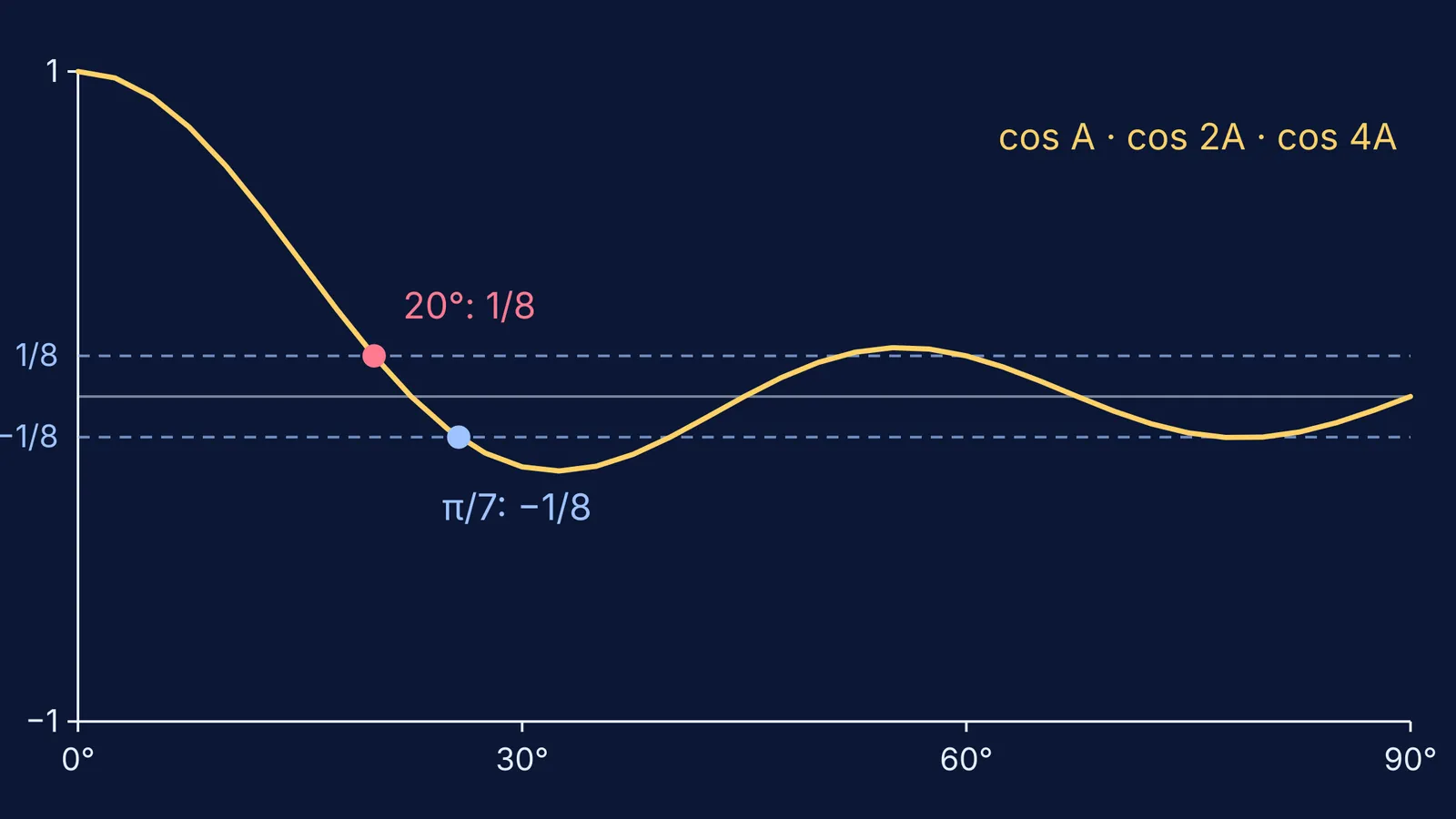
Put A = 20°: cos 20° cos 40° cos 80° = sin 160° / (8 sin 20°). Since sin(180° − x) = sin x, sin 160° equals sin 20°, the sines cancel, and the product is exactly 1/8.
This identity has a name: cos 20° · cos 40° · cos 80° = 1/8 is called Morrie's law, according to the Wikipedia article on Morrie's law. The article says the physicist Richard Feynman used that name for it, after Morrie Jacobs, a boy he knew in childhood, and remembered the identity all his life. W. A. Beyer, J. D. Louck and D. Zeilberger generalised it in a short 1996 note in Mathematics Magazine, "Math Bite: A Generalization of a Curiosity that Feynman Remembered All His Life".
What is the general formula for cos A cos 2A … cos 2ⁿ⁻¹A?
With n cosines, multiply and divide by 2ⁿ sin A. The result, as stated in the Morrie's law article, is:
cos A · cos 2A · cos 4A ⋯ cos 2ⁿ⁻¹A = sin 2ⁿA / (2ⁿ sin A), for sin A ≠ 0.
Quick check: with n = 1 it gives sin 2A / (2 sin A) = cos A, as it should. The answer is a clean number whenever sin 2ⁿA is ± sin A, which happens, for example, for these angle choices:
A = 180°/(2ⁿ + 1): then 2ⁿA = 180° − A, so the product is +1/2ⁿ. For n = 3 that is A = 20°.
A = 180°/(2ⁿ − 1): then 2ⁿA = 180° + A, so the product is −1/2ⁿ. For n = 3 that is A = π/7.
A = 360°/(2ⁿ − 1): then 2ⁿA = 360° + A, so the product is +1/2ⁿ. For n = 3 that is A = 2π/7.
What changes for cos(π/7) cos(2π/7) cos(4π/7)?
Here A = π/7, so 8A = 8π/7 = π + π/7, and sin(8π/7) = −sin(π/7). The formula gives cos(π/7) cos(2π/7) cos(4π/7) = −sin(π/7) / (8 sin(π/7)) = −1/8.
Check the sign separately. π/7 and 2π/7 are less than π/2, so their cosines are positive. 4π/7 is more than π/2, so cos(4π/7) is negative. One negative factor means a negative product.
A common variant is cos(π/7) cos(2π/7) cos(3π/7). The angles no longer double, but 3π/7 = π − 4π/7, so cos(3π/7) = −cos(4π/7). Swap it in and the product becomes −(−1/8) = 1/8.
How do you spot this pattern in an exam question?
Run this checklist on any product of cosines:
List the angles. Does each one double the last? If not, try cos(π − x) = −cos x, or pull out a known value such as cos 60°.
Count the cosines, n. Multiply and divide by 2ⁿ sin A, where A is the smallest angle.
Collapse the product with sin 2x = 2 sin x cos x, n times, until one sine is left.
Simplify sin 2ⁿA with sin(180° − x) = sin x or sin(180° + x) = −sin x, then confirm the sign by counting negative cosines.
If you keep missing the pattern, the Fermi Problem Library has worked problems with a step-by-step solver that explains the reasoning rather than printing an answer, so you can see why each angle was chosen.
The identities behind this are in our Class 11 trigonometric functions formulas. To test yourself, try these JEE Advanced trigonometry practice questions with solutions and our guide on how to prepare trigonometry for JEE Advanced.
Try it now: evaluate cos(π/17) cos(2π/17) cos(4π/17) cos(8π/17) with the checklist. The answer should be 1/16.


