

On this page
Potassium is in almost every volcanic rock, and a small part of it is radioactive potassium-40. Some of that potassium-40 turns into argon-40, a gas, so a lava flow carries its own clock. Read the clock correctly and a basalt from the Deccan Traps tells you when it cooled. Read it with one factor missing and you get an age about nine times too young. The missing factor is the branching fraction, and this post shows exactly where it goes in the dating formula.
How does potassium-40 decay?
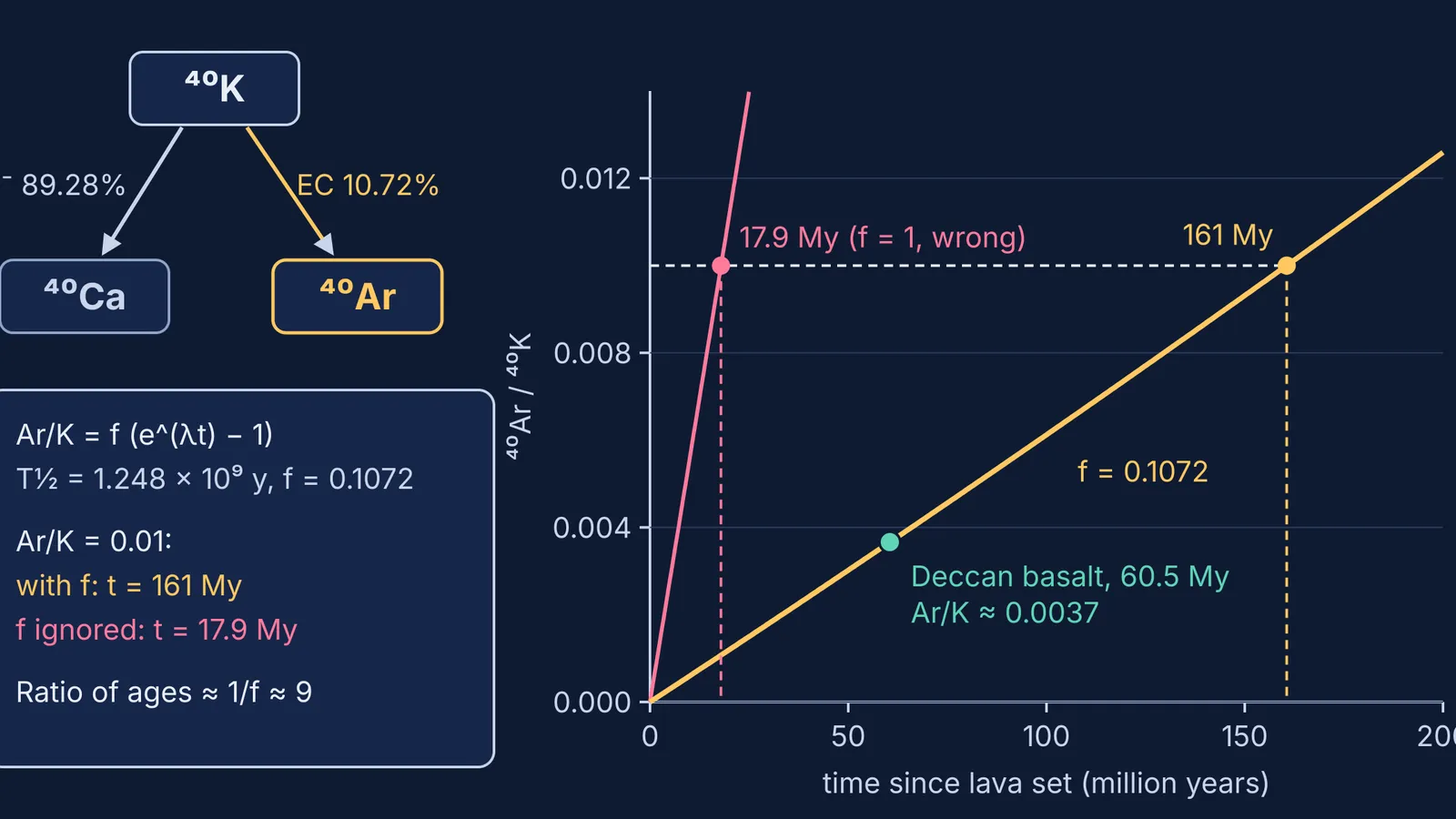
Potassium-40 decays in two competing ways, with the values given by the US National Nuclear Data Center (NNDC NuDat, potassium-40 decay data):
β⁻ decay to calcium-40, in 89.28% of decays: ⁴⁰K → ⁴⁰Ca + e⁻ + ν̄.
Electron capture to argon-40, in 10.72% of decays: ⁴⁰K + e⁻ → ⁴⁰Ar + ν. A tiny β⁺ branch, about 0.001%, also gives argon-40.
The half-life is 1.248 × 10⁹ years (same NNDC source). Potassium-40 is only a small part of natural potassium: its amount fraction is 0.000117, or 0.0117% (CIAAW, isotopic composition of potassium). So a dating lab measures total potassium and multiplies by 0.000117 to get the potassium-40 atoms.
How two decay modes combine into one decay constant is worked in effective half-life when a nucleus decays by two parallel modes. Here you need one result from it: the share of decays going to argon is f = λ_EC/λ = 0.1072, and the 1.248 × 10⁹ year half-life belongs to the total decay constant λ = λ_EC + λ_β.
Why does the clock start when lava sets?
Argon is a noble gas. It does not bond to anything in the melt, so while the rock is molten, argon escapes. Once the lava solidifies, argon-40 made by new decays is trapped in the crystals. The clock starts at zero argon at the moment the rock sets.
Calcium-40 cannot be used the same way, even though it is the main product. Ordinary calcium is common in rocks and most of it is calcium-40, so a few extra atoms from decay are lost in a huge background.
How do you put the branch into the dating formula?
Let K be the number of potassium-40 atoms left in the rock today, and λ the total decay constant.
Atoms decayed. Today K = K₀e^(−λt), so the number that has decayed since the rock set is K₀ − K = K(e^(λt) − 1).
Argon made. Only a fraction f of those decays give argon. So Ar = fK(e^(λt) − 1).
Divide by K. Ar/K = f(e^(λt) − 1).
Solve for t. t = (1/λ) ln[1 + (Ar/K)/f] = (T½/ln 2) ln[1 + (Ar/K)/f].
Compare this with the uranium-lead clock in age of a rock from its uranium-lead ratio. There every decay of uranium-238 ends as lead-206, so f = 1 and the formula has no division. For potassium-40 only about one decay in nine and a third (1/0.1072 = 9.33) gives argon.
Worked example: how old is a rock with Ar/K = 0.01?
A basalt is found to contain 0.01 argon-40 atoms for every potassium-40 atom. Take T½ = 1.248 × 10⁹ years and f = 0.1072.
Decay constant. λ = ln 2 / T½ = 0.693 / (1.248 × 10⁹ y) = 5.554 × 10⁻¹⁰ per year.
Divide by the branch. (Ar/K)/f = 0.01 / 0.1072 = 0.0933. This is the number of potassium-40 atoms that have decayed, per atom left.
Take the log. ln(1.0933) = 0.0892.
Age. t = 0.0892 / (5.554 × 10⁻¹⁰ per year) = 1.61 × 10⁸ years, about 161 million years.
Without the branch. Putting f = 1 gives ln(1.01) / λ = 0.00995 / (5.554 × 10⁻¹⁰) = 17.9 million years. That is 9 times too young.
Why nine? For small ratios, ln(1 + x) ≈ x, so the age is nearly proportional to 1/f. Dropping f divides the age by about 1/0.1072 = 9.3. At Ar/K = 0.001 the ages are 16.7 and 1.80 million years, a ratio of 9.3.
Check the answer another way: in 161 million years the fraction of potassium-40 that decays is 1 − e^(−λt) = 8.5%. Of that, 10.72% became argon, and per atom left that is 0.01. It fits.
What argon ratio does a Deccan basalt hold?
Run the formula forwards. The Deccan Traps post quotes an argon age of about 60.5 million years for the basalt of Gilbert Hill in Mumbai.
At t = 60.5 million years, Ar/K = 0.1072 × (e^(λt) − 1) = 0.0037.
At 66 million years, close to the asteroid impact, Ar/K = 0.0040.
So the lab must measure argon-40 at a few thousandths of the potassium-40, which is itself only 0.0117% of the potassium. The two ages differ by only about 9% in Ar/K, so careful mass spectrometry is essential.
What can go wrong with potassium-argon dates?
Argon at the start. If some argon stayed trapped when the lava set, the rock looks too old.
Argon leaking out. Heating or weathering later can let argon escape, so the rock looks too young.
Decay constants. Labs have revised the potassium-40 constants over the years. A 2020 study in Geochronology gives a total decay constant of 5.475 × 10⁻¹⁰ per year and a partial constant to argon-40 of 0.592 × 10⁻¹⁰ per year (Carter and colleagues, Geochronology 2, 355), a branch of 0.108. With those values the example rock comes out at about 162 million years instead of 161. Always use the constants your question or source gives.
Argon–argon dating was developed to check the first two problems: the sample is irradiated with neutrons so that some potassium-39 becomes argon-39, and the ratio of argon-40 to argon-39 is measured as the sample is heated step by step.
If a decay problem keeps going wrong at the setup stage, the Fermi Problem Library has a step-by-step solver that explains the reasoning, so you can see where the branch should enter.
Quick checklist
Potassium-40: 89.28% β⁻ to calcium-40, 10.72% electron capture to argon-40 (NNDC).
Use the total half-life, 1.248 × 10⁹ years, in e^(λt).
Ar/K = f(e^(λt) − 1), so t = (T½/ln 2) ln[1 + (Ar/K)/f].
Forgetting f makes young rocks look about 9 times younger than they are.
Count only potassium-40 atoms: 0.0117% of natural potassium.
The clock assumes no argon at the start and none lost since.


