

On this page
If you are revising the animal kingdom for a Class 11 test or NEET-UG, flatworms and roundworms are an easy pair to mix up. Both look like worms, and both include parasites that live inside people. The real differences are inside the body, and five of them will answer almost any question you meet.
What is the difference between Platyhelminthes and Aschelminthes?
Platyhelminthes are the flatworms and Aschelminthes are the roundworms. Indian school textbooks use the name Aschelminthes; university textbooks such as OpenStax Biology 2e call the roundworm phylum Nematoda. Here are the five features to compare, drawn from OpenStax's chapters on flatworms and nematodes:
Body shape. Flatworms are flattened from top to bottom. Roundworms have "a tubular morphology and circular cross-section".
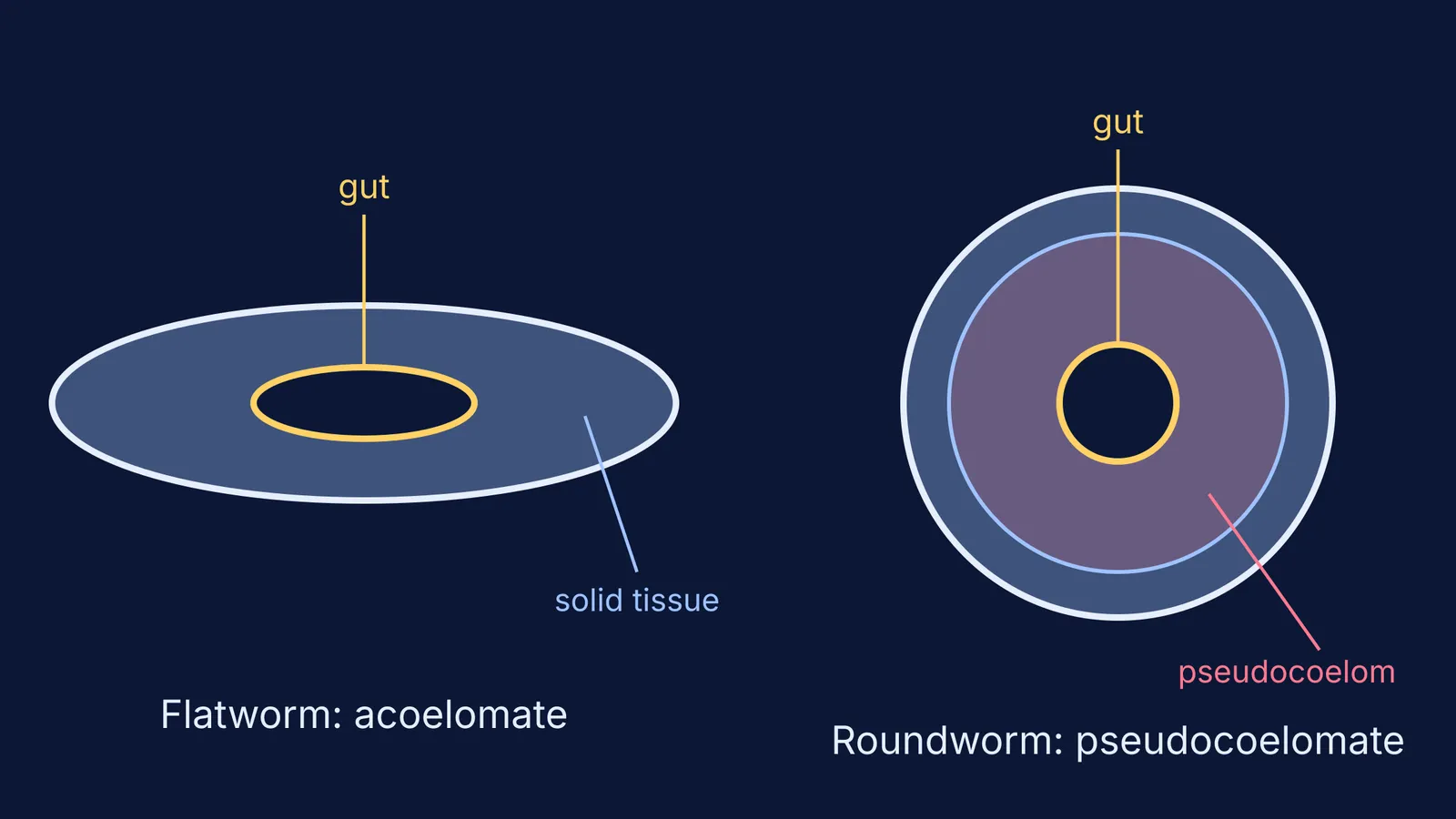
Body cavity. Flatworms are acoelomate: there is no cavity between the gut and the body wall. Roundworms are pseudocoelomates.
Gut. Most flatworms have a gut with a single opening, and tapeworms have no digestive system at all. Roundworms have a complete gut with a separate mouth and anus.
Excretion. Flatworms use flame cells, whose beating cilia push waste fluid along tubules and out through excretory pores. In roundworms, nitrogenous waste, mostly ammonia, leaves directly across the body wall.
Sexes. Most flatworm species are monoecious, meaning one animal has both male and female organs. Roundworm strategies vary by species, and the examples you study, such as Ascaris, have separate males and females.
The UC Davis reference Nemaplex adds that a roundworm's excretory canal opens at a pore on its underside, level with the oesophagus. For more, read our explainer on flame cells in flatworms.
How do Taenia, Fasciola, Ascaris and Wuchereria fit?
Tie each feature to one of these four textbook examples.
Taenia (tapeworm), a flatworm. The US Centers for Disease Control and Prevention (CDC) says adult Taenia solium is 2 to 7 m long, clings to the small intestine by its head (the scolex) and has an average of 1,000 segments called proglottids. With no gut of its own, it absorbs food that its host has already digested, as OpenStax explains. The World Health Organization says people get the adult worm from raw or undercooked infected pork.
Fasciola (liver fluke), a flatworm. CDC describes adult Fasciola hepatica as "large and broadly-flattened", up to 30 mm long and 15 mm wide, living in the bile ducts of the liver. Its larvae develop in freshwater snails, and people can swallow them on watercress. Our post on the liver fluke and its hosts follows that life cycle step by step.
Ascaris (intestinal roundworm), a roundworm. CDC gives adult Ascaris lumbricoides females a length of 20 to 35 cm and males 15 to 31 cm, so the female is larger. WHO estimates that 1.5 billion people, or 24% of the world's population, have soil-transmitted worm infections, and Ascaris is one of the main species. Our post on sexual dimorphism in Ascaris covers how to tell the male from the female.
Wuchereria (filarial worm), a roundworm. WHO says Wuchereria bancrofti causes 90% of lymphatic filariasis cases, and mosquitoes carry its larvae from one person to the next. Long-term infection can cause the swelling known as elephantiasis.
How do you tell them apart in an exam question?
Work through these questions in order. Stop as soon as one answer settles it.
Is the body flat or round in cross-section?
Does the gut have one opening, two openings or none?
Is there a cavity between the gut and the body wall?
Flame cells, or an excretory canal and pore?
One body with both sexes, or separate males and females?
Worked example. "An organism has a mouth and an anus, a body cavity that is not a true coelom, and the female is larger than the male." Question 2 already rules out a flatworm, because a textbook flatworm's gut has one opening or none. Question 3 points to a pseudocoelom, and question 5 points to separate sexes. The answer is Aschelminthes, and Ascaris fits.
A common trap. "Taenia has an incomplete digestive system." This is false: the tapeworm has no digestive system at all. Fasciola, like most flatworms, is the one with a one-opening gut.
If words like acoelomate, pseudocoelomate and coelomate still blur together, the Fermi Concept Library gives every biology concept its own lesson and shows where it sits in the map. To practise, the Fermi Problem Library has worked problems with a step-by-step solver that explains the reasoning rather than just printing the answer.
Next time you revise, draw two cross-sections from memory, one flat and solid and one round with a gap around the gut, then label all five features on each.


