

On this page
In the study of biology—especially when tackling the Animal Kingdom chapter in Class 11—*Ascaris lumbricoides* is the classic example of a roundworm. It belongs to the phylum Aschelminthes, a group defined by their cylindrical bodies and unique internal structures.
But one of the most frequent questions about *Ascaris* is how to tell the sexes apart. This species shows pronounced sexual dimorphism, meaning the male and female forms are visibly different even to the naked eye. Recognizing these differences is a standard requirement in biology practicals and a common theme in multiple-choice questions for exams like NEET-UG.
What is sexual dimorphism in Ascaris?
Sexual dimorphism is a condition where the two sexes of the same species exhibit different morphological characteristics beyond their sexual organs. In *Ascaris*, these physical differences are directly driven by their distinct reproductive roles.
The female *Ascaris* is built for massive egg production. A single mature female inhabiting the small intestine can produce approximately 200,000 eggs per day, according to the Mayo Clinic. To house this extensive, Y-shaped double reproductive system (called a didelphic system), the female's body has evolved to be significantly larger and thicker than the male's. The male, on the other hand, requires a more specialized body shape to successfully mate and fertilize those eggs.
How do you tell a male and female Ascaris apart?
If you are looking at a diagram or examining a preserved specimen in the laboratory, here is the practical checklist to identify the sex:
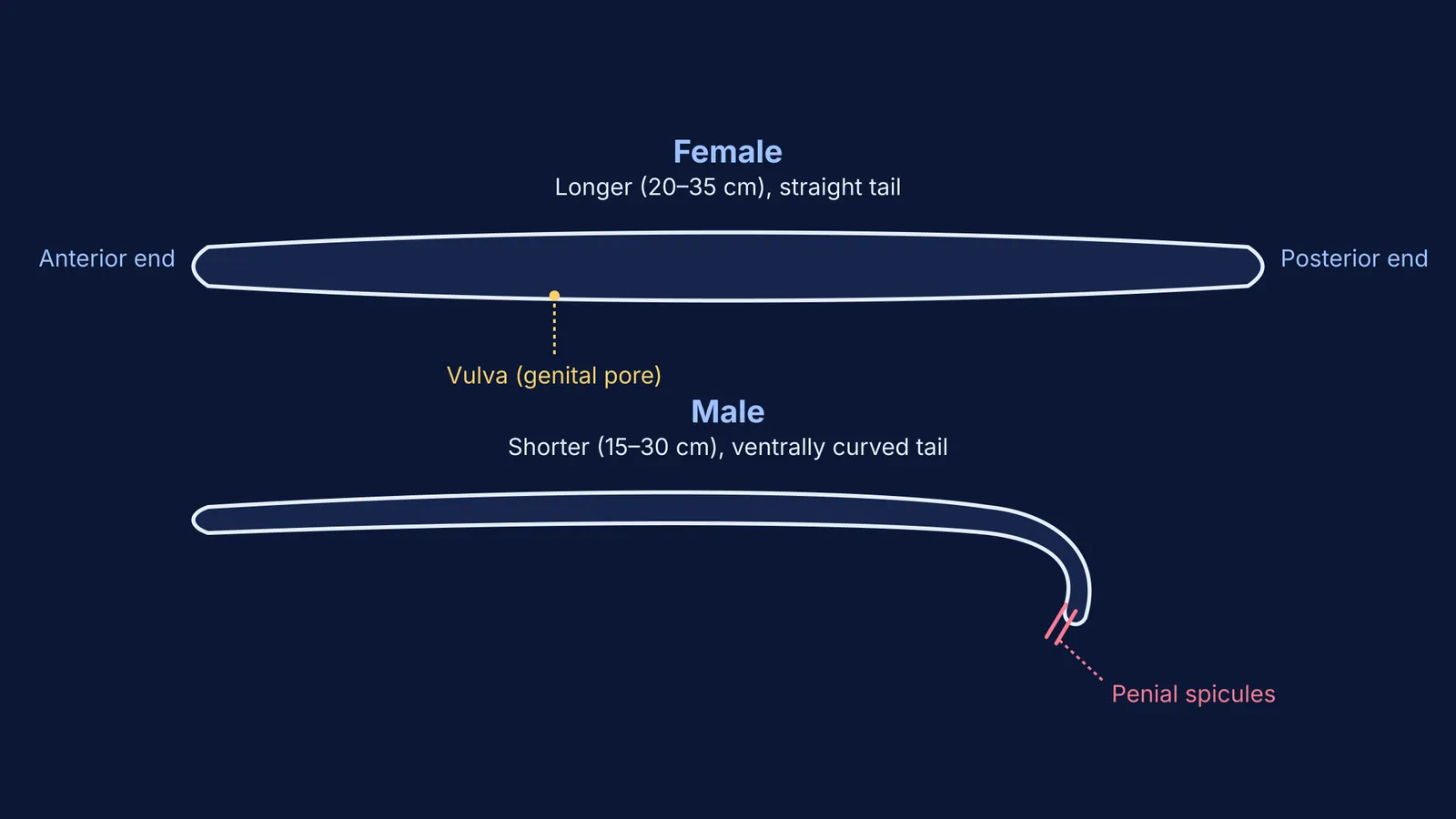
Body length and width: Females are noticeably larger, typically measuring 20 to 35 cm in length. Males are shorter, usually between 15 and 30 cm long, as detailed by the CDC.
Tail shape: This is the most reliable visual clue. The female has a straight, pointed posterior end. The male’s tail curves ventrally into a tight hook shape.
Copulatory organs: At the curved tail of the male, you will find two small bristles called penial spicules (or setae) protruding from the cloaca. The male uses these to hold the female's genital pore open during mating. Females do not possess spicules.
Genital openings: The female has a dedicated genital pore, or vulva, located on the ventral (belly) side, about one-third of the way down from the anterior end. In males, the digestive and reproductive tracts merge into a single exit opening called the cloaca at the tail end.
If you are trying to picture these different body plans or finding it hard to keep track of which phyla have which features, the Fermi Concept Library contains every concept in physics, chemistry, biology, mathematics and computing, each with its own lesson and its place in the map.
What are the key roundworm features of Ascaris?
Beyond their differences, male and female *Ascaris* share the defining traits of the phylum Aschelminthes. The syllabus highlights several major characteristics that govern how these worms live and function:
The Pseudocoelom: They are described as pseudocoelomate animals. This means their body cavity is not fully lined by mesoderm. Instead, the mesoderm is present as scattered pouches between the outer ectoderm and inner endoderm. This false cavity acts as a hydrostatic skeleton, giving the worm its shape.
Body symmetry and tissues: Roundworms are bilaterally symmetrical and triploblastic, meaning they develop from three primary germ layers.
Digestive system: *Ascaris* has a complete alimentary canal. A standout feature is the well-developed muscular pharynx, which it relies on to actively pump digested food from the host's intestine into its own gut.
Just as you might categorise animals by how they handle nitrogenous waste into ammonotelic, ureotelic and uricotelic groups, understanding body cavities separates the pseudocoelomates from true coelomates. And if you are revising biological classification from the ground up, placing these worms is just as vital as knowing where to place the viruses, viroids and lichens that defy normal kingdom rules.
Because *Ascaris lumbricoides* is an endoparasite living in the human small intestine, it has adapted a thick, tough outer cuticle to survive the host's harsh digestive enzymes. Infection causes the disease ascariasis, which can result in abdominal pain and intestinal obstruction, and is typically transmitted through contaminated soil or water, according to the WHO.
When you sit down to study these organisms, Fermi's AI tutor works out what you already know, builds a plan for the session, and teaches through it, checking understanding as it goes. By keeping the visual differences straight—the long, straight female and the shorter, hooked male—you will easily navigate the details of this classic roundworm.


