

On this page
Whenever several planets gather in the evening sky, messages go round claiming that the "alignment" will pull on the oceans and raise unusual tides. The short answer is that planetary alignments have no meaningful effect on tides. NASA's Jet Propulsion Laboratory puts it plainly: the only two bodies that can affect Earth's tides are the Moon and the Sun, and the other planets have a negligible effect on the Earth. You do not have to take that on trust. One formula from Class 11 gravitation and the numbers on NASA's fact sheets are enough to check it yourself, and the method is exactly what JEE and NEET questions on tides test.
What a planetary parade looks like, and why the planets only appear close together, is covered in what a planetary parade is and how to see one. Here we do the tidal arithmetic that post leaves out.
Why do tides depend on the difference in pull, not the pull itself?
Earth is in free fall towards every body that pulls on it. If the Moon pulled every drop of ocean exactly as hard as it pulls Earth's centre, everything would fall together and nothing would move relative to the ground. Tides come only from the difference in pull across Earth.
The pull at distance d is a = GM/d². On the side facing the body you are a distance R closer, so the pull is a little larger. Differentiating, the change across one Earth radius is:
Δa ≈ |da/dd| × R = 2GMR/d³
This is the tidal acceleration. The key point is the cube. The direct pull falls as 1/d², but the tidal effect falls as 1/d³, so distance punishes it much harder. If you want to see the stretching arrows drawn over the whole globe, see tidal forces of the Moon, visualised.
Units check: G (m³ kg⁻¹ s⁻²) × M (kg) × R (m) ÷ d³ (m³) gives m/s², an acceleration, as it should.
How strong are the Moon's and the Sun's tides?
Take R = 6.371 × 10⁶ m and G = 6.674 × 10⁻¹¹ N m² kg⁻². From the NASA Moon fact sheet, the Moon's mass is 7.346 × 10²² kg and its mean distance 3.844 × 10⁸ m. From the NASA Sun fact sheet, the Sun's mass is 1.9884 × 10³⁰ kg, at about 1.496 × 10¹¹ m.
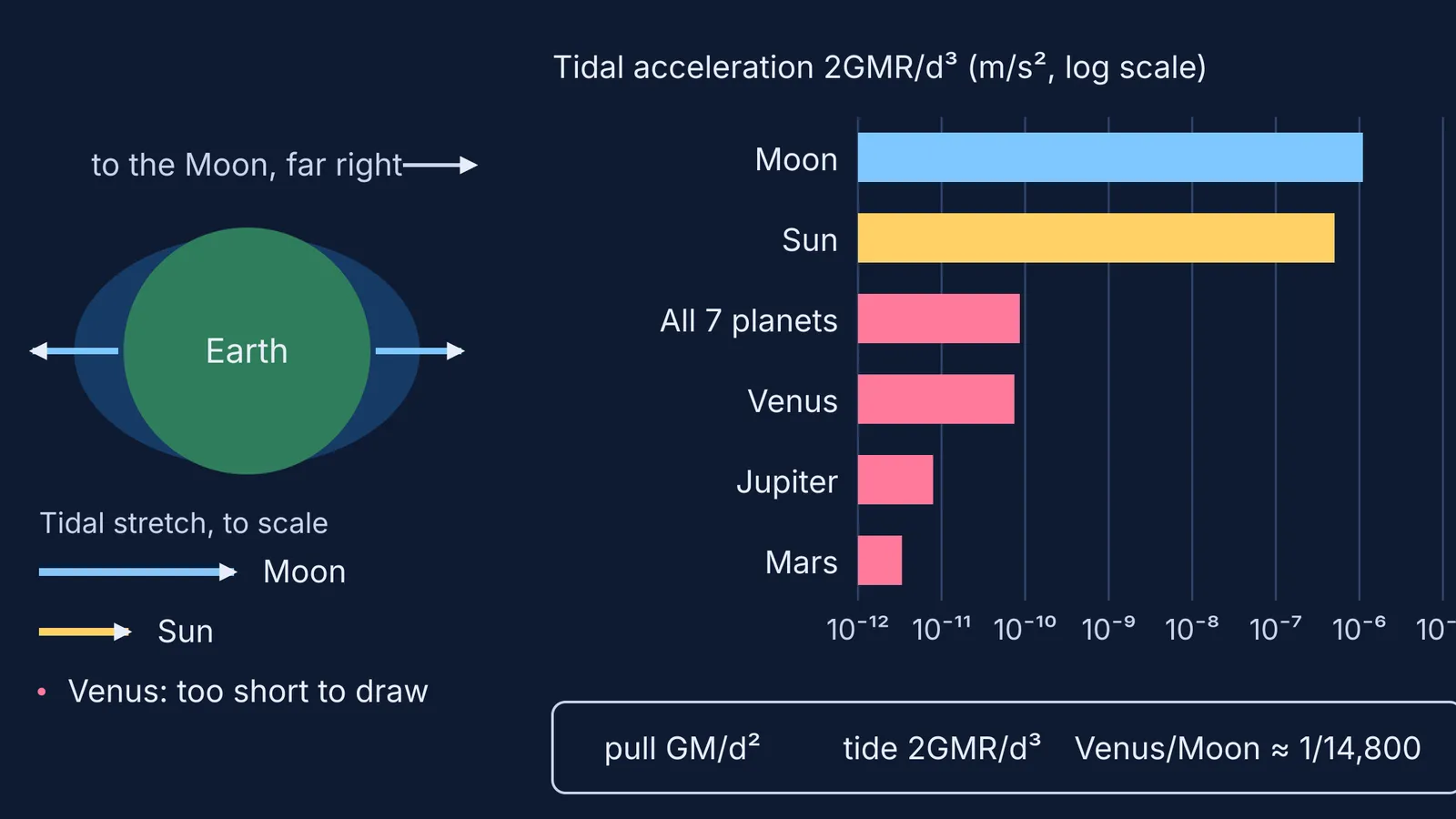
Moon: 2GMR/d³ = 1.10 × 10⁻⁶ m/s²
Sun: 2GMR/d³ = 5.05 × 10⁻⁷ m/s², about 0.46 of the Moon's
The Sun's direct pull on Earth is about 179 times the Moon's, yet its tide is less than half the Moon's. That single fact shows why you must use 1/d³ and not 1/d² for tides.
Worked example: how much tide does Venus raise at its closest?
Venus comes closer to Earth than any other planet. The NASA Venus fact sheet gives its mass as 4.8673 × 10²⁴ kg and its minimum distance from Earth as 38.2 million km, so d = 3.82 × 10¹⁰ m.
Direct pull. GM/d² = (6.674 × 10⁻¹¹ × 4.8673 × 10²⁴) ÷ (3.82 × 10¹⁰)² = 2.23 × 10⁻⁷ m/s².
Tidal acceleration. 2GMR/d³ = 2 × 6.674 × 10⁻¹¹ × 4.8673 × 10²⁴ × 6.371 × 10⁶ ÷ (3.82 × 10¹⁰)³ = 7.43 × 10⁻¹¹ m/s².
Compare with the Moon. 1.10 × 10⁻⁶ ÷ 7.43 × 10⁻¹¹ ≈ 14,800. Venus at its very closest stretches the oceans about 14,800 times more weakly than the Moon.
Turn it into a height. In the simple equilibrium-tide model, the Moon's bulge rises h = (Moon's mass ÷ Earth's mass) × (R/d)³ × R above the mean level. With Earth's mass 5.9724 × 10²⁴ kg, h = 0.0123 × (6.371 × 10⁶ ÷ 3.844 × 10⁸)³ × 6.371 × 10⁶ ≈ 0.36 m.
Scale it. Tide height is proportional to tidal acceleration, so Venus raises about 0.36 m ÷ 14,800 ≈ 2.4 × 10⁻⁵ m, or 24 µm.
That is about a quarter of the thickness of a sheet of paper. Real ocean tides are larger than the equilibrium model because ocean basins resonate, but that amplification multiplies every body's forcing by the same factor, so the ratio of 1 to 14,800 stays.
What happens if all the planets line up?
Using the closest distances and masses from NASA's planetary fact sheets, the tidal accelerations on Earth are:
Venus: 7.4 × 10⁻¹¹ m/s²
Jupiter: 7.9 × 10⁻¹² m/s²
Mars: 3.4 × 10⁻¹² m/s²
Mercury: 6.1 × 10⁻¹³ m/s²
Saturn: 2.8 × 10⁻¹³ m/s²
Uranus: 4.3 × 10⁻¹⁵ m/s²
Neptune: 1.1 × 10⁻¹⁵ m/s²
Adding all seven gives 8.6 × 10⁻¹¹ m/s², about 1/12,700 of the Moon's. Scaled to the 0.36 m lunar bulge, that is about 28 µm of water.
Even that is far too generous. Venus is closest when it lies between Earth and the Sun, while Jupiter is closest when it is on the opposite side of Earth from the Sun, so the two can never be closest at the same time. And planets in a "parade" are not in a straight line in space; they only look close together in the sky. NASA's page on the planetary alignment of May 2000 makes the same point: the combined gravitational effect of all the planets together is much less than the effect of the Sun or the Moon.
How does that compare with things that do change the tide?
The Moon's own orbit matters far more. From the NASA Moon fact sheet, its distance varies between about 363,300 km at perigee and 405,500 km at apogee. Because the tide goes as 1/d³, the tidal pull at perigee is (405.5 ÷ 363.3)³ ≈ 1.39 times that at apogee. In the equilibrium model the bulge changes from about 0.30 m to about 0.42 m, a difference of 12 cm. That happens every month, and it is about 4,000 times bigger than everything the planets could add even in an impossible perfect line-up.
A fun comparison on direct pull: a 70 kg person standing 0.5 m from you pulls on you with GM/d² = 1.9 × 10⁻⁸ m/s². Mars at its closest pulls on you with 1.4 × 10⁻⁸ m/s². Neither one raises a tide on you, for the same reason.
The same 1/d³ law also decides when tides become strong enough to tear a body apart, which is the subject of the Roche limit and planetary rings. If you want to practise more numericals of this type, the Fermi Problem Library has a step-by-step solver that explains the reasoning at each line, and the Concept Library covers gravitation and tidal forces concept by concept.
Quick checklist
Tides come from the difference in pull across Earth, not the pull itself.
Tidal acceleration is 2GMR/d³; it falls as 1/d³.
The Sun pulls 179 times harder than the Moon but raises less than half the tide.
Venus at its closest gives 1/14,800 of the Moon's tide, about 24 µm.
All seven planets together give at most about 28 µm, and they can never all be closest at once.
The Moon's monthly change in distance shifts the tide about 4,000 times more than the planets can.


