On this page
The Moon stretches Earth's oceans. Now imagine a moon so close to its planet that the stretch beats the gravity holding the moon together. A 19th-century mathematician in Montpellier worked out where that line falls, and it explains planetary rings.
Who was Édouard Roche?
Édouard Roche was born in Montpellier, France, on 17 October 1820 and died there on 27 April 1883, according to his Wikipedia biography. He studied at the University of Montpellier and taught in its Faculté des Sciences from 1849. Three ideas in celestial mechanics carry his name: the Roche sphere, the Roche lobe and the Roche limit. He was not famous in his lifetime: in 1883 he received one vote out of 56 for membership of the French Academy of Sciences.
What is the Roche limit, in plain words?
The Roche limit is the distance from a planet within which a second body, held together only by its own gravity, falls apart because the planet's tidal forces exceed its self-gravity (Wikipedia, Roche limit). Roche first calculated this limit in 1848.
Tidal force is the difference in pull across an object. The near side of a moon is pulled harder than the far side, so the moon is stretched along the line to the planet; the same stretch makes Earth's two ocean bulges, drawn as arrows in why there are two high tides a day. Move a moon closer and the stretch grows faster than the planet's ordinary pull, until it beats the moon's own gravity.
How do you calculate the Roche limit?
The Roche limit article gives two textbook versions. For a rigid moon, d = R × (2ρP / ρm)^(1/3). For a fluid moon that can deform, d ≈ 2.44 × R × (ρP / ρm)^(1/3). Here R is the planet's radius and ρP and ρm are the planet's and moon's densities. The moon's size does not appear: only the planet's radius and the density ratio matter.
Worked example 1: could our Moon be torn apart?
NASA's Moon fact sheet gives Earth's mean radius as 6,371 km, Earth's density as 5,514 kg/m³ and the Moon's as 3,344 kg/m³.
Density ratio: 5,514 ÷ 3,344 = 1.649.
Cube root: 1.649^(1/3) = 1.18.
Fluid limit: 2.44 × 6,371 km × 1.18 ≈ 18,400 km.
The same sheet puts the Moon's average distance at 384,400 km, about 21 times the fluid limit. Our Moon is safe.
Worked example 2: where should Saturn's rings be?
NASA's Saturn fact sheet lists an equatorial radius of 60,268 km and a mean density of 687 kg/m³ (which is why people ask whether Saturn could float in water). The ring particles are mostly water ice (NASA Science), and the USGS puts ice at about 90 percent of the density of water, so take 900 kg/m³.
Density ratio: 687 ÷ 900 = 0.763.
Cube root: 0.763^(1/3) = 0.914.
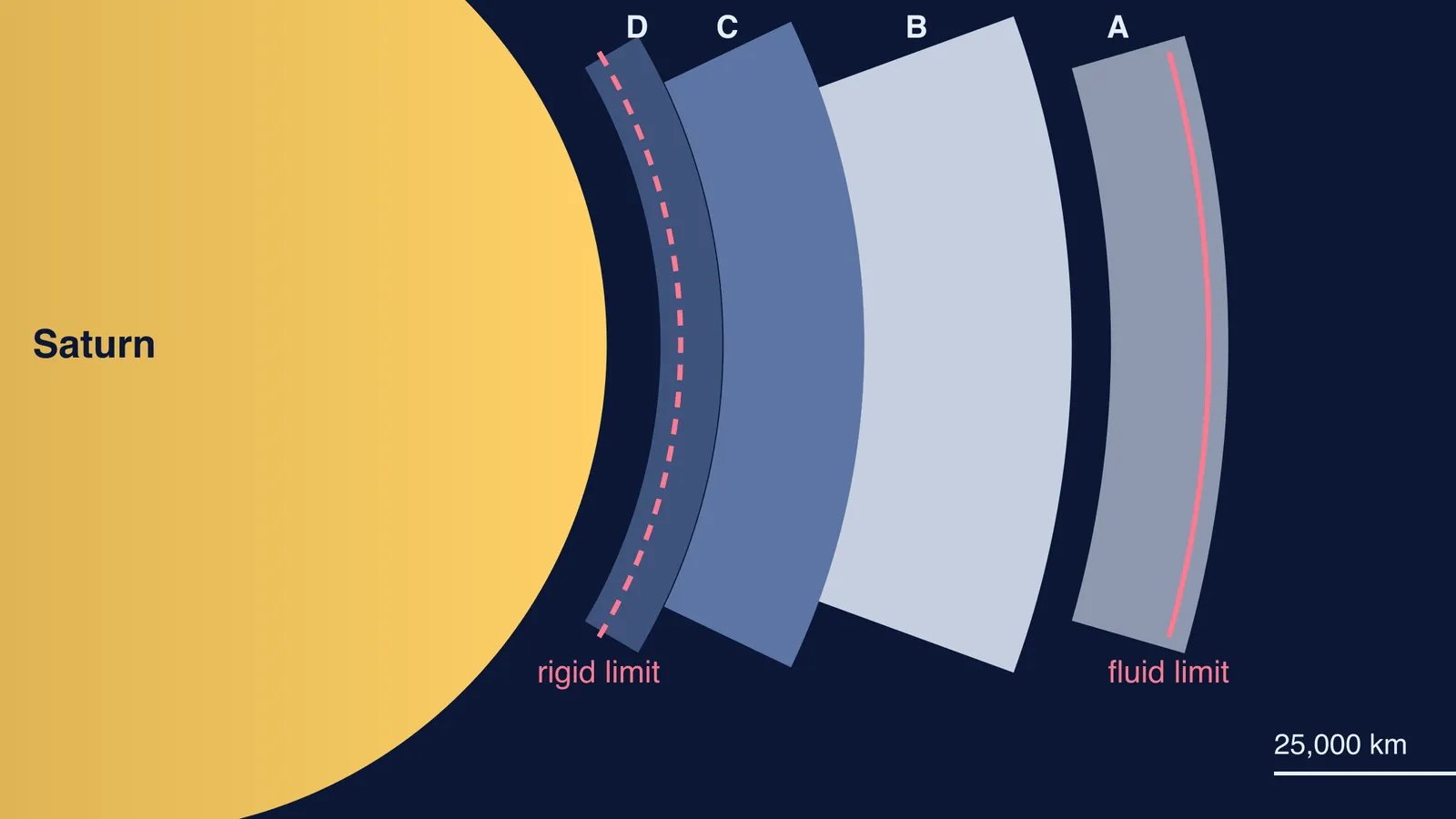
Fluid limit: 2.44 × 60,268 km × 0.914 ≈ 134,400 km.
Rigid limit: 60,268 km × (2 × 0.763)^(1/3) ≈ 69,400 km.
Why does Saturn have rings?
NASA's Saturnian rings fact sheet puts the main rings between 66,900 km (inner edge of the D ring) and 136,780 km (outer edge of the A ring). That closely matches the band our two limits mark out, given our assumed ice density; the A ring ends within about 2 percent of the fluid limit.
Roche's own suggestion was that Saturn's rings formed when a moon came too close and was pulled apart (Wikipedia). Whatever their origin, the limit explains why the material stays a ring: inside it, loose ice cannot gather into a new moon. Almost all known planetary rings lie within their Roche limit, with exceptions such as Saturn's E ring and Phoebe ring. Long before Roche, Christiaan Huygens was the first to explain that Saturn is circled by a thin, flat ring.
Has anyone seen the Roche limit in action?
Yes. Comet Shoemaker-Levy 9 made a close approach to Jupiter in July 1992 and was torn apart by tidal forces into more than 20 pieces; they hit Jupiter between 16 and 22 July 1994 (NASA Science).
Closer to home, Mars is drawing in its moon Phobos by about 2 metres every hundred years, and scientists expect it to be pulled apart in 30 to 50 million years (NASA, 2015).
How to remember and use the Roche limit
A quick checklist for exam answers:
Name the contest: the planet's tidal stretch against the moon's self-gravity.
Write the fluid formula with the planet's density on top.
Check the scale: the answer should be a few planet radii.
Remember that the moon's size cancels out.
Give one example: Saturn's rings, Shoemaker-Levy 9 or Phobos.
If tides are hard to picture, the Fermi Simulation Lab has interactive simulations for ideas that are easier to see than to read. To practise gravitation numericals like the two above, the Fermi Problem Library has worked problems with a step-by-step solver that explains the reasoning rather than printing an answer.
Next time you see Saturn, remember: two densities, one radius and a cube root tell you where its rings should be.