On this page
It is a classic staple of space trivia: if you could find a bathtub big enough, Saturn would float in it.
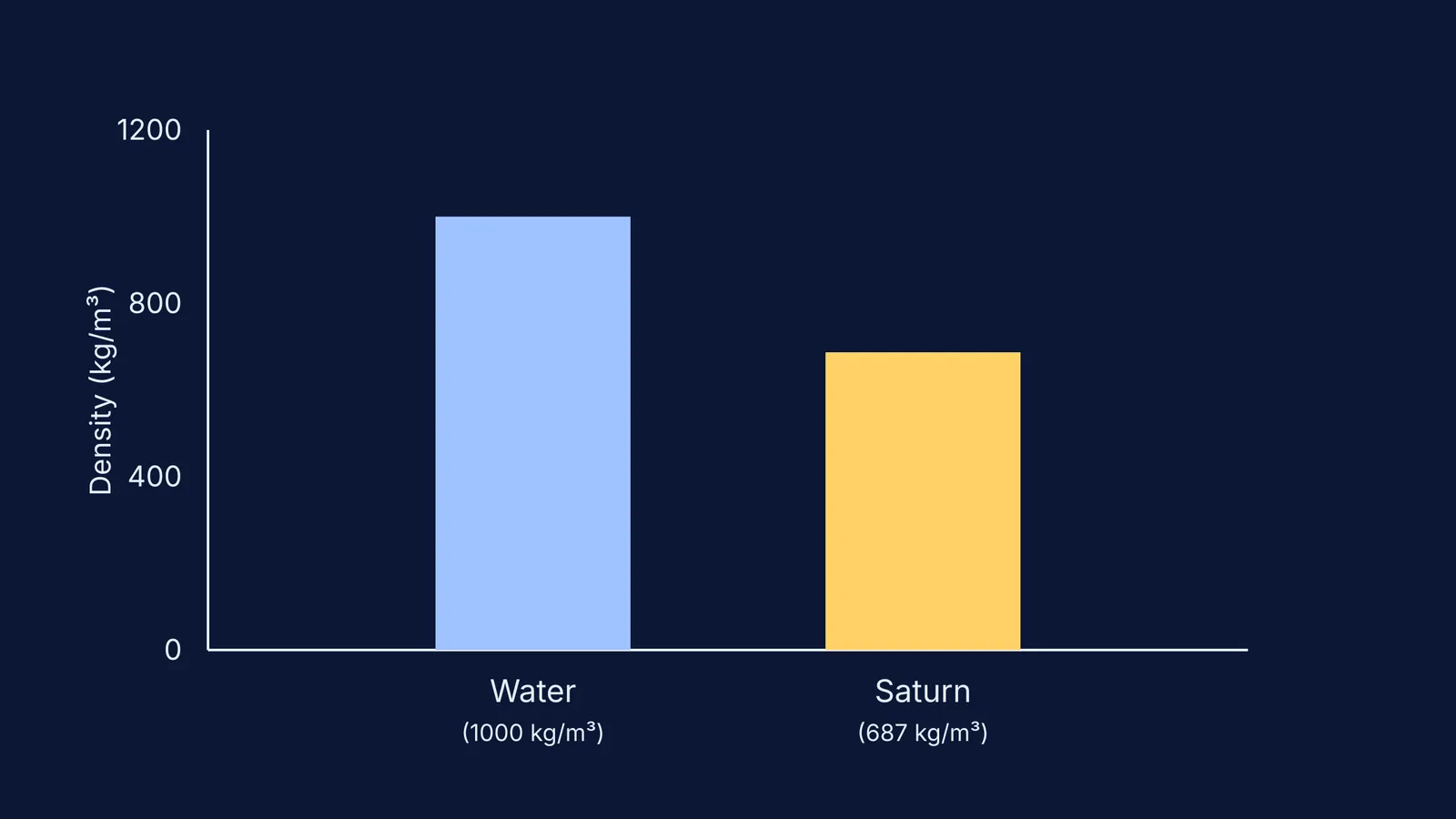
The math behind the claim is sound. Density is simply mass divided by volume. According to the NASA Planetary Fact Sheet, Saturn has an average density of 687 kg/m³. Water, by standard reference, has a density of roughly 1,000 kg/m³. Because Archimedes' principle states that an object will float if it is less dense than the fluid it is placed in, a naive calculation says that Saturn would bob on the surface.
But physics is about reality, not just plugging numbers into formulas. What happens when we subject this thought experiment to physical scrutiny?
Why is Saturn so much less dense than Earth?
To understand the bathtub myth, we first have to look at what Saturn is made of. The rocky inner planets of our solar system are dense. Earth is mostly rock and metal, giving it a mean density of 5,513 kg/m³, according to the NASA Planetary Fact Sheet.
Saturn, however, is a gas giant. It formed further away from the Sun, where temperatures were low enough for lightweight gases to accumulate in massive quantities. Its immense volume is overwhelmingly composed of hydrogen and helium, the two lightest elements in the universe. While the planet is gigantic in size, this light composition drags its average density down below that of liquid water.
Does Saturn have a solid surface?
The first physical problem with the bathtub myth is that Saturn is not a rigid billiard ball. It lacks a solid outer surface, meaning it cannot interact with a liquid in the way a rubber duck does.
When we drop a solid object into water, the object displaces the liquid and maintains its own structural integrity. If you attempted to place Saturn in an unimaginably large ocean, the planet would not hold its spherical shape. The outer layers of hydrogen and helium gas would likely disperse, dissolve into the water, or be stripped away entirely by the surrounding environment.
Deep beneath those gaseous layers, Saturn hides a dense, rocky core. Without the outer layers of gas to lower the average density of the remaining object, this core—which is much denser than water—would quickly sink straight to the bottom, a reality often cited by physicists. If you want to dive deeper into the mechanics of rigid boundaries and restoring forces, exploring the SHM of a floating body can clarify what a proper floating object looks like in equilibrium.
Would gravity allow a giant bathtub?
The second problem is the scale of the "bathtub" itself.
Saturn is enormous. At 568.32 × 10²⁴ kg, it is more than 95 times as massive as Earth. To hold it, you would need a body of water significantly larger and more massive than the planet. A body of water that large would exert an immense gravitational pull of its own.
Instead of Saturn resting peacefully on the surface, the overwhelming gravity of the giant ocean would pull Saturn in, while Saturn's gravity would tear the water apart. The collision would result in a massive, swirling mixture of steam, water and gas. The intense pressure from the combined mass would prevent any calm floating, instead pulling both bodies into a catastrophic gravitational collapse. It is a fundamental difference between a local point mass and a massive gravitational body; distinguishing these effects is much like understanding the centre of gravity vs centre of mass.
Why does this thought experiment matter?
Testing the Saturn bathtub myth is a brilliant exercise in learning science. It forces us to stop blindly applying a rule (density determines floating) and start questioning the physical assumptions behind the rule (is the object solid, and what role does gravity play at this scale?).
When you are solving complex problems, you need to look beyond the surface numbers. This is where Fermi's AI tutor changes how students learn physics. Instead of simply affirming that 687 is less than 1,000, it asks what happens to the gas when it touches the water, checking understanding as it goes. For visualising how scale and mass interact in space, the Fermi Simulation Lab lets you run interactive simulations for the ideas that are easier to see than to read.
The bathtub myth is fun, but the real physics of giant planets and infinite oceans is far more interesting.