

On this page
To name a fish scale in an exam diagram, ask two questions: is it a little tooth in the skin or a flat plate, and if a plate, what does its rear edge look like? Here is what each type is, which fish carry it, and a quick way to draw all three.
What is the difference between placoid, cycloid and ctenoid scales?
The Australian Museum groups fish scales into placoid (sharks and rays), cosmoid (lungfishes and some fossil fishes), ganoid (bichirs, the bowfin, paddlefishes, gars and sturgeons), and cycloid and ctenoid (most bony fishes). School syllabuses focus on the three in this post.
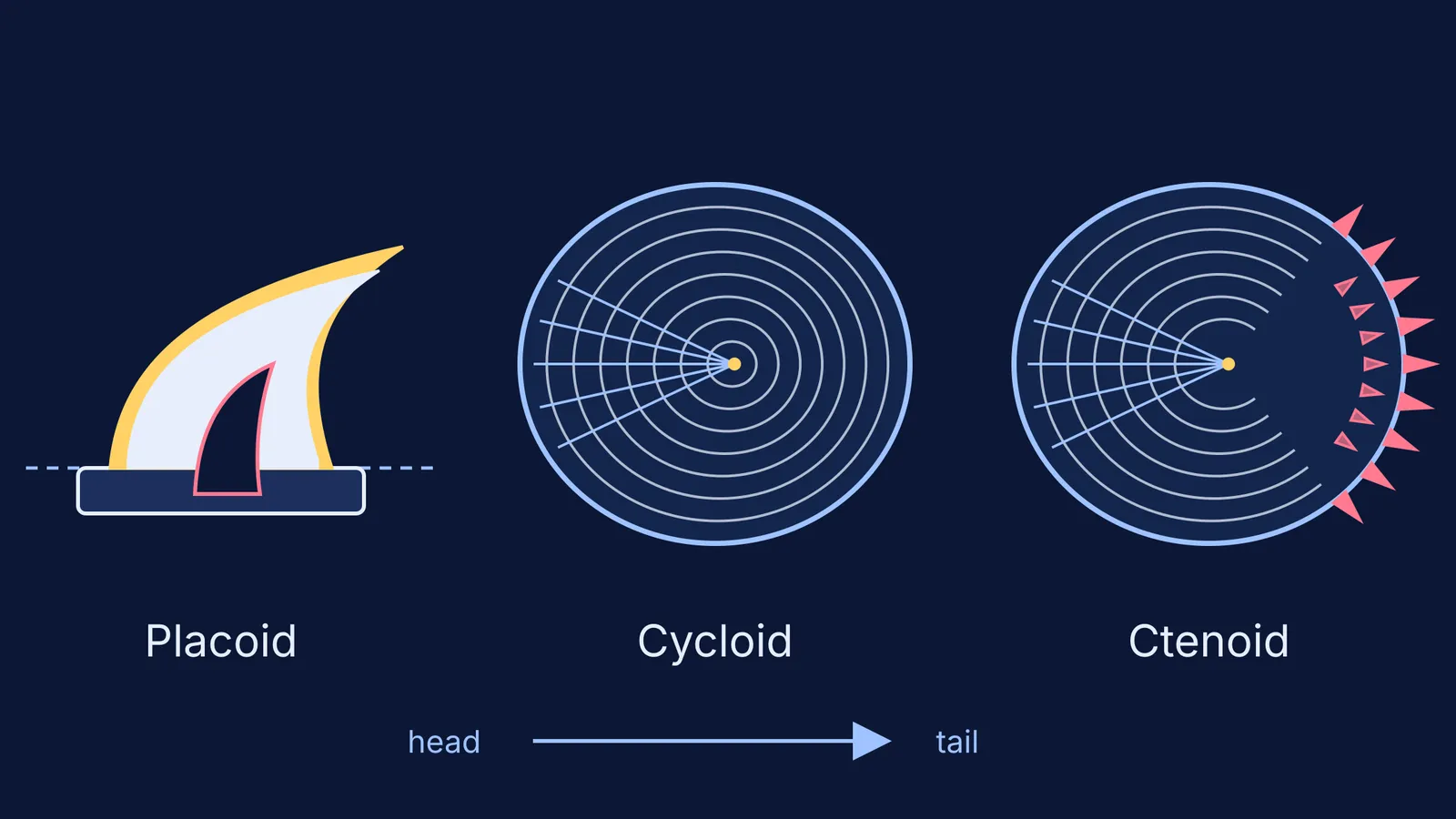
Placoid scales are small tooth-like structures. A study of shark denticles in EvoDevo by Rory Cooper and colleagues describes them as a central pulp cavity surrounded by a dentine layer, encased in an enamel-like covering called enameloid. The paper calls them dermal denticles and notes that recent genetic work supports the old idea that denticles and teeth share deep homology, with their development controlled by a common gene network.
Cycloid scales are thin plates with a smooth rear edge. The Australian Museum's guide to cycloid and ctenoid scales defines them as having "a smooth posterior margin lacking ctenii".
Ctenoid scales are the same kind of plate with a spiny rear edge. The same guide says ctenoid scales have "a variously developed spiny posterior margin", and the name comes from the Greek for comb. It also notes that the front part of each scale is usually overlapped by the rear part of the scale in front, so on a living fish you mostly see the rear edges.
Which fish have placoid, cycloid and ctenoid scales?
Placoid: cartilaginous fishes, the sharks and rays, according to the Australian Museum. If you want to know why this makes shark skin feel like sandpaper, read our post on why shark skin is rough and how denticles cut drag.
Cycloid and ctenoid: bony fishes. A paper in the Indian Journal of Fisheries by V. R. Prakasam and Pius Johnson found that the oil sardine (Sardinella longiceps) has cycloid scales and the climbing perch (Anabas testudineus) has ctenoid scales.
Both on one fish: the same paper found both types on the pearl spot (Etroplus suratensis), the karimeen of Kerala. The Australian Museum adds that some flatfishes, such as flounders and soles, have ctenoid scales on the eyed side and cycloid scales on the blind side.
So "bony fish equals cycloid" is not a safe shortcut. For the scientific names that turn up in these questions, see our list of dog fish, saw fish and sting ray scientific names.
How do you spot each scale type in a diagram?
Work through these checks in order:
Is it drawn in side view, sitting on a base plate in the skin, with a point sticking out backwards? That is placoid. Look for the labels pulp cavity, dentine and enamel or enameloid. A flat plate will never have a pulp cavity.
Is it a flat, roughly round plate with concentric rings? It is cycloid or ctenoid. The rings are growth rings called circuli. The Australian Museum explains that slower growth in cooler months packs the circuli together into a band called an annulus, and counting the annuli lets you estimate the age of the fish.
Now look at the rear edge, the side facing the tail. Smooth all round means cycloid. A fringe of small teeth means ctenoid.
How do you draw placoid, cycloid and ctenoid scales quickly?
With practice you can draw all three in a couple of minutes. Put the tail to your right each time, so the rear edge is always on the right.
Placoid: draw a short horizontal line for the skin surface and a flat rectangle just below it for the basal plate. Rise a thorn shape from the plate that curves up and back to a point on the right. Shade a thin outer band (enameloid), leave the middle (dentine) and draw a small hollow inside (pulp cavity).
Cycloid: draw a circle. Put a dot slightly right of centre for the focus. Add three or four rings around it and a few straight lines (radii) fanning out to the left edge. Keep the right edge smooth.
Ctenoid: copy the cycloid, but stop the rings before they reach the right-hand side. Add a row of small triangles along the right edge, pointing outwards. Those are the ctenii.
Label each drawing with its name and one example fish: shark, oil sardine, climbing perch.
If you mix up dentine, keratin and bone, read whether feathers, hair and scales are made of the same protein. Each idea in animal classification has its own lesson in the Fermi Concept Library, and Fermi's AI tutor can draw the figure with you and check your understanding as you go.


