

On this page
Shark skin feels rough because it is not covered in smooth, overlapping scales like a rohu's. It is covered in tiny teeth, and the ridges on those teeth change how water flows past the shark.
Why is shark skin rough?
Shark skin is covered in dermal denticles, tooth-like structures made of enameloid, dentine and a central pulp cavity (Gabler-Smith and colleagues, Integrative Organismal Biology, 2021). The same study compared denticles on the skin covering the gill pouches of 13 shark species and found that their shape changes even across this small patch: on average, denticles at the leading edge of each gill pouch were shorter and wider than those at the trailing edge, and in every species studied they were smoother-edged.
Your biology textbook calls them placoid scales, and our explainer on shark features such as cartilage, placoid scales and the missing air bladder covers the syllabus side.
How can ridges on a surface reduce drag?
On fast-swimming sharks, the skin carries riblet structures aligned with the direction of flow, and these are known to reduce skin-friction drag in turbulent flow (Dean and Bhushan, Philosophical Transactions of the Royal Society A, 2010). Skin friction is the drag from fluid rubbing along a surface, as opposed to the drag from pushing fluid out of the way; our post on fluid friction and why fish, birds and planes are streamlined explains the difference.
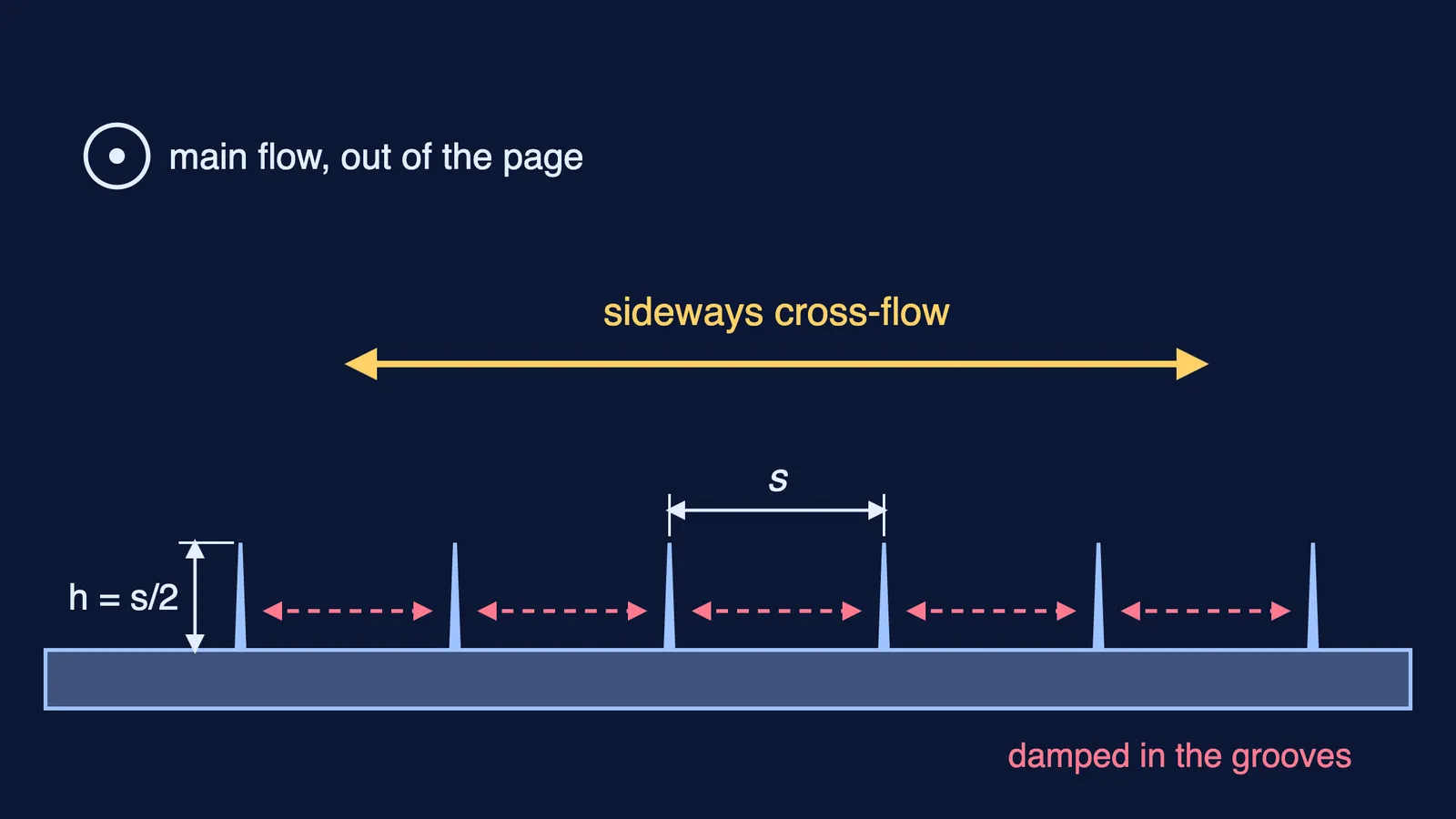
That sounds backwards. Surely smooth is best? Not in turbulent flow. Near the wall, turbulence keeps sloshing fluid sideways, and that churning carries momentum into the surface. The theory Bechert's team tested assumes that riblets impede this fluctuating sideways crossflow near the wall, which reduces momentum transfer and shear stress, and their measurements supported it (Bechert and colleagues, Journal of Fluid Mechanics, 1997).
Bechert's team measured this in the Berlin oil channel. Ordinary triangular and semicircular grooves cut skin friction by about 5%. Thin blade ribs with grooves half as deep as the rib spacing cut it by 8.7%, and by a record 9.9% once small gaps and similar flaws were eliminated. A sturdier trapezoidal shape, designed for riblet film on aircraft, still gave 8.2%.
Did shark-skin swimsuits actually work?
In 2012, Johannes Oeffner and George Lauder at Harvard tested the claim with a robotic flapping foil that measured self-propelled swimming speed (Journal of Experimental Biology, 2012). Here is what they found:
A Speedo "shark skin-like" swimsuit fabric gave no consistent increase in swimming speed.
A silicone riblet material made the foil 7.2% faster.
Real shark skin, flexing like a membrane, was 12.3% faster than the same skin with its denticles removed.
Real shark skin held rigid on flat plates did not show that gain.
Flow imaging suggested the denticles strengthen suction at the front edge of the moving skin, so they may add thrust as well as cut drag.
In 2014, Li Wen, James Weaver and Lauder 3D-printed thousands of denticles, modelled on the shortfin mako, onto flexible membranes (Journal of Experimental Biology, 2014). At one motion setting (1.5 Hz, plus or minus 1 cm), swimming speed rose 6.6% and the energy cost of transport fell 5.9% compared with a smooth control.
What did aircraft tests find?
The thin layer of air flowing along an airliner's skin is turbulent, which is where riblets work. In December 2022, Lufthansa Technik said the European Union Aviation Safety Agency had granted a certificate for its AeroSHARK riblet film, made with BASF, on Boeing 777-300ER and 777F aircraft, and that fuel use and CO2 emissions fall by around one percent (Lufthansa Technik, 2022).
In April 2025, the company said Austrian Airlines had finished fitting the film to four Boeing 777-200ERs (Lufthansa Technik, 2025). Its riblets measure about 50 micrometres, each aircraft gets 830 square metres on the fuselage and engine nacelles, and the saving is around one percent of fuel per flight. The airline projects fuel savings of around 2,650 tonnes across the four aircraft.
How do you read a "drag cut by X%" claim?
Lab riblets: up to 9.9% less skin friction (Bechert and colleagues, 1997). A riblet-covered 777: about 1% less fuel (Lufthansa Technik, 2022). Neither number is wrong; they measure different things. Ask five questions before you believe any shark-skin claim:
What was measured: skin friction, total drag, speed or fuel? Riblets act on skin friction only.
How much of the object was covered? The 777 film goes on the fuselage and nacelles, not every surface.
Was the flow turbulent? Riblets are a turbulent-flow tool.
Did the test surface move like the real one? Shark skin helped when flexing, not when rigid.
What was the control? Oeffner and Lauder compared shark skin with the same skin minus its denticles.
Worked example: the Austrian figures give 2,650 tonnes divided by 4 aircraft, about 660 tonnes of fuel per aircraft. One percent, flight after flight, adds up.
If turbulence near a wall is hard to picture from text, the Fermi Simulation Lab has interactive simulations for ideas that are easier to see than read. And if fluids feels like a pile of loose terms, Fermi's AI tutor can work out what you already know and build a plan for the session, so you start from a clear next step.
Next time a product says "inspired by shark skin", run it through the five questions first.


