On this page
Photosynthesis in Higher Plants (NCERT Class 11, Chapter 11) belongs to the Plant Physiology unit (Unit 4) of the NEET (UG) 2026 syllabus. Most wrong answers on it are half-right facts placed in the wrong cell, compartment or condition.
Each of the eight slips below gets why it feels right, what the NCERT chapter says (section in brackets), a check and a habit. For the full chapter walk-through, start with our photosynthesis guide for NEET.
Which side of the membrane, and which cell?
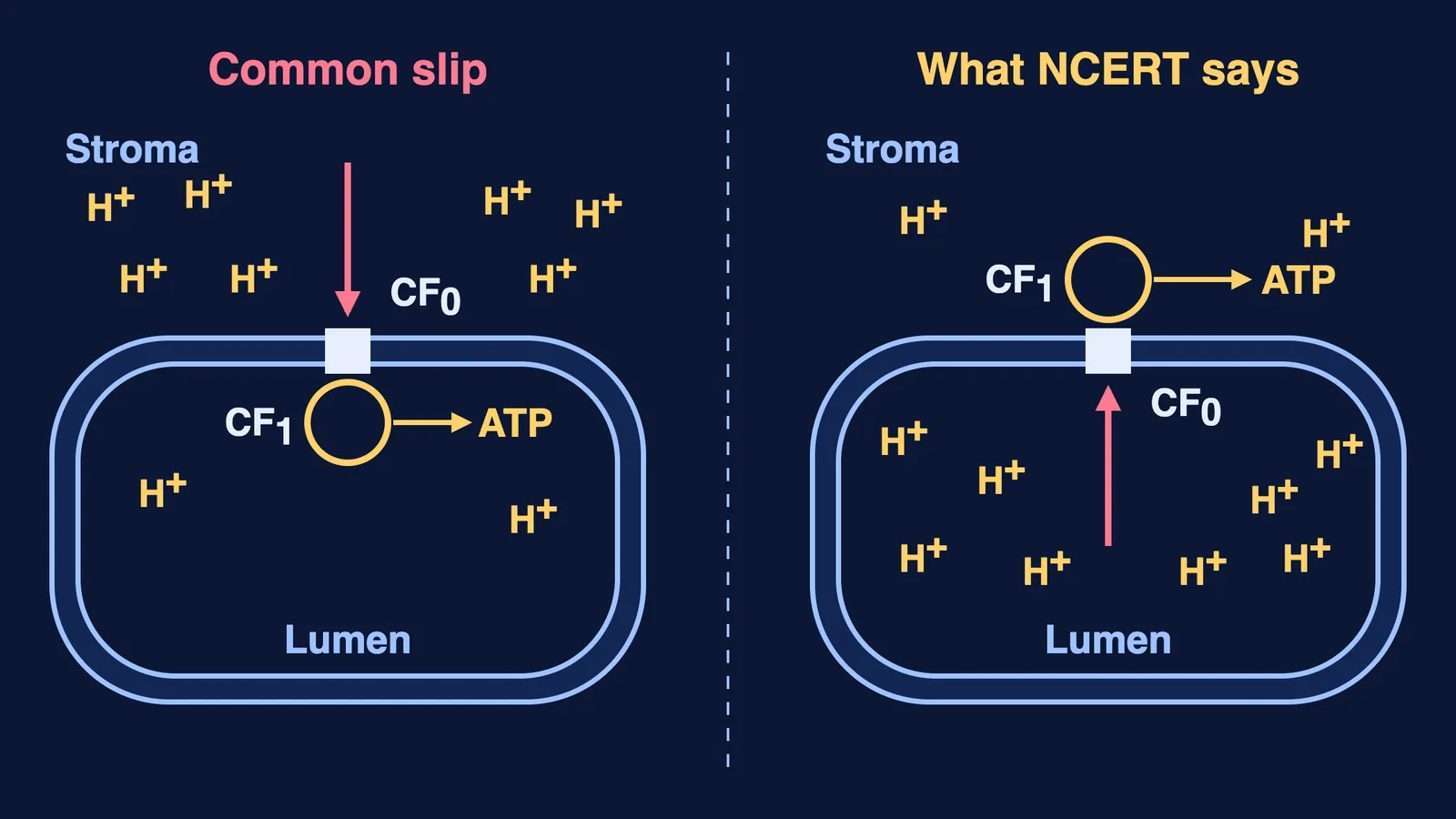
"Protons pile up in the stroma, and the ATP-making head of ATP synthase faces the lumen."
Why it feels right: students carry the mitochondrial picture into the chloroplast and flip the compartments.
What NCERT says (11.6.3): water splitting and electron transport load protons into the thylakoid lumen, so the lumen's pH drops. They return via the CF0 channel in the membrane, and CF1, which sticks out on the stroma side, makes the ATP.
Check: this ATP is used at once in the stroma. If CF1 faced the lumen, could the Calvin cycle reach it? (No.)
Habit: sketch one thylakoid before any chemiosmosis question: H+ inside, CF1 knob outside.
"Bundle sheath cells are full of air spaces so CO2 can reach RuBisCO easily."
Why it feels right: spongy mesophyll has air spaces, so students assume every leaf cell does.
What NCERT says (11.8): in Kranz anatomy the bundle sheath cells have many chloroplasts, thick walls that gases cannot cross, and no intercellular spaces. Their CO2 arrives inside 4-carbon acids from the mesophyll and is released there.
Check: if these walls let gas leak freely, what would happen to the CO2 level around RuBisCO, and to its oxygenase activity? (CO2 would leak away and oxygenase activity would rise, the reverse of NCERT 11.9.)
Habit: for each C4 feature, ask what it does to CO2 at RuBisCO.
Which look-alike ideas get swapped?
"The action spectrum of photosynthesis is just chlorophyll a's absorption spectrum."
Why it feels right: both graphs peak in blue and red, so they look like one curve drawn twice.
What NCERT says (11.4): most photosynthesis happens in the blue and red regions where chlorophyll a absorbs strongly, but the two curves do not match one-to-one, because some photosynthesis also runs at other visible wavelengths.
Check: if a leaf lost its carotenoids, which graph could change? (The action spectrum; chlorophyll a's own absorption would not.)
Habit: read the y-axis first. "Absorption" means one pigment; "rate of photosynthesis" means the whole process.
"Accessory pigments only add colour; chlorophyll a does all the work."
Why it feels right: NCERT calls chlorophyll a the chief pigment.
What NCERT says (11.4, 11.5): chlorophyll b, xanthophylls and carotenoids absorb light and pass the energy on to chlorophyll a. They widen the range of usable wavelengths and protect chlorophyll a from photo-oxidation. In each photosystem every pigment except one chlorophyll a molecule forms the antenna; that lone molecule is the reaction centre (PS II uses P680, PS I uses P700).
Check: name the two jobs carotenoids do for chlorophyll a. (Pass on absorbed energy; shield it from photo-oxidation.)
Habit: split every pigment question into two roles: antenna (many molecules, several kinds) and reaction centre (one chlorophyll a).
Which numbers trip students up?
"C3 and C4 plants are named after the number of carbons in their CO2 acceptor."
Why it feels right: acceptor and first product are both learned as "step one", so the label gets pinned to the wrong molecule.
What NCERT says (11.7, 11.7.1, 11.8): the label counts carbons in the first stable product of CO2 fixation, not in the acceptor. In C3 plants, RuBP (5 carbons) takes up one CO2 and yields two 3-carbon PGA molecules. In C4 plants, PEP (3 carbons) takes up CO2 in the mesophyll and yields 4-carbon OAA.
Check: a statement reads "maize, a C4 plant, fixes CO2 onto a 4-carbon acceptor." True or false, and which molecule really has 4 carbons? (False: its acceptor PEP has 3; OAA, the first product, has 4.)
Habit: think "named for the first product", then balance carbons: 5 + 1 = 2 × 3, and 3 + 1 = 4.
"C4 plants gain the most from extra CO2 because they are the efficient ones."
Why it feels right: "C4 means higher productivity" gets stretched to every condition.
What NCERT says (11.10.2): C4 plants saturate at about 360 µL L⁻¹, while C3 plants keep responding and saturate only beyond 450 µL L⁻¹, so current CO2 levels limit C3 plants. In low light, neither group responds to more CO2.
Check: a C3 leaf and a C4 leaf sit in bright light at 380 µL L⁻¹. If CO2 rises, whose rate climbs? And if the lights are then dimmed? (Only the C3 leaf; then neither.)
Habit: before answering "which plant benefits", ask which one is already saturated. Our C3 vs C4 comparison table lists the other differences.
What really limits the rate of photosynthesis?
"More light always means more photosynthesis, so light is the main limiting factor."
Why it feels right: light starts the process.
What NCERT says (11.10.1, 11.10.2): the rate tracks light only when light is dim, and saturation is reached at 10 per cent of full sunlight, so outside shade and dense forest light rarely limits plants. NCERT names CO2, just 0.03 to 0.04 per cent of the air, as the major limiting factor.
Check: for a sunflower in an open field at noon and a fern on a dense forest floor, which gains from extra light? (The fern.)
Habit: apply Blackman's idea first: find the factor closest to its minimum before blaming light.
"Drought cuts photosynthesis mainly because water is a raw material."
Why it feels right: water is a reactant in the equation.
What NCERT says (11.10.4): water's effect is mostly indirect. Water stress closes the stomata, which cuts CO2 supply, and wilting shrinks leaf surface and slows the leaf's metabolism.
Check: trace the chain: water shortage, then stomata, then which gas, then which phase of photosynthesis slows? (Stomata close, less CO2 enters, the biosynthetic phase slows.)
Habit: for each factor, ask "direct, or through the plant?"
A 60-second self-check before you mark
Not sure which of these eight slips is yours? Fermi's AI tutor works out what you already know and builds a plan for the session.