

On this page
Plants have different ways of fixing carbon from the atmosphere. When you study photosynthesis for your exams, the differences between C3 and C4 pathways are a common source of confusion. The two groups of plants have evolved distinct biochemical strategies, specialized enzymes and unique leaf structures to survive and reproduce in their native climates. Understanding how they handle carbon dioxide and oxygen is crucial for mastering plant physiology.
What is the primary acceptor and first stable product?
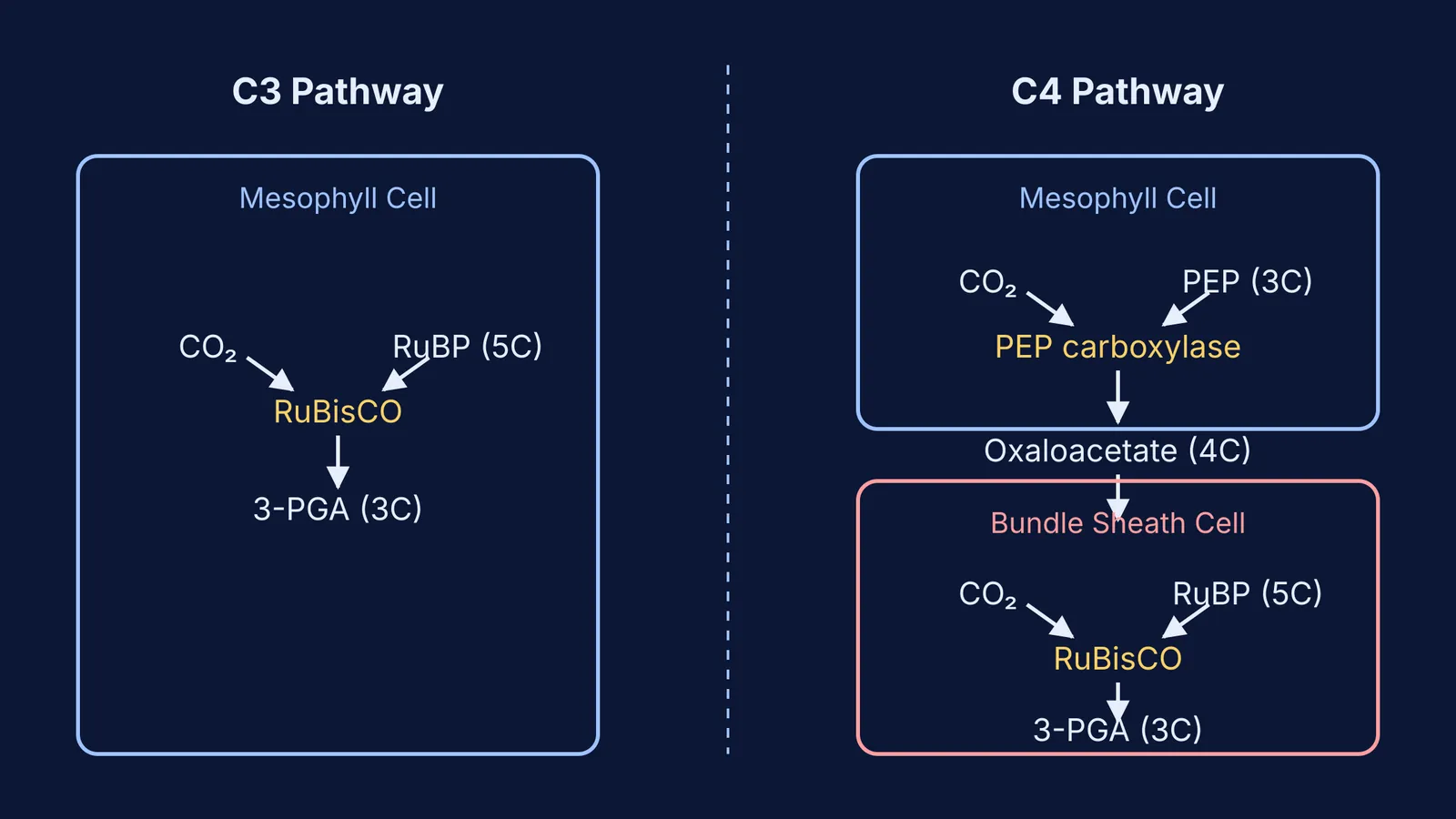
C3 plants begin the Calvin cycle by adding CO₂ to a 5-carbon sugar called RuBP (ribulose-1,5-bisphosphate), which produces two molecules of the 3-carbon compound 3-phosphoglycerate (3-PGA) [[1]](https://en.wikipedia.org/wiki/C3_carbon_fixation).
C4 plants use PEP (phosphoenolpyruvate) as their primary acceptor, forming a 4-carbon compound called oxaloacetate [[2]](https://en.wikipedia.org/wiki/C4_carbon_fixation).
Why do C3 plants lose energy to photorespiration?
The enzyme RuBisCO is meant to fix CO₂. However, it can also bind to oxygen. When temperatures rise and stomata close to save water, the internal concentration of oxygen increases. RuBisCO binds more oxygen instead of carbon dioxide, triggering a wasteful process called photorespiration [[1]](https://en.wikipedia.org/wiki/C3_carbon_fixation).
This flaw explains Photorespiration: why RuBisCO wastes energy in C3 plants. Photorespiration produces no sugars and actually costs the plant energy to recycle the wrong products.
How does Kranz anatomy help C4 plants?
C4 plants solve the oxygen problem with Kranz (wreath) anatomy. They split the work of photosynthesis between two distinct types of cells: mesophyll cells and bundle sheath cells [[2]](https://en.wikipedia.org/wiki/C4_carbon_fixation).
In this specialized system, CO₂ is initially captured in the mesophyll by PEP carboxylase, an enzyme that has a much higher affinity for carbon dioxide and no tendency to bind oxygen. This carbon is then ferried as a 4-carbon acid, typically malate, into the bundle sheath. The bundle sheath cells build a localized, high-CO₂ environment where RuBisCO can run the Calvin cycle without being distracted by oxygen. This spatial separation effectively suppresses photorespiration, allowing the plant to conserve vital energy and water [[2]](https://en.wikipedia.org/wiki/C4_carbon_fixation).
Temperature optimum: which plants grow where?
Because they do not lose energy to photorespiration, C4 plants like maize and sugarcane thrive in high temperatures and intense sunlight [[2]](https://en.wikipedia.org/wiki/C4_carbon_fixation).
C3 plants, which include about 95% of Earth's plant biomass (such as rice, wheat and soybeans), are more efficient in cooler, moist conditions [[1]](https://en.wikipedia.org/wiki/C3_carbon_fixation). Keep this in mind when revising Limiting factors in photosynthesis: Blackman's law and CO₂.
What are the main differences between C3 and C4 plants?
Primary CO₂ acceptor: C3 plants use RuBP (5-carbon); C4 plants use PEP (3-carbon).
First stable product: C3 plants make 3-PGA (3-carbon); C4 plants make oxaloacetate (4-carbon).
Primary enzyme: C3 plants use RuBisCO; C4 plants use PEP carboxylase in the mesophyll.
Photorespiration rate: High in C3 plants (especially when hot); negligible in C4 plants (suppressed).
Leaf anatomy: C3 plants have standard mesophyll; C4 plants have Kranz anatomy.
Optimum climate: C3 plants are suited for cool and moist climates; C4 plants thrive in hot and dry climates.
Examples: Rice, wheat and soybean are C3; maize, sugarcane and sorghum are C4.
When you are reviewing these differences, it is easy to mix up the details. The Fermi Concept Library breaks down Kranz anatomy and the dual nature of RuBisCO, so you can check your understanding step by step.
What is on the exam checklist for photosynthesis?
Before your next test, make sure you can answer these standard questions:
Draw Kranz anatomy and point out the bundle sheath cells.
Name the enzyme that fixes CO₂ in the mesophyll of C4 plants.
Explain why RuBisCO's oxygenase activity wastes a plant's energy.
List three examples each of C3 and C4 plants.


