

On this page
When two sprinters hit the line together, the result comes from a photo-finish image. It looks like a photograph of the finish, but it is not a picture of one moment. It is a record of a single line on the track, taken thousands of times a second and laid side by side. That makes it a graph of time, and once you see it that way, the odd shapes in it, such as stretched bodies, squashed feet and stripy backgrounds, all follow from v = d/t.
What does a photo-finish camera actually record?
An ordinary camera records a full frame, many columns of pixels at once, a few dozen times a second. A photo-finish camera is a line-scan camera. It sits exactly in line with the finish line, looking along it, and its sensor records only a column one pixel wide: the finish line itself.
FinishLynx, a maker of these systems, describes the image as a series of thin vertical slices of the finish line, each with its own time stamp. It gives typical line-scan rates of 1,000 to 2,000 frames per second, against 30 to 120 for ordinary video. Its Vision PRO camera comes standard at 3,000 frames per second, upgradable to 6,000 or 20,000.
Each "frame" here is one line. The camera never sees the track in front of or behind the finish. It only sees what is on the line at each instant.
Why is the horizontal axis of a photo-finish image time, not distance?
The camera stacks its line images side by side, one column per time step. So moving across the picture means moving forward in time, not across the track. Up and down in the picture is still distance: the column runs along the finish line, across the lanes.
Three things follow:
Everything appears at the moment it crosses the line. A runner who arrives later is drawn further along the time axis, whatever lane they are in.
The background is the line repeated. Nothing in the background moves, so every column shows the same thing. The lane markings on the line become long horizontal stripes.
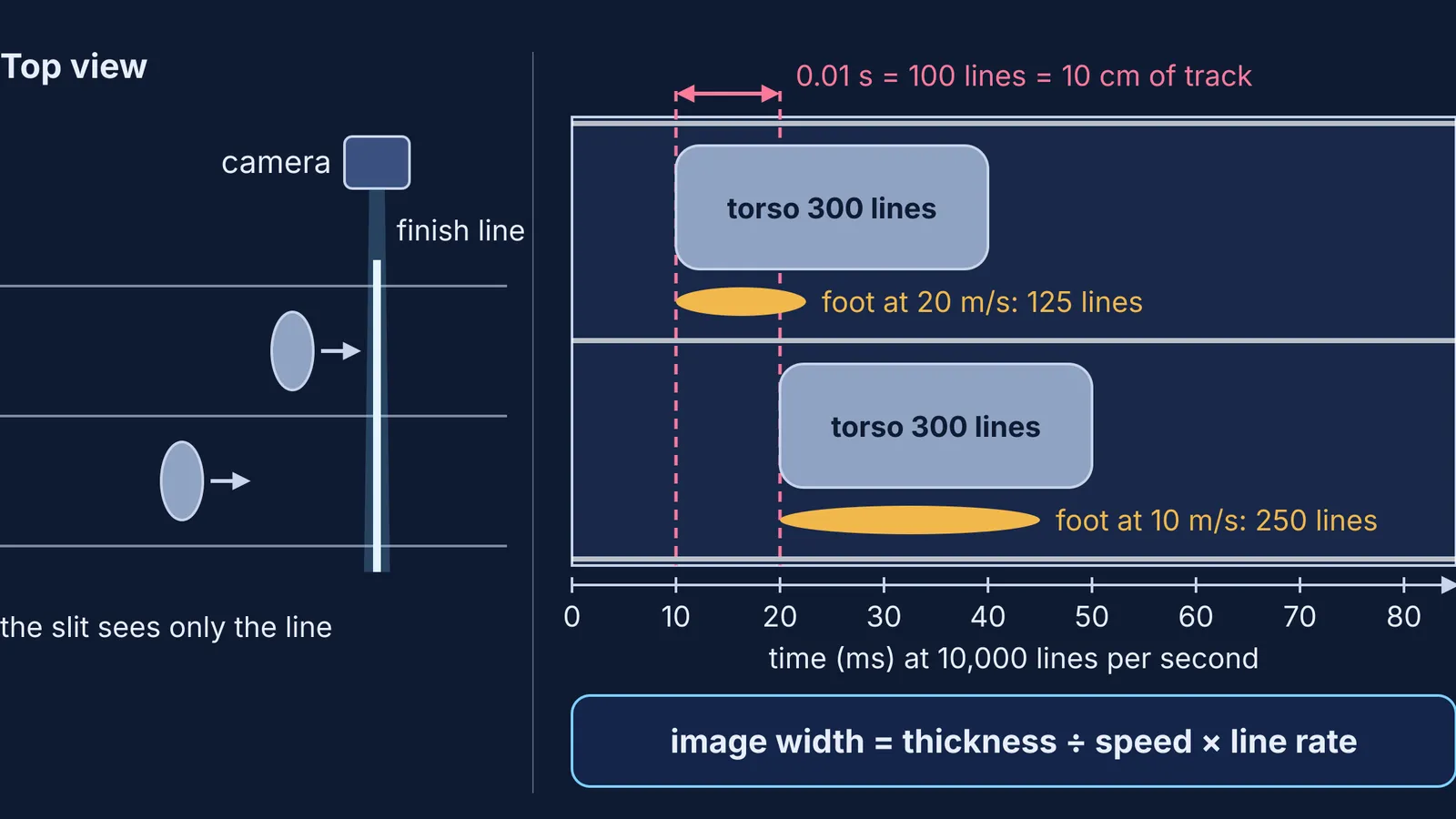
Width in the image depends on speed. A part of the body of thickness d, moving at speed v, takes a time d/v to cross the line. At a line rate r, it fills (d ÷ v) × r columns.
That last rule is the whole trick: image width = thickness ÷ speed × line rate.
Ordinary cameras do the opposite: each frame is one instant, and you compare frames to find motion, as in analysing motion from video frame by frame. Raising the frame rate of such a camera, as in slow-motion video experiments, still gives snapshots. A line-scan camera gives none.
How far back is a runner who finishes 0.01 s behind?
Take a round illustrative line rate of 10,000 lines per second, inside the range FinishLynx sells, and a sprinter crossing at 10 m/s.
Distance per line. In 1 ÷ 10,000 s = 0.1 ms the runner moves 10 × 0.0001 = 0.001 m = 1.0 mm. Each column is 1 mm of the runner's body.
Torso width. A torso 30 cm thick takes 0.30 ÷ 10 = 0.030 s to cross. That is 0.030 × 10,000 = 300 lines wide in the image.
A gap of 0.01 s. That is 0.01 × 10,000 = 100 lines. On the track, at 10 m/s, it is 10 × 0.01 = 0.10 m = 10 cm.
A gap of 0.001 s. That is 10 lines, or 1 cm of track.
A slower runner. At 8 m/s the same 30 cm torso takes 0.0375 s, so it looks 375 lines wide. Slower runners look fatter.
Check units. m ÷ (m/s) = s, and s × lines/s = lines.
So a hundredth of a second is not hard to see. It is a clear gap of 10 cm at sprint speed. The hard cases are the ones within a thousandth, and even those are 10 lines apart at this rate.
Why does a swinging foot look shrunk and a still object smeared?
Apply image width = d ÷ v × r to things that do not move at the runner's speed.
A foot swinging forward. During the swing, a foot moves faster than the body, at its peak up to about twice as fast. A 25 cm foot at 20 m/s crosses in 0.25 ÷ 20 = 0.0125 s, which is 125 lines. If it moved at the body's 10 m/s it would be 0.025 s, 250 lines. So it looks half as long.
A foot planted on the ground. A foot in contact with the track is momentarily still. If it lands on the line, it is drawn in column after column until it lifts, so it is smeared out sideways.
Anything resting on the line. With v = 0, d ÷ v has no limit. An object left on the line, like the lane markings, is drawn across the whole image.
That is why arms and legs in photo-finish images look bent, stretched or squashed in ways no real body could be. The torso, moving steadily at the runner's speed, keeps nearly its true proportions.
What decides the winner in a photo finish?
World Athletics sets the rules in its Technical Rules, published in the Book of Rules:
The torso counts. Athletes are placed in the order in which their torso, as distinguished from the head, neck, arms, legs, hands or feet, reaches the vertical plane of the nearer edge of the finish line. A lunging head or an outstretched arm does not count.
Line rate. For the top international competitions named in the rules, the composite image must be built from at least 1,000 images per second; for others, at least 100. At 1,000 lines per second and 10 m/s, each column is 1 cm, and our 30 cm torso is 30 lines wide.
Reading the time. For track races up to 10,000 m, a time is rounded up to the next longer 0.01 s. A time of 10.031 s is recorded as 10.04 s.
Ties. If the judges cannot separate two athletes on the image, the tie stands. When a tie decides a ranking across different heats, the judge compares the times to 0.001 s.
The start matters as much as the finish. How sound delay from the gun affects the outer lanes is covered in why lane 8 hears the starting gun 25 ms late.
To practise problems that turn speed, time and distance into each other, the Fermi Problem Library has a step-by-step solver that explains the reasoning.
Quick checklist
A photo-finish camera records one line, the finish line, thousands of times a second.
Across the image is time; up and down is position along the finish line.
Image width = thickness ÷ speed × line rate.
At 10,000 lines/s and 10 m/s: 1 mm per line, 300 lines for a 30 cm torso.
0.01 s behind is 100 lines, 10 cm of track; 0.001 s is 10 lines, 1 cm.
Fast parts look short, slow parts look long, still objects become stripes.
The torso decides the placing; times go up to the next 0.01 s.


