

On this page
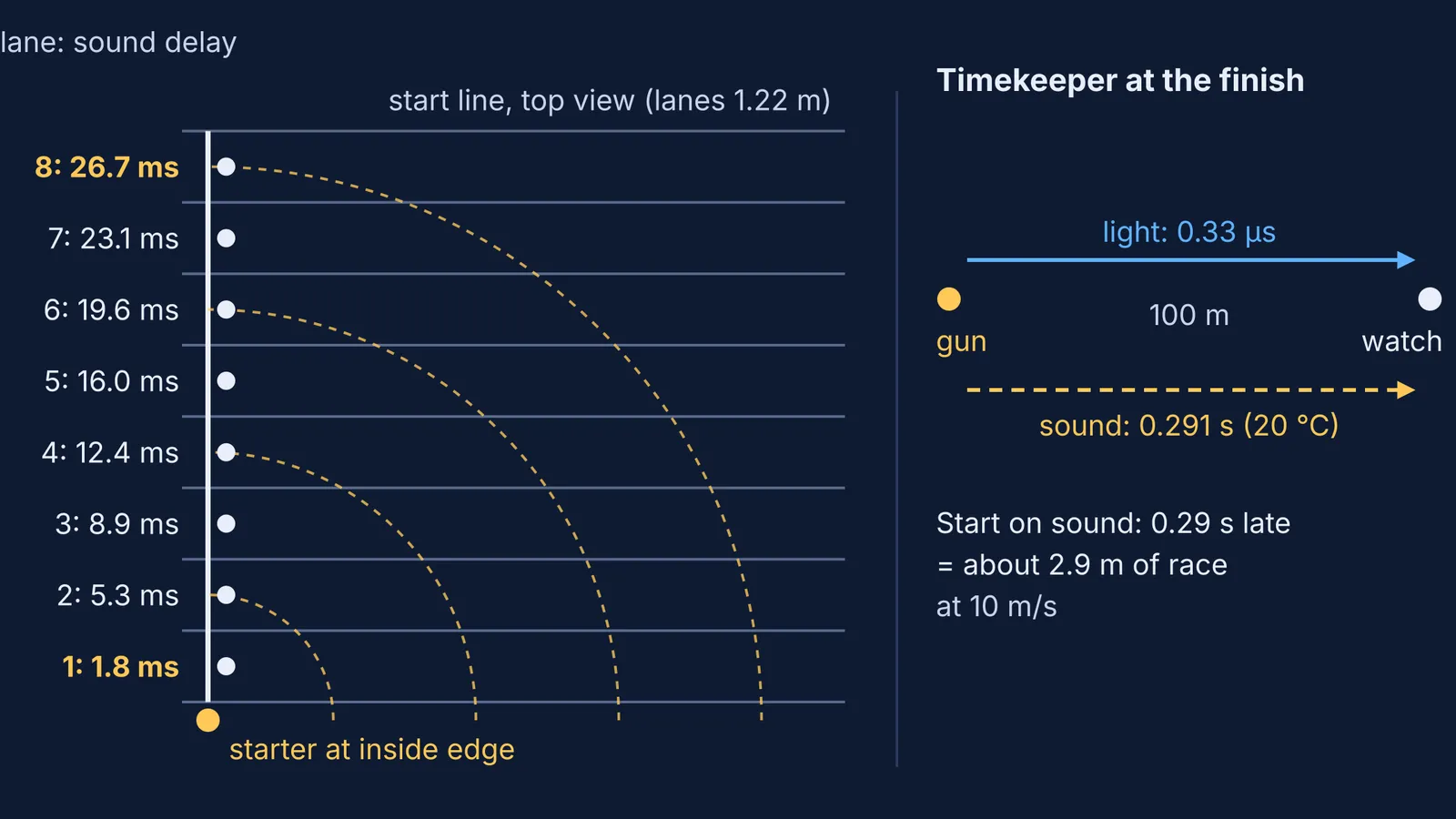
In a 100 m final, eight sprinters crouch in their blocks and wait for one sound. Light from the gun reaches them all at once, but they are told to react to the bang, and sound is slow. If the gun is fired from one side of the track with no speakers, the runner in lane 8 hears it about 25 ms after the runner in lane 1. That sounds tiny, until you compare it with the 0.100 s reaction limit that decides false starts. This post works out the delay, checks it against the rules, and shows why hand timekeepers were never allowed to start their watches on the bang.
How fast does the sound of a starting gun travel?
In air, the speed of sound depends on temperature, not on pressure. For dry air a good approximation is:
v ≈ 331√(1 + T/273) m/s, with T in °C.
At 0 °C, v ≈ 331 m/s.
At 20 °C, v ≈ 343 m/s.
At 30 °C, v ≈ 349 m/s.
Light covers the same ground almost a million times faster, at 3 × 10⁸ m/s. Over 100 m it takes 100 / (3 × 10⁸) = 3.3 × 10⁻⁷ s, or 0.33 µs. For every practical purpose the flash is instant and only the sound is late.
How late does lane 8 hear the gun? A worked example
World Athletics rules set each sprint lane at 1.22 m ± 0.01 m wide (Technical Rules, World Athletics Book of Rules). Take a 100 m start on a straight, so all eight runners are on one line. Suppose the starter stands at the inside edge of lane 1, level with the line, and there are no lane speakers. Take the air at 20 °C.
Find the speed of sound. v = 331.3 × √(1 + 20/273.15) = 343.2 m/s.
Place each runner. A runner sits near the middle of the lane, so the runner in lane n is about (n − 0.5) × 1.22 m from the starter.
Lane 1. Distance = 0.5 × 1.22 = 0.61 m. Delay = 0.61 / 343.2 = 1.8 ms.
Lane 8. Distance = 7.5 × 1.22 = 9.15 m. Delay = 9.15 / 343.2 = 26.7 ms.
The difference. Lane 8 is 7 × 1.22 = 8.54 m farther away, so it hears the gun 8.54 / 343.2 = 24.9 ms later than lane 1.
Worst case. To the outer edge of lane 8, 9.76 m, the delay is 28.4 ms.
Check the units. m ÷ (m/s) = s, and 0.0249 s = 24.9 ms.
The delay grows by about 3.6 ms for every lane. A colder day makes it slightly worse: at 0 °C the lane 1 to lane 8 gap is 8.54 / 331.3 = 25.8 ms.
Why do 25 milliseconds matter in a sprint?
Because the rules measure reaction time from the gun, not from when each runner hears it. The World Athletics 100 m event page says sensors in the blocks measure the start and that a reaction time of less than 0.1 seconds is deemed a false start. The Technical Rules say the certified Start Information System signals a possible false start when the reaction time is less than 0.100 second.
Compare the two numbers. 24.9 ms is about a quarter of 0.100 s. The far runner's recorded reaction time includes that extra 25 ms of sound travel, so they leave the blocks later through no fault of their own. Fully automatic times are recorded to 0.01 s, and 25 ms is two and a half of those hundredths.
The time for sound to travel is pure physics. How fast a person reacts once the sound arrives is biology, and it is covered for cricket in how much time a batter gets against a 150 km/h ball.
How do races remove the delay?
The rulebook deals with it in two ways (World Athletics Book of Rules):
Loudspeakers in the lanes. The rules recommend, especially for staggered starts, that loudspeakers in the individual lanes relay the commands, the start and any recall signal to all athletes at the same time. A speaker a short distance behind each block puts every runner at almost the same distance from the sound.
Where the starter stands. Where speakers are not used in staggered starts, the starter must stand so that the distance to each athlete is about the same. If that is not possible, the gun is placed in such a spot and fired by electric contact.
With a speaker behind every block, the sound path is short and almost equal for all eight lanes, so the lane-to-lane difference shrinks to well under a millisecond.
Why did timekeepers start on the flash, not the bang?
Now move to the finish line, 100 m from the gun. A timekeeper who starts the watch on hearing the bang starts late by:
100 / 343.2 = 0.291 s at 20 °C.
100 / 349.0 = 0.287 s at 30 °C.
A sprinter running at 10 m/s covers 10 × 0.291 = 2.9 m in that time. Every hand time would be about 0.29 s too fast. The rulebook removes the error by saying the time shall be taken from the flash or smoke of the gun (World Athletics Book of Rules). Light from the flash arrives in 0.33 µs, so starting on the flash is effectively starting at the true instant.
This is the same physics as seeing lightning before you hear the thunder. Sound used as a measuring tool, bouncing off two walls, is worked in echoes between two cliffs. What the runner does in the first steps after the gun, once the sound has arrived, is covered in why sprinters use starting blocks.
If you want to try more sound-delay problems with temperature changes, the Fermi Problem Library has a step-by-step solver that explains the reasoning at each stage.
Quick checklist
Speed of sound in air: v ≈ 331√(1 + T/273) m/s; 343 m/s at 20 °C.
Delay = extra distance / v. Light over 100 m takes only 0.33 µs.
8.54 m from lane 1 to lane 8: 24.9 ms at 20 °C, about a quarter of the 0.100 s false-start limit.
World Athletics recommends loudspeakers in each lane, especially for staggered starts.
A timekeeper at 100 m who starts on the bang is 0.29 s late, so hand times start from the flash or smoke.
Sound speed changes with temperature, not with air pressure.


