

On this page
Your phone's slow-motion mode is a cheap high-speed camera. Predict first, and the replay tests your physics.
How do you set up slow-motion physics experiments at home?
Start with the prediction. In a study of classroom physics demonstrations, students who only watched understood the ideas no better than students who never saw the demonstration, while students who predicted the outcome first showed significantly greater understanding (Crouch and colleagues, 2004). It is the habit behind pausing to predict during video lectures. For every clip:
Predict: write one sentence and, where you can, a number.
Film: record two or three takes.
Explain: step through the frames and write down what your prediction missed.
The iPhone 15 Pro records slow motion at 120 or 240 frames per second (Apple tech specs); many Android phones also have slow-motion modes. At 240 frames per second, frames are about 4.2 milliseconds apart.
Steady the phone on a stand or books.
Use bright light; each slow-motion frame gets very little exposure time.
Fix a measuring tape in the frame, at the same distance as the action.
Film side-on, level with the event.
Experiment 1: how much height does a bouncing ball lose?
Predict: does each bounce lose the same height or the same fraction?
The coefficient of restitution, e, is the speed of separation after a collision divided by the speed of approach before it; for a ball dropped from rest, e = √(h/H), where H is the drop height and h the rebound height, if friction can be neglected (coefficient of restitution).
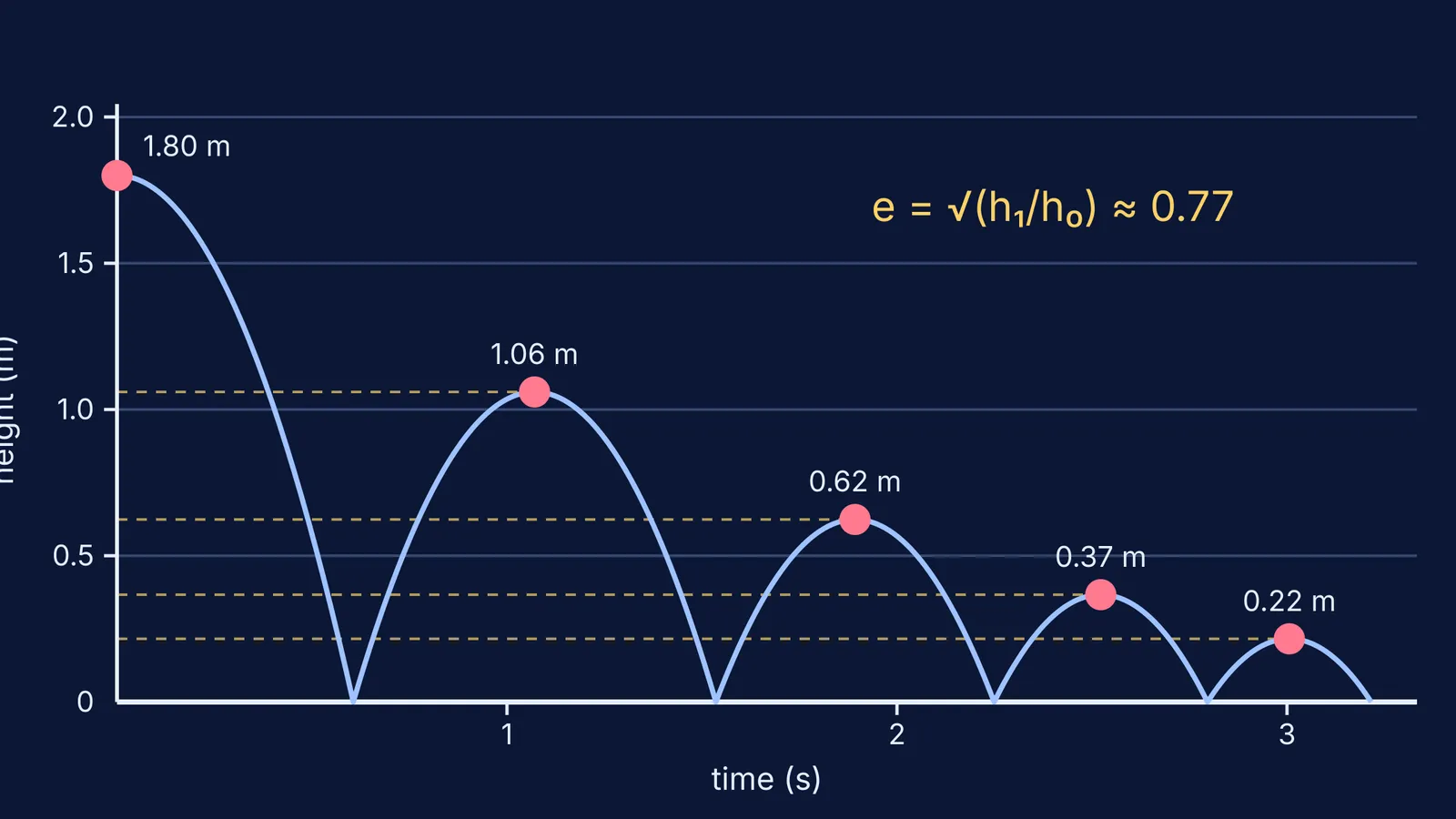
A worked example: FIBA's equipment rules say a match basketball dropped from about 1,800 mm must rebound to between 1,035 and 1,085 mm, measured to the underside of the ball (FIBA equipment rules, 2024). Take the middle value, 1,060 mm:
Fraction kept: 1,060 ÷ 1,800 = 0.59, so one bounce costs the ball about 41% of its height.
e = √0.59 ≈ 0.77.
Since potential energy is mgh, it also keeps about 59% of its energy; the rest is lost, mostly as heat and sound, as the ball squashes and recovers.
If e stays the same, each bounce keeps the same fraction: about 1.06 m, then 0.62 m, then 0.37 m.
In your video, step to the top of each bounce and read the ball's underside against the tape; then try tile against a rug. For exam practice, see our guide to collisions, momentum and restitution.
Experiment 2: why does a water drop splash?
Predict: what makes a drop splash on a dry, smooth plate: the plate, the water or the air?
Lei Xu, Wendy Zhang and Sidney Nagel used high-speed photography to show that splashing on a smooth, dry surface can be completely suppressed by lowering the pressure of the surrounding gas (Physical Review Letters, 2005). The pressure at which a splash first appeared depended on the impact speed, and scaled with the gas's molecular weight and the liquid's viscosity.
At home, vary the impact speed: drip water onto a dry glass plate from 10 cm, 50 cm and 1 m, predicting whether and where a crown first appears.
Experiment 3: why does a spinning coin speed up before it stops?
Spin a ₹5 coin on its edge on a hard table. Predict: as it settles, does the whirring get lower or higher?
It gets higher. In Nature, H. K. Moffatt studied Euler's disk, a toy disc that settles like a coin, and proposed that viscous dissipation in the thin air layer underneath brings it to rest; in his model, the contact point runs round the rim ever faster, without limit, in a finite time (Moffatt, 2000; his publication notes). A 2017 paper describes two decades of debate over whether air drag or friction dominates, and adds impacts (Baranyai and Várkonyi, 2017).
Mark a dot on the rim and predict whether the frames per wobble rise or fall in the last second.
Experiment 4: what happens when a rubber band snaps?
Hook a rubber band over a door handle, stretch it and let go. Predict: does the whole band move at once?
No. Vermorel, Vandenberghe and Villermaux showed that when a stretched band is released at one end, a stress front runs along it at the speed of sound in the rubber, separating a free part from a still-stretched part; at the fixed end it rebounds as a compression front, and the band can buckle into waves (Proc. R. Soc. A, 2006). They linked the buckling wavelength to the initial stretch and the band's thickness.
The front may show in only a frame or two; the buckling is easier to see. Predict whether a thicker band gives longer or shorter waves.
What should you do after filming?
Write the gap between prediction and video in one line; that is what you learned. For effects you cannot film at home, the Fermi Simulation Lab has interactive simulations for the ideas that are easier to see than to read. If the restitution maths is where you get stuck, the Fermi Problem Library has a step-by-step solver that explains the reasoning.
For more, try these five safe kitchen science experiments.


