

On this page
Watch a petrol pump attendant fill a car. The fuel gushes in, and then, with no one touching anything, the nozzle clicks and the flow stops. The usual design has no float and no electronic level sensor. The cut-off runs on Bernoulli's principle: the moving fuel makes its own suction, and a tiny hole near the tip of the spout decides when that suction is allowed to act.
What makes a fuel nozzle stop on its own?
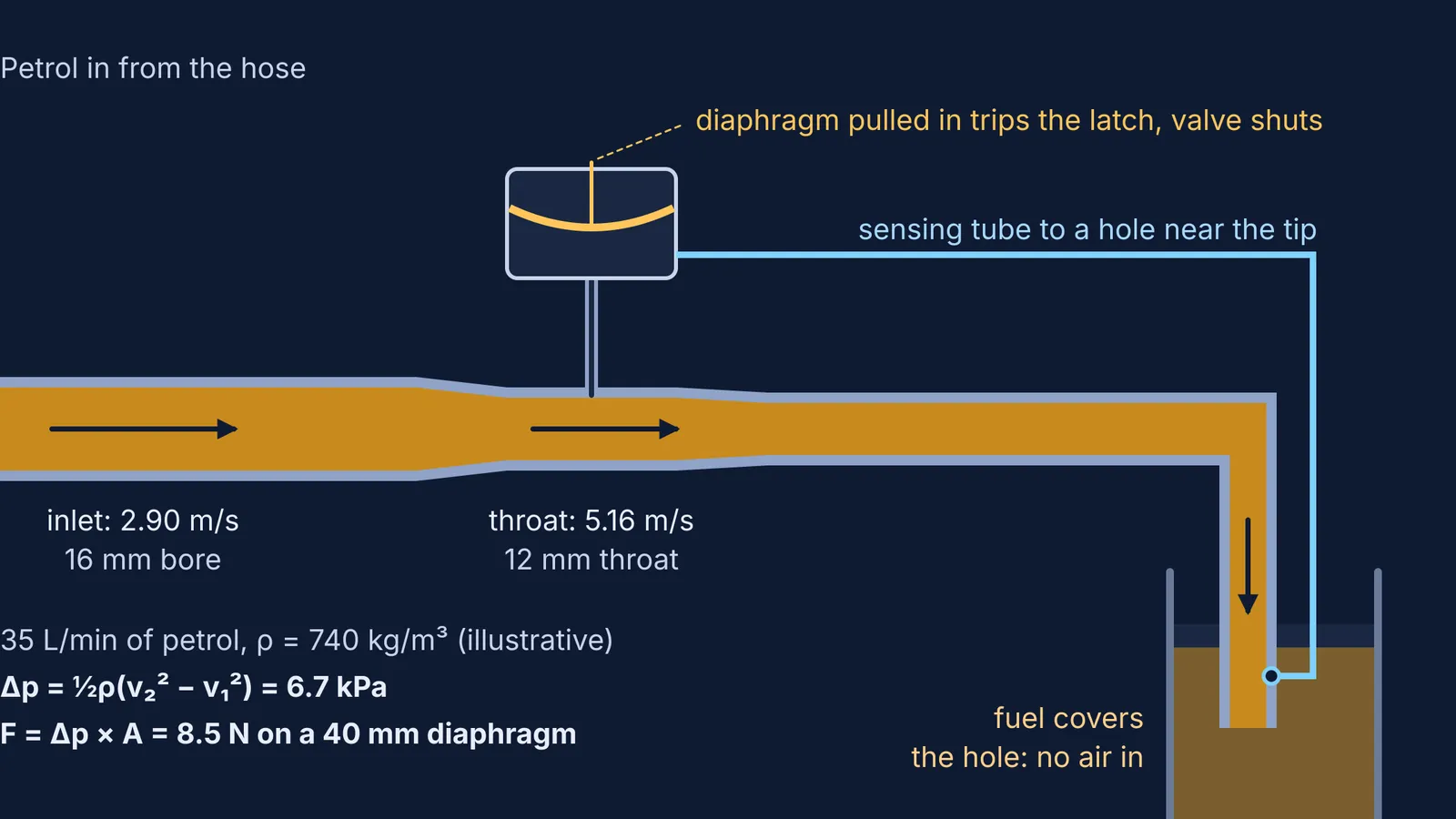
Three parts work together. A venturi in the fuel path makes a region of low pressure. A diaphragm chamber is connected to that low-pressure region. A thin sensing tube runs from the chamber to a small hole near the end of the spout.
A 1978 Union Oil patent for an automatic shut-off nozzle describes the sequence (US patent 4,098,306). While the hole at the spout is in air, air "is simply drawn through the orifice and aspirated into the gasoline flowing through the venturi". When the fuel rises and covers the hole, "the orifice becomes flooded with gasoline and air can no longer be aspirated". The suction then builds in the chamber, lifts the diaphragm and triggers a mechanism that releases the spring-loaded main valve, which snaps shut. That snap is the click you hear.
Where does the suction come from?
From the venturi effect. When a liquid is forced through a narrower section, continuity (A₁v₁ = A₂v₂) says it must speed up, and Bernoulli's equation says its pressure must fall. The pressure drop at a constriction is worked in detail in how a venturimeter measures flow rate, and the history of the idea is in Giovanni Venturi and why fluid speeds up in a narrow pipe, so neither is repeated here.
In the Union Oil design, the narrow section is not a separate tube. The patent says that when petrol flows between the poppet valve disc and its seat ring, "a venturi effect is created". So the main valve itself is the constriction. In the worked example below we model it as a simple pipe narrowing, which keeps the numbers clear.
Worked example: how hard does the suction pull?
All numbers here are illustrative round values, not the dimensions of any real nozzle.
Given: petrol at 35 L/min, density ρ = 740 kg/m³ (approximate; petrol varies), flowing from a 16 mm bore into a 12 mm throat. The diaphragm is 40 mm across.
Flow rate in SI units. Q = 35 L/min = 35 × 10⁻³ m³ / 60 s = 5.83 × 10⁻⁴ m³/s.
Areas. A₁ = π(0.008)² = 2.01 × 10⁻⁴ m². A₂ = π(0.006)² = 1.13 × 10⁻⁴ m².
Speeds. v₁ = Q/A₁ = 2.90 m/s. v₂ = Q/A₂ = 5.16 m/s. Check: v₂/v₁ = (16/12)² = 1.78.
Pressure drop. Δp = ½ρ(v₂² − v₁²) = 0.5 × 740 × (5.16² − 2.90²) = 6.7 kPa below the pressure upstream.
Force on the diaphragm. A = π(0.020)² = 1.26 × 10⁻³ m². F = Δp × A = 6730 Pa × 1.26 × 10⁻³ m² = 8.5 N.
Checks. Units: Pa × m² = N. Size: 6.7 kPa is about 69 cm, or 27 inches, of water. The Union Oil patent describes a venturi drawing a vacuum of about 30 inches of water, so the simple model lands in the same range. A pull of 8.5 N is about the weight of a 0.87 kg mass, plenty to move a light latch.
What if the flow is slow? Δp depends on v², and v is proportional to Q, so Δp ∝ Q². At 10 L/min the suction is (10/35)² = 0.082 times as large: about 0.55 kPa, and the pull on the diaphragm drops to about 0.69 N. A gentle trickle gives the mechanism much less force to work with.
Why does covering a tiny hole change everything?
Think of the chamber as a room with two doors. One door, the port at the venturi, is always trying to suck air out. The other door, the sensing tube, lets outside air back in.
Hole in air. Air flows in through the sensing tube as fast as the venturi pulls it out. The chamber stays close to atmospheric pressure, the diaphragm has the same pressure on both sides, and it stays put. The air is carried away in the fuel stream.
Hole covered. Air can no longer get in. In the patent's words, the suction "can no longer be relieved with air from the atmosphere". The venturi keeps pulling, and the chamber pressure falls towards the full venturi suction. Now there is atmospheric pressure on one side of the diaphragm and several kilopascals less on the other, and the diaphragm moves.
The patent gives the orifice size: a preferred diameter of 1/16 inch, about 1.6 mm. A hole that small only needs a thin layer of liquid over it to block the air supply.
This also explains why a nozzle sometimes clicks off before the tank is full. If the fuel foams in the filler neck, or the neck cannot drain fast enough and liquid backs up around the tip, the hole is covered early and the nozzle trips exactly as designed.
Why is the auto cut-off a safety feature?
The click stops fuel from flowing onto the ground. Petrol is highly flammable, and Indian petrol pumps are licensed premises. IndianOil's citizen charter for retail outlets says that all activities there "are subject to strict PESO Rules", PESO being the Petroleum and Explosives Safety Organisation (IndianOil citizen charter for retail outlets). It lists these precautions for customers:
Switch off the engine before taking delivery of fuel, to avoid fire caused by spillage of fuel.
Do not smoke within the petrol pump premises.
Never light a match stick within the premises.
Switch off the mobile within the premises. The physics behind that rule is discussed in why mobile phones are not allowed at petrol pumps.
One more rule from us: never tamper with a nozzle or try to defeat its cut-off. It is a safety device, and at Indian pumps it is normally operated by the pump's staff.
If Bernoulli and continuity problems still trip you up, the Fermi Problem Library has a step-by-step solver that explains the reasoning at each stage.
Quick checklist
Fuel speeding through a constriction makes suction (continuity plus Bernoulli).
A diaphragm chamber is connected to that suction and, through a thin tube, to a hole near the spout tip.
Hole in air: air leaks in, the chamber stays near atmospheric pressure, nothing happens.
Hole covered: the suction builds, the diaphragm moves, a latch releases and a spring shuts the valve.
Illustrative numbers: 35 L/min through a 16 mm to 12 mm narrowing gives 6.7 kPa and 8.5 N on a 40 mm diaphragm.
Suction scales as the flow rate squared, so a trickle gives far less force.
Never tamper with a fuel nozzle.


