

On this page
You pull into a petrol pump, reach for your phone, and see the warning sign: a mobile phone with a red line through it. The implication is clear: use your phone, and you might spark an explosion. But the chemistry of combustion and decades of safety data tell a very different story.
The chemistry of a spark
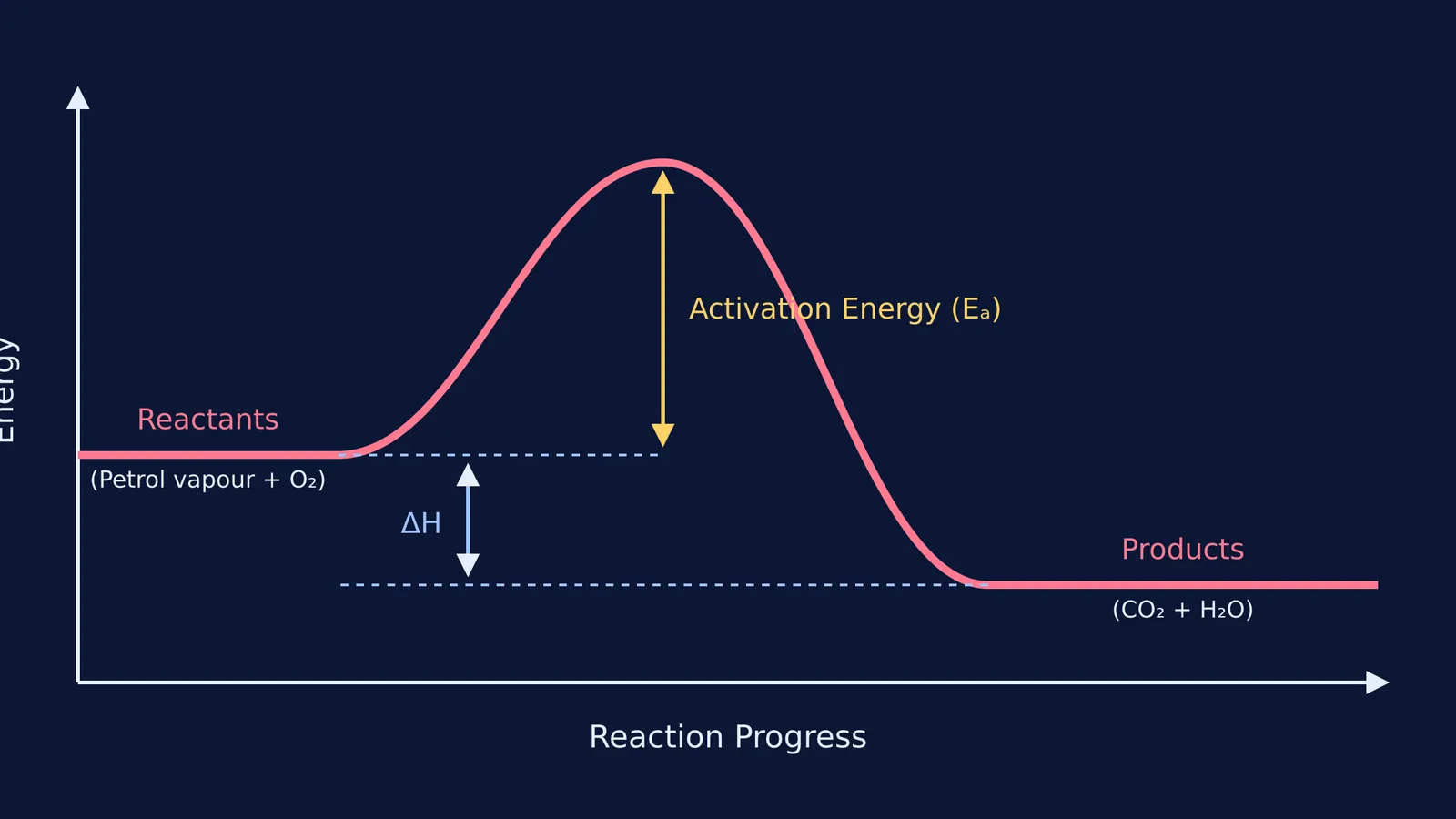
For petrol to burn, it needs three things: fuel vapour, oxygen, and an ignition source to provide the activation energy. Petrol vapour is highly flammable, meaning it requires very little energy to ignite. A spark—a sudden discharge of electrical energy—can easily provide this push, which is why we learn about measuring the energy of combustion with a bomb calorimeter.
Because petrol stations are classified as "hazardous areas," safety regulations demand that any electrical equipment used near the pumps must be "intrinsically safe". This means the device is engineered so that even if it breaks or short-circuits, it cannot release enough energy to ignite vapour. Standard mobile phones are not certified to this standard, so they are banned by default as a precaution.
But in reality, a phone battery produces only a tiny fraction of the energy needed to spark a fire. In chemistry and physics, understanding ignition means understanding activation energy. In our Fermi Simulation Lab, you can safely explore how much energy it takes to trigger combustion in different vapour concentrations. Being able to change the variables and watch the reaction helps turn abstract safety rules into hands-on experiments.
Can static electricity start a fire at a petrol pump?
If phones are not sparking fires, what is? The answer lies in simple friction.
The physics behind these fires is rooted in the triboelectric effect. When a driver starts the pump and then gets back into their car, their clothes rub against the fabric car seat. This friction transfers electrons, leaving the driver's body with a net electrical charge.
Because the driver is insulated from the ground by rubber-soled shoes, this charge cannot escape. A significant potential difference builds up between the driver and the grounded metal of the fuel pump. When they step back out and reach for the nozzle, the electric field between their finger and the metal exceeds the dielectric breakdown strength of the air. The air briefly becomes a conductor, allowing a sudden flow of current that heats the air and creates a visible spark.
If this spark jumps near the concentrated petrol vapours escaping from the tank, it provides the activation energy needed to trigger a rapid combustion reaction.
The Petroleum Equipment Institute (PEI) tracks incidents of petrol station fires. They have historically found that static electricity is the primary cause, tracking over 150 incidents frequently involving a driver re-entering their vehicle. In their extensive tracking of refueling fires, they have not documented incidents caused by mobile phones.
Do mobile phones cause fires at petrol stations?
To investigate the persistent myth of phone-ignited fires, the Australian Transport Safety Bureau (ATSB) conducted a major review in 2004, publishing a report titled *Mobile Phones and Service Stations*.
The ATSB analyzed 243 reported fires at petrol stations worldwide. They found that not one of these incidents was caused by a mobile phone. Like the PEI, they concluded that static electricity was the primary culprit, alongside other everyday oxidation and combustion hazards like smoking. The idea of the exploding phone was largely fueled by internet hoaxes in the late 1990s, not by physical evidence.
Why are mobile phones not allowed at petrol pumps today?
If the explosion risk is a myth, why do the signs remain? The UK's Energy Institute provides the modern rationale: distraction.
A petrol station forecourt is a busy environment with moving vehicles, pedestrians, and hazardous chemicals. A driver looking at their screen is less likely to notice a fuel spill, more likely to overfill their tank, and at a higher risk of stepping into the path of a moving car.
The ban on phones at the pump is no longer about preventing a spark; it is about keeping your eyes on the task.
Safety checklist for the pump
To stay safe on the forecourt, safety bodies recommend three simple steps:
Leave the phone in the car: Minimise distraction while dispensing fuel.
Stay outside: Do not get back into your vehicle while the pump is running.
Discharge static: If you must re-enter, touch bare metal on the car body before touching the nozzle.
Next time you see the no-phone sign, you will know the real science behind it. Your phone will not blow up the pump, but ignoring the physical risks of static electricity and distraction just might.


