

On this page
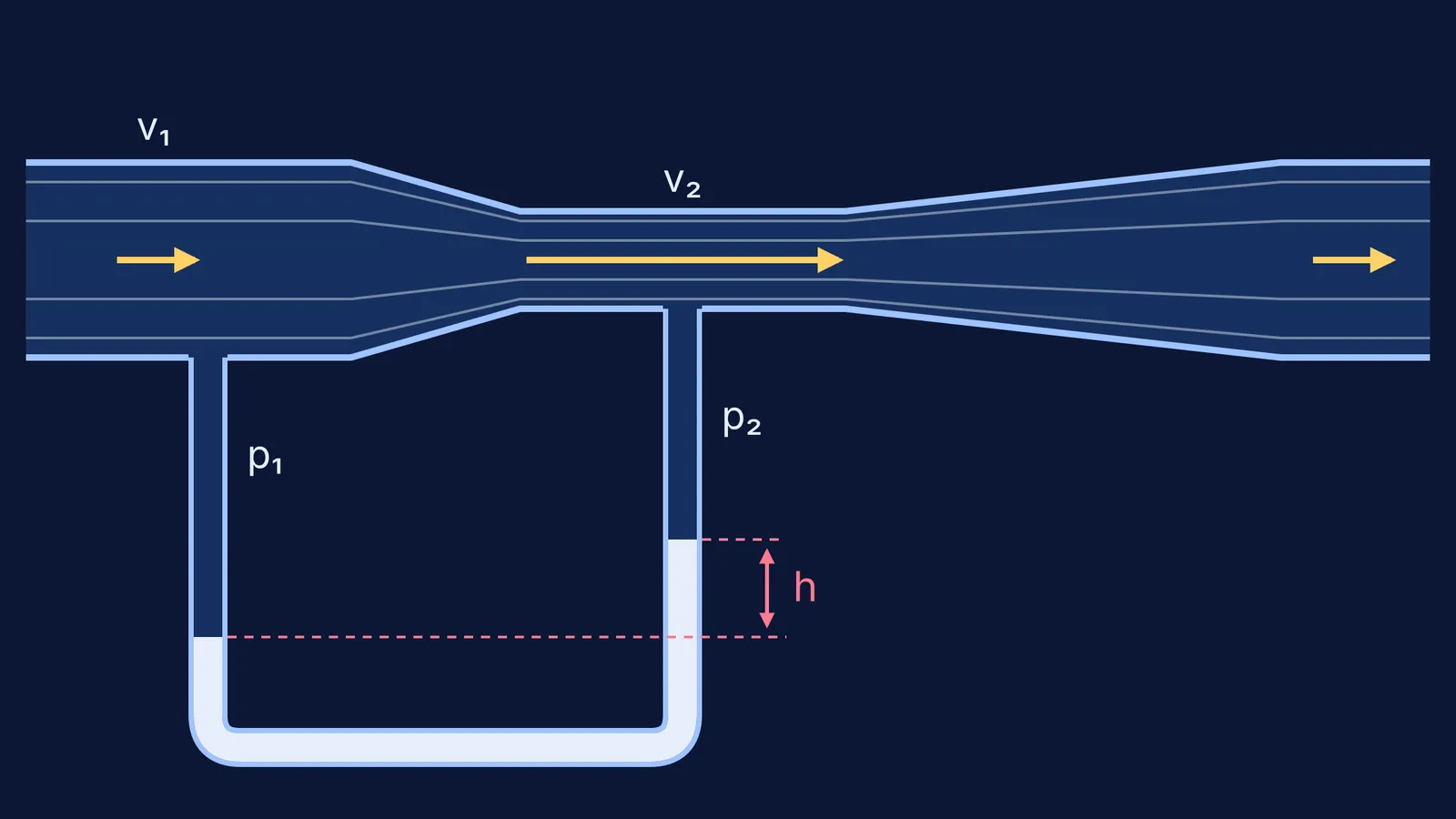
A venturimeter is a pipe with a narrow throat in the middle and a U-tube manometer joining the wide part to the throat. You cannot see how fast water moves inside a closed pipe, but you can read a mercury column. Two equations turn that height into a flow rate, and they also explain the Pitot tube and the perfume atomiser. If continuity feels shaky, read the equation of continuity in pipes and nozzles first.
How does a venturimeter measure flow rate using Bernoulli?
Three steps, one idea each.
Continuity. An incompressible fluid cannot pile up, so A1v1 = A2v2. A narrower throat means faster flow there.
Bernoulli. For a steady, incompressible, frictionless fluid, p + ½ρv² + ρgh is constant along a streamline, so in a horizontal pipe pressure drops where speed rises (OpenStax University Physics, section 14.6). That gives p1 − p2 = ½ρ(v2² − v1²).
The manometer. The higher pressure at the wide section pushes the mercury down on that side. Using hydrostatics, a level difference h gives p1 − p2 = (ρm − ρ)gh, where ρm is the manometer liquid's density and ρ is the flowing fluid's.
Put v2 = (A1/A2)v1 into step 2, set it equal to step 3, and solve. The result is v1 = √[2(ρm − ρ)gh / ρ((A1/A2)² − 1)], the same formula Peter Dourmashkin derives in his MIT worked example on the venturi meter/28%3A_Fluid_Dynamics/28.05%3A_Worked_Examples-_Bernoullis_Equation). The flow rate is Q = A1v1.
The minus ρ in (ρm − ρ) is an easy term to drop. Both limbs of the manometer have the flowing fluid sitting on top of the mercury, so that column partly cancels. For more slips like this, see our list of Bernoulli and buoyancy mistakes to avoid.
What does a worked venturimeter problem look like?
Water flows through a horizontal pipe 10 cm in diameter. The throat is 5 cm across. The mercury manometer shows h = 5 cm. Find the flow rate.
Take mercury as 13,600 kg/m³ (PubChem lists 13.534 g/cm³ at 25 °C and a rounded 13.6 from OSHA and NIOSH, in its mercury density record), water as 1,000 kg/m³ and g as 9.8 m/s².
Area ratio: the diameter halves, so A1/A2 = 2² = 4, and (A1/A2)² − 1 = 15.
Pressure drop: (13,600 − 1,000) × 9.8 × 0.05 = 6,174 Pa.
Speed in the pipe: v1 = √(2 × 6,174 / (1,000 × 15)) = √0.823 ≈ 0.91 m/s.
Speed at the throat: v2 = 4 × 0.91 ≈ 3.6 m/s.
Flow rate: A1 = π(0.05)² ≈ 0.00785 m², so Q ≈ 0.00785 × 0.91 ≈ 0.0071 m³/s, about 7.1 litres per second.
Real water has friction, so engineers multiply by a coefficient of discharge. Its value for a venturimeter usually lies between 0.95 and 0.98, according to NPTEL lecture notes on the venturimeter. Applied here, that gives about 6.8 to 7.0 litres per second.
If your answer differs, find the step that went wrong. The Fermi Problem Library has worked problems with a step-by-step solver that explains the reasoning rather than printing an answer.
How does a Pitot tube measure speed?
A Pitot tube makes one point of the flow stop completely. NASA describes the centre tube, which points into the flow, as reading total pressure, while side holes at right angles to the flow read static pressure (NASA Glenn, pitot-static tube). The difference is the dynamic pressure, so V = √[2(pt − ps)/ρ].
The same NASA page notes two limits. At low speeds the pressure difference is too small to measure well. At supersonic speeds Bernoulli's assumptions fail and a shock wave forms at the tube's front, so the reading needs corrections.
Why does an atomiser spray?
Squeezing the bulb pushes a fast jet of air across the top of a thin tube dipped in the liquid. The fast jet has low pressure, so the higher pressure outside forces other fluid into the stream. OpenStax calls this entrainment and gives atomisers, paint sprayers, Bunsen burners and aspirators as examples (OpenStax, section 14.6). Here atmospheric pressure on the liquid surface pushes liquid up the tube, and the jet breaks it into droplets.
A five-line checklist for any Bernoulli device problem
Mark the two points you will compare and note whether they are at the same height.
Write continuity first to link the two speeds.
Write Bernoulli between the same two points.
Convert the manometer or tube reading into a pressure difference, remembering (ρm − ρ).
Check the answer: is the throat speed higher, and does the flow rate have units of m³/s?
For the hydrostatics behind every manometer reading, see pressure at depth and gauge pressure, or the Fermi Concept Library, which gives each concept its own lesson and its place in the map.


