

On this page
How do engineers check whether a road, a footpath or a polished stone floor is slippery when wet? One common instrument is a pendulum with a rubber foot. You let the arm fall from horizontal, its rubber slider brushes across a wet patch of the surface, and the arm swings up on the other side. On a slippery surface it rises almost as high as it started. On a grippy one it stops well short. The gap between the two is the work done by friction, and you can work it out with the work-energy theorem from Class 11.
What is a pendulum skid tester?
It is often called the British pendulum tester. ASTM E303 describes it as an instrument that measures the energy lost when a rubber slider edge is pushed across a test surface, and says its readings do not necessarily match other friction-measuring methods (ASTM E303 summary).
The numbers below come from the version of the method in DRS 534, a public review draft by the Rwanda Standards Board that is based on BS EN 14231 for natural stone (DRS 534 draft). It specifies:
The arm. Mass 1.50 kg including the slider, with its centre of gravity 410 mm from the axle. It is released from horizontal.
The slider. A rubber pad 76.2 mm wide, held 510 mm from the axle and pressed down by a spring. The calibrated static force is 22.2 N, not the weight of the arm.
The contact length. The height of the axle is set so that the slider stays in contact for 126 mm.
The scale. A pointer carried by the arm stops at the highest point of the swing on a C scale marked from 0 to 150.
Wet testing. The surface and slider are wetted with water at about 20 °C before each swing, and floor readings are corrected for temperature using a graph in the standard, because rubber grips differently when warm or cold.
Other standards set slightly different values, so always quote the one you are using.
How does energy conservation turn a swing into a friction value?
Treat the arm as a rigid body. Its potential energy depends only on the height of its centre of gravity.
At release. The arm is horizontal, so its centre of gravity is h₀ = 0.41 m above its lowest position. The energy available is mgh₀.
Across the surface. Friction acts on the slider over the contact length s. With normal force N and coefficient of friction μ, the work done against friction is μNs.
At the top of the far swing. The arm stops with its centre of gravity at height h. Energy left: mgh.
Energy balance. mgh₀ − μNs = mgh, so μNs = mg(h₀ − h).
A rougher surface takes more energy out, so the arm rises less. The pointer simply marks how far it got. The instrument is set up so that a free swing with nothing to brush against reads zero.
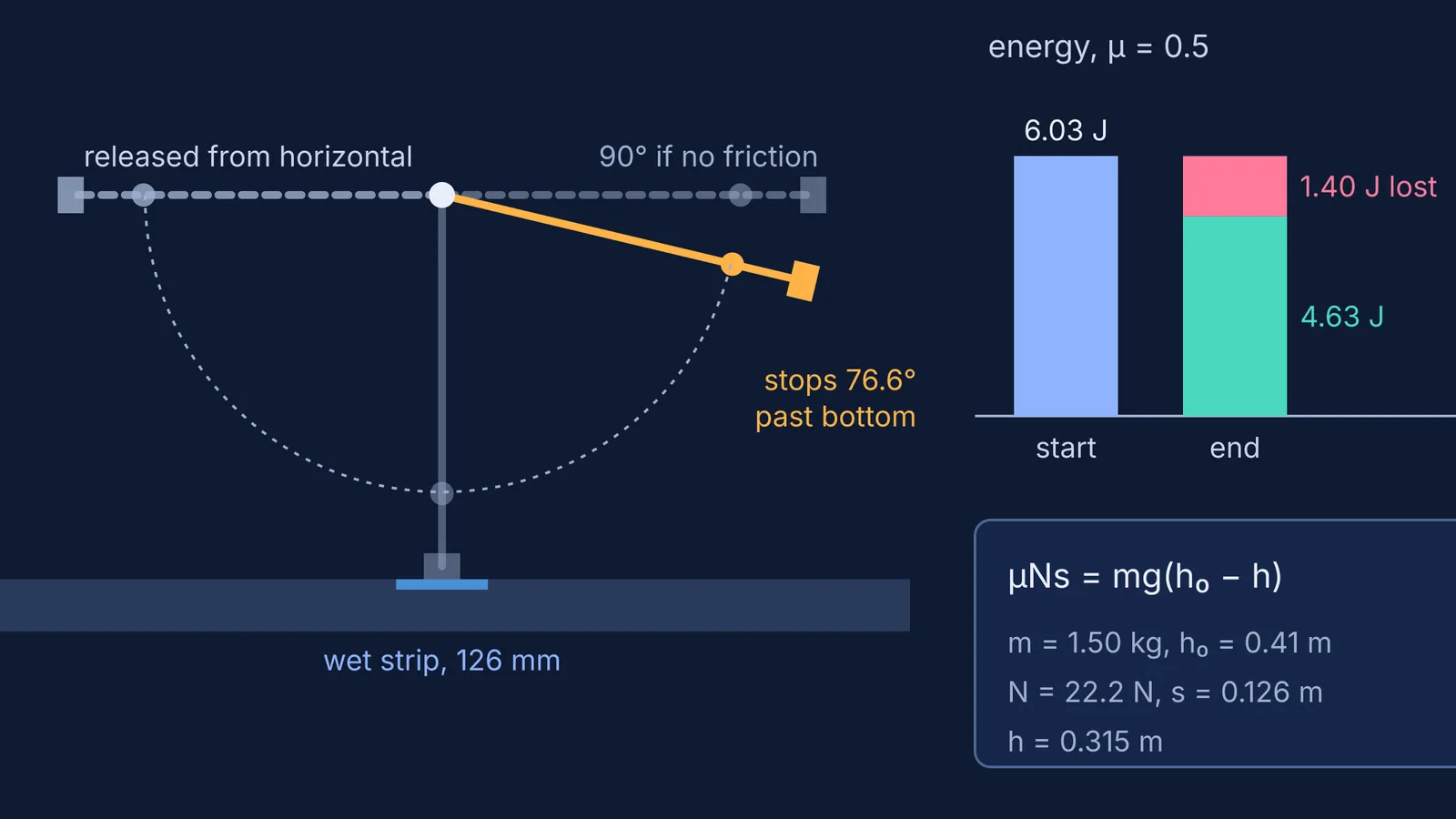
Worked example: what happens on a surface with μ = 0.5?
Use m = 1.50 kg, h₀ = 0.41 m, N = 22.2 N, s = 0.126 m and g = 9.81 m/s².
Starting energy. mgh₀ = 1.50 × 9.81 × 0.41 = 6.03 J.
Energy lost to friction. μNs = 0.5 × 22.2 × 0.126 = 1.40 J.
Fraction lost. 1.40/6.03 = 0.232, so about 23% of the swing's energy goes into the road and rubber as heat.
Energy left. 6.03 − 1.40 = 4.63 J.
Final height. h = 4.63 / (1.50 × 9.81) = 0.315 m. The centre of gravity rises 31.5 cm instead of 41 cm.
Final angle. The height above the lowest point is h₀(1 − cos θ), where θ is the angle past the bottom. So 1 − cos θ = 0.315/0.41 = 0.768, cos θ = 0.232 and θ ≈ 76.6°. Without friction it would have reached 90°, horizontal again.
Units check: μNs is newtons times metres, joules. mg(h₀ − h) is kg × m/s² × m, also joules.
Now compare surfaces:
μ = 0.3. Loses 0.84 J (14%), and the arm stops at about 82° past the bottom.
μ = 0.5. Loses 1.40 J (23%), and the arm stops at about 77°.
μ = 0.7. Loses 1.96 J (32%), and the arm stops at about 71°.
The lost energy grows in direct proportion to μ, so the stopping point moves steadily back as the surface gets grippier.
Is the scale reading the same as 100 times μ?
No. Treat μNs = mg(h₀ − h) as the physics of the instrument, not as the definition of its scale. The C scale is calibrated by the standard for a 126 mm sliding length. The real slider tilts on its pivot, its rubber deforms, and the spring force changes a little as the slider moves up and down. The pointer and bearings also take some energy, which is why the zero is set with a free swing. The reading is a standardised number that lets you compare one surface with another under the same conditions. That is also why ASTM warns that its values need not match other friction tests.
A different way to estimate μ for a road is to skid a car and measure how far it slides, worked through in how to find the coefficient of friction from stopping distance. The pendulum tests a palm-sized patch of the surface texture instead. Why the wet test matters for tyres, and how grooves clear the water away, is covered in why tyres have treads. The same "measure the lost swing" idea is used to test the toughness of steel, in the history of the Charpy impact test.
If you want to see how energy splits between height and friction as a pendulum swings, try the Simulation Lab, which has interactive simulations for ideas easier to see than read.
Quick checklist
The arm falls from horizontal with energy mgh₀ = 6.03 J.
Friction across the 126 mm contact takes μNs out of the swing.
μNs = mg(h₀ − h): the lower the far swing, the grippier the surface.
N is the spring force on the slider (22.2 N), not the arm's weight.
μ = 0.5 loses 1.40 J (23%) and the arm stops about 77° past the bottom.
The scale is a calibrated reading, not exactly 100μ, and tests are done wet with a temperature correction.


